Loading cart…
No products in the cart.

1847 · Oil on canvas · Musée Fabre, Montpellier, France
Save articles to your collection
Log in or create a free account, and this article will be waiting in your Private Collection.
Log in or sign up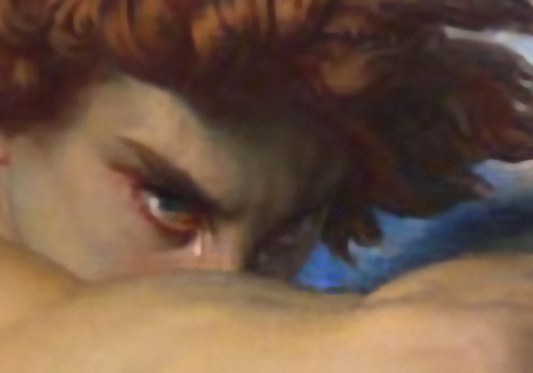
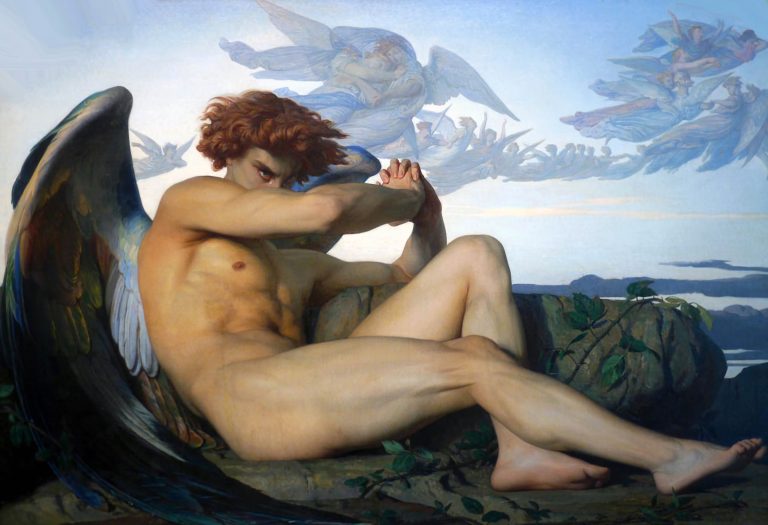
Start with the eye. It is the only part of his face he lets you see. Everything else is hidden behind a muscled forearm, and above it the eye is narrowed, red at the rim, and fixed straight on you. It is a look of pure fury. And on the lower lid, catching the light, is a tear.
That is the whole painting in one detail, and it is why The Fallen Angel by Alexandre Cabanel has become one of the most shared paintings on the internet. Anger and grief at the same time, in a face that is young and beautiful. He is not a monster with horns. He is a boy who has just lost everything and refuses to say sorry.
He is Lucifer, the angel who rebelled against God and was thrown out of heaven. His name means light-bringer, the old Latin name for the morning star, and the prophet Isaiah mourned his fall in a line that gave him that name in English:
How art thou fallen from heaven, O Lucifer, son of the morning!
Isaiah 14:12, King James Version
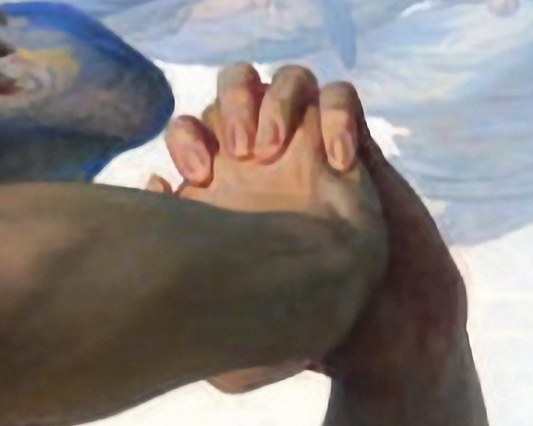
Cabanel shows him in the first moments after the fall. He has landed on a bare rock at the edge of the world, naked, his wings still on his back. He is sitting up, knees drawn in, arms folded tight across his face, hands locked together. The pose of someone who has been hit and is not going to let you see him cry. Except you can.
The Bible says almost nothing about what Lucifer felt. The idea of a proud, tragic, grieving Satan comes from John Milton's epic poem Paradise Lost, published in 1667, which every educated reader in nineteenth-century France knew. In Book 1, Satan rises from the burning lake, gathers his defeated army, and tries to speak to them. He cannot. Three times he starts, and three times he weeps:
Thrice he assayed, and thrice in spite of scorn,
John Milton, Paradise Lost, Book 1
Tears such as Angels weep, burst forth.
In spite of scorn. He is crying and he despises himself for crying. That is exactly the face Cabanel painted. And Milton gave Satan the line that explains the glare:
Better to reign in Hell, than serve in Heav'n.
John Milton, Paradise Lost, Book 1
By the 1840s the Romantics had turned Milton's Satan into a hero: the rebel who would rather fall than bow. The poet William Blake had already written that Milton was of the Devil's party without knowing it. Cabanel's Lucifer belongs to that tradition. He is beaten, but he has not given in.
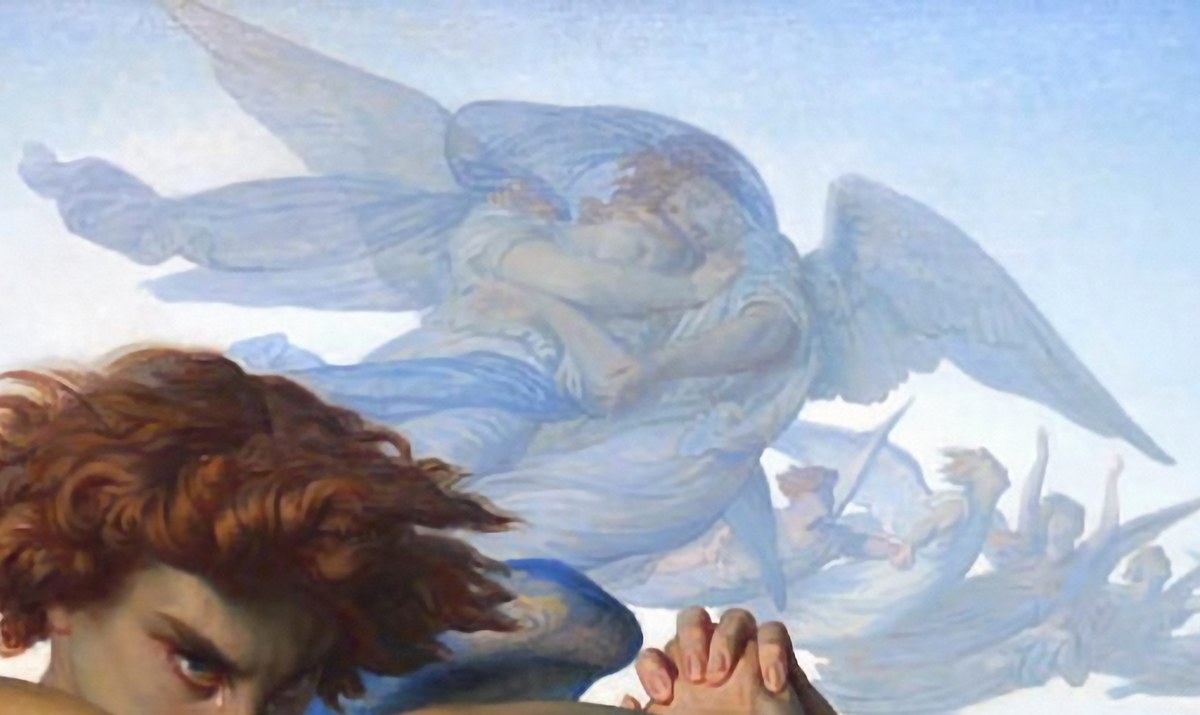
Now look up. The sky behind him is full of angels, painted so pale and blue they almost dissolve into the clouds. They fly in a long procession, embracing, raising their arms, trailing robes. Not one of them looks down at him.
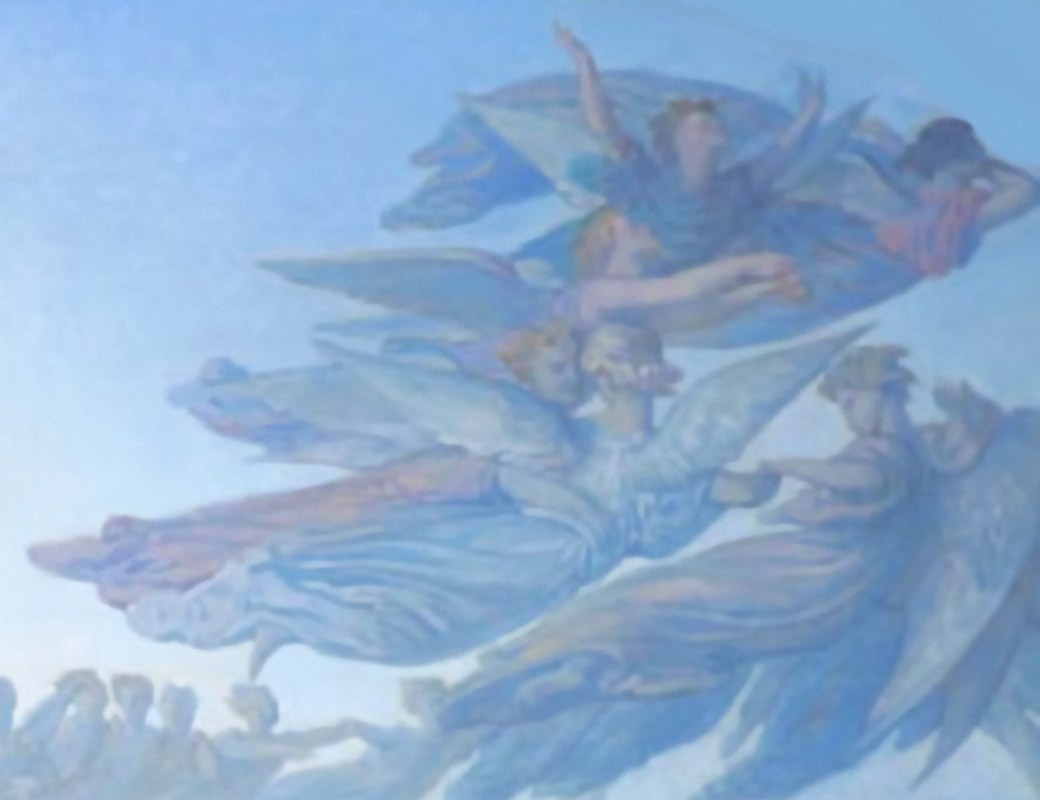
Cabanel explained the idea himself, in a letter to his friend and patron in Montpellier, the collector Alfred Bruyas. He was staging two natures, he wrote: one doomed to evil and to falling, the other pure and rising towards God. Satan was his main subject, a broken power bowing his head before his creator, while above him the good angels sway joyfully through the air. The whole painting is built on that contrast: the warm, heavy, earthbound body in front, and the weightless, cool, happy crowd behind, already moving on without him.
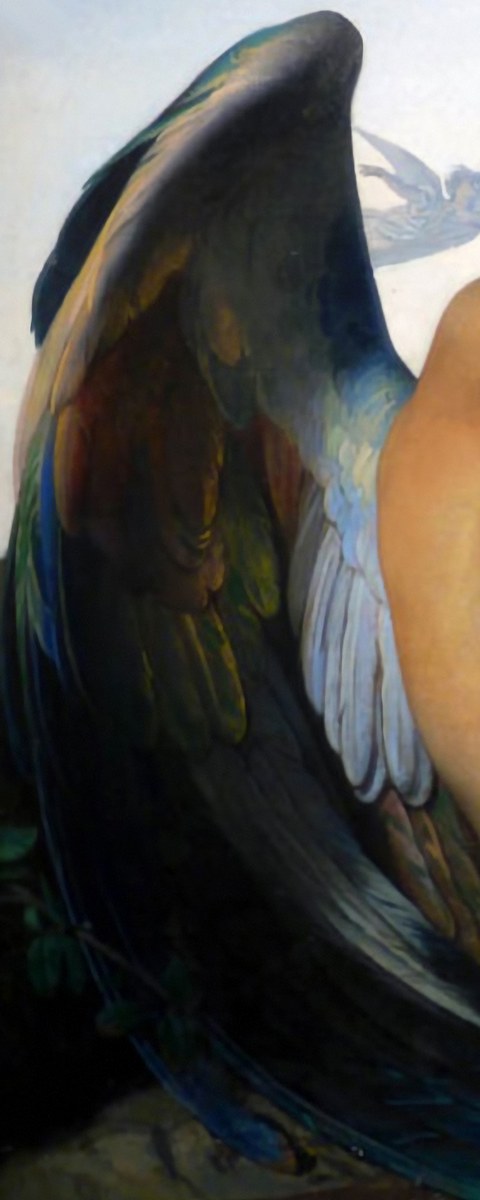
Look at his wing. Near his shoulder the small feathers are still white, the colour of the angels in the sky. Further out they turn blue, green and gold, like a peacock, the bird of pride. At the tips the long flight feathers have gone dark navy, almost black. The light is draining out of him from the edges in. Cabanel shows the fall still happening, inside the body, as you watch.
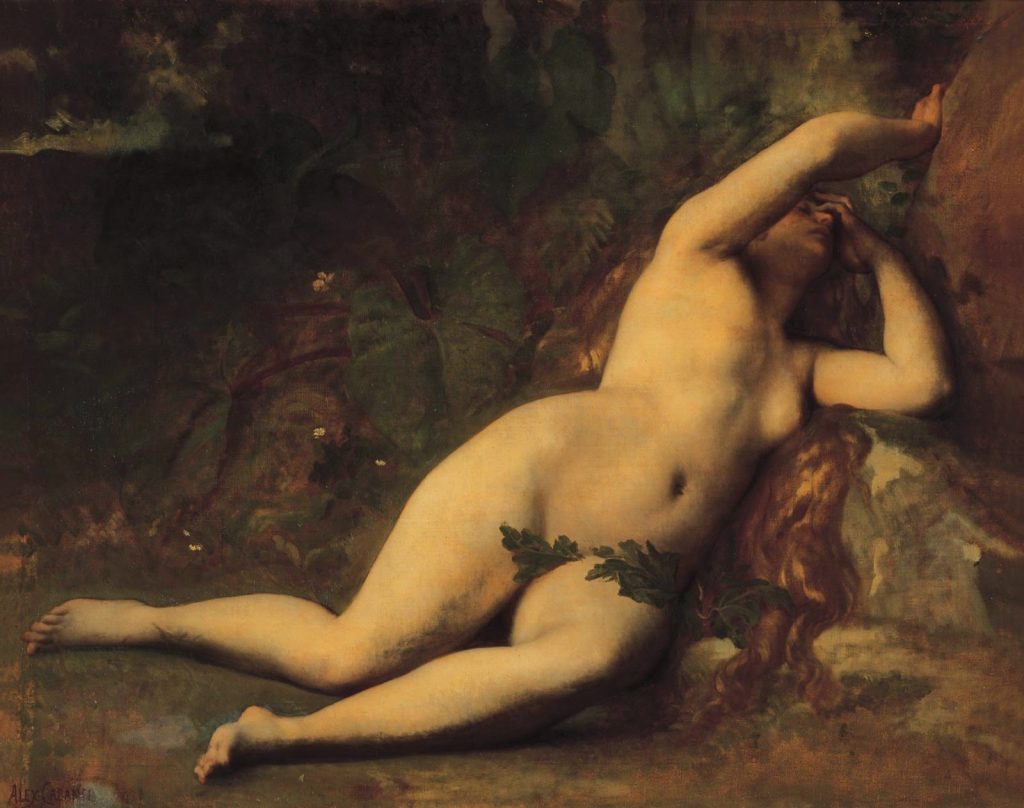
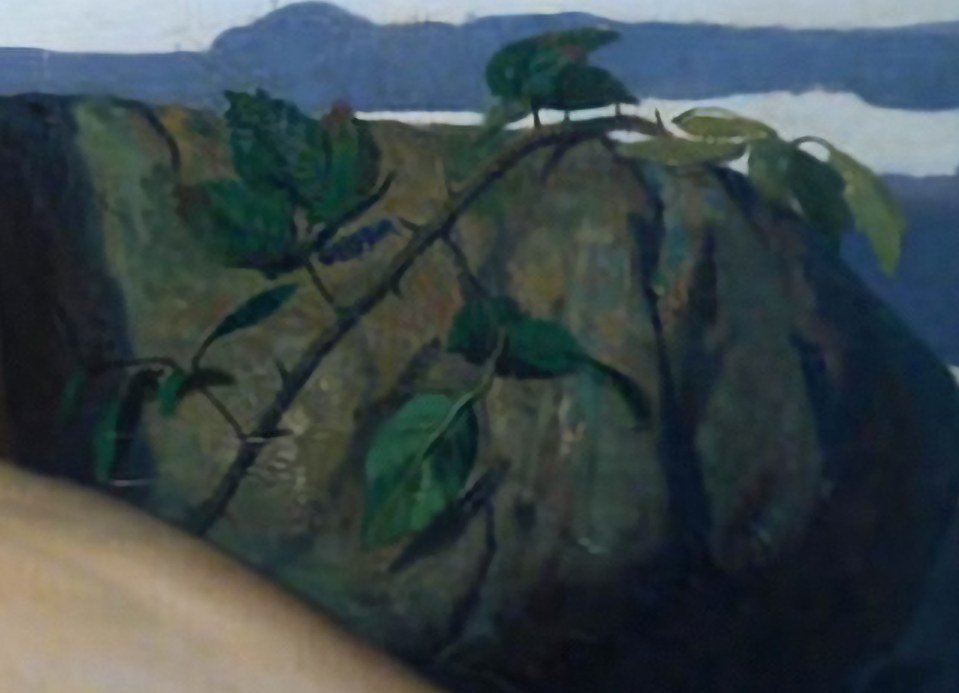
The ground is changing him too. Next to his legs, a thorny bramble creeps over the rock. In the book of Genesis, when Adam and Eve are expelled from paradise, God tells them that the earth will now bring forth thorns and thistles. Lucifer has fallen into a world with thorns in it.
Cabanel was only 24 when he painted The Fallen Angel. Born in Montpellier in 1823, he had won a place at the French Academy in Rome in 1845, a prize that came with years of study at the Villa Medici. In return, every student had to send paintings back to Paris, called envois, so that the members of the Académie des Beaux-Arts could judge their progress. The Fallen Angel was his second.
The academicians did not like it. They wanted calm, correct, classical figures, and here was a nude Satan glaring out of the canvas, twisted in an awkward pose, soaked in feeling. According to the Musée Fabre, they were somewhat startled by the young painter's independent spirit. Their report found the movement wrong, the drawing imprecise and the execution weak, and the whole thing too Romantic. Cabanel wrote to Bruyas that in their eyes he had become a kind of renegade of their school.
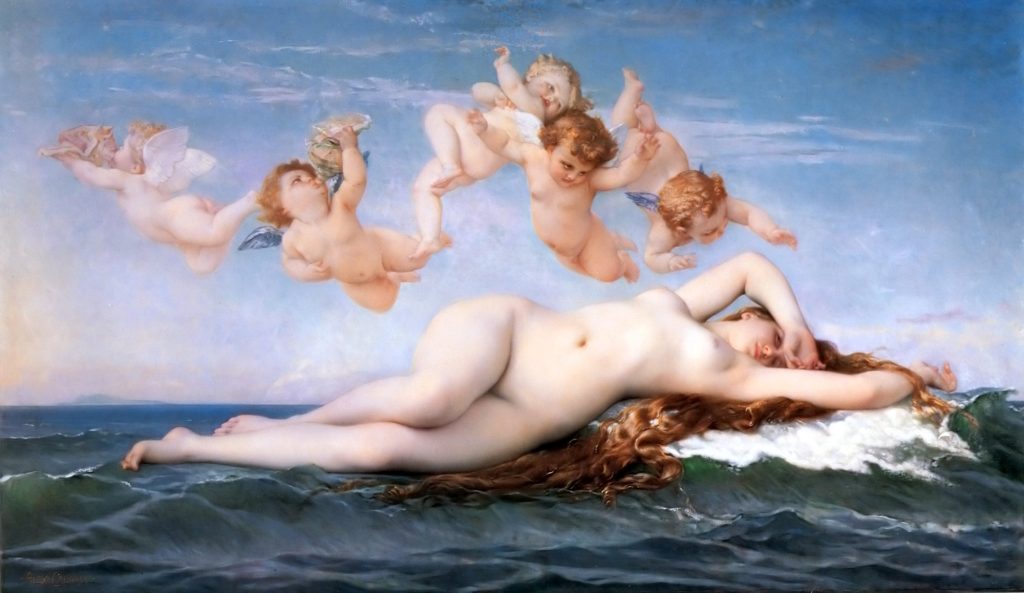
Here is the twist. The renegade did not stay a renegade. Within sixteen years Cabanel was the most official painter in France. In 1863 his Birth of Venus, a pearly nude floating on the waves, was the triumph of the Salon and was bought by the Emperor Napoleon III himself. The same year he was elected to the Académie des Beaux-Arts, the body that had scolded his Lucifer, and became a professor at the École des Beaux-Arts, where he taught hundreds of students.
He sat on the Salon juries that turned away Manet and the young Impressionists, the new rebels of their day. The painter who had once been told he was too Romantic became the face of the establishment they were fighting against. In a way, Cabanel's career is the story of his own painting in reverse: the fallen angel climbed all the way back to heaven.
The Fallen Angel (L'Ange déchu) hangs in the Musée Fabre in Montpellier, Cabanel's home town. It is oil on canvas, 121 by 189.7 centimetres, painted in Rome in 1847. Cabanel kept it all his life. After his death in January 1889 it went up for auction in Paris that May, was probably bought back by the family, and was given to the museum the same year by his brother Barthélémy.
We paint The Fallen Angel by hand in oil on canvas, with the red-rimmed eye, the peacock wings and the pale procession of angels in the sky. See the hand-painted reproduction.
Enjoyed this story?
Save articles to your collection
Log in or create a free account, and this article will be waiting in your Private Collection.
Log in or sign up