Loading cart…
No products in the cart.

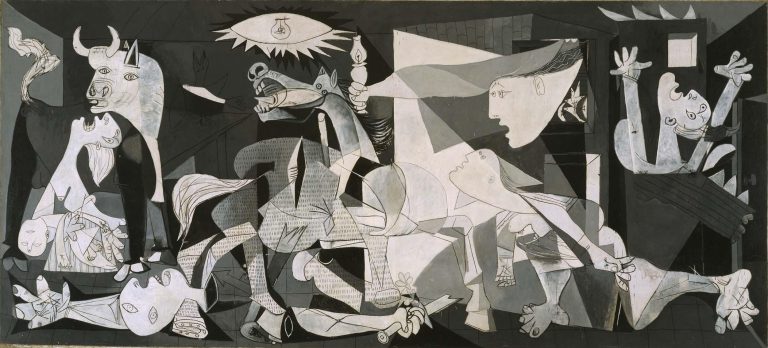
1937 · Oil on canvas · Museo Reina Sofía, Madrid, Spain
Save articles to your collection
Log in or create a free account, and this article will be waiting in your Private Collection.
Log in or sign up Explore the artistPablo Picasso paintings →
Because of one afternoon. On Monday 26 April 1937, planes bombed the small Basque town of Guernica in northern Spain. It was market day, and the streets were full of farmers, families and refugees from the war.
Picasso was in Paris. He read the news, saw the photographs of the ruins, and within days he began the largest and angriest painting of his life. Five weeks later it was finished: a canvas almost eight metres wide, painted only in black, white and grey.
Guernica shows no planes and no burning town. It shows what a bomb does to people and animals. That is why, nearly ninety years later, it is still the most famous anti-war painting in the world.
Spain was ten months into its civil war. General Franco had risen against the elected Republic, and Hitler and Mussolini were helping him. Guernica was the old heart of the Basque people, home to the oak tree where Basque assemblies had met for centuries.
Late in the afternoon, the German Condor Legion, with Italian planes beside it, attacked the town. For around three hours, bombers dropped explosives and firebombs, and fighter planes flew low over the roads. By night the centre of Guernica was burning.
Nobody agrees on how many people died. The Basque government spoke of 1,654 dead. Historians today count far fewer, from about 120 to a few hundred. But the shock was not only the number. It was one of the first times a town full of civilians had been destroyed from the air, on purpose, while the world could read about it the next morning.
Two days later, the British journalist George Steer described the ruins in The Times. His report was printed again in Paris. Franco’s side denied everything and claimed the Basques had burned their own town.
Pablo Picasso’s work is still under copyright, so we don’t sell copies.
Months before the bombing, the Spanish Republic had asked Picasso, its most famous artist, to paint a large mural for its pavilion at the 1937 World’s Fair in Paris. He had said yes, and then done almost nothing. He had no subject.
Guernica gave him one. On 1 May, five days after the attack, he made his first sketches. Within two weeks he was working on the huge canvas in his new studio on the rue des Grands-Augustins. It was so big that it had to be set at an angle, and he painted the top with brushes tied to long sticks.
His partner, the photographer Dora Maar, photographed the canvas as it changed. Her pictures show Picasso moving figures, removing a raised fist, and repainting the horse’s head again and again. By early June the painting was done.
That summer Picasso wrote that in the panel he called Guernica, he was expressing his horror of the military caste which has sunk Spain in an ocean of pain and death.
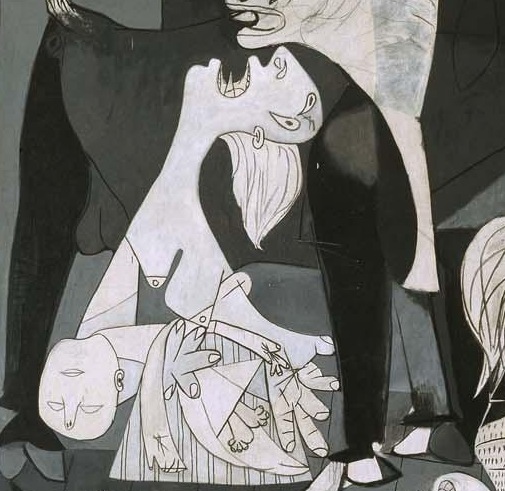
Start at the left. A mother throws her head back and screams at the sky. In her arms, her child hangs limp, its eyes empty. It is already dead.
This is the oldest image of grief in Western art: a mother holding her dead son, like Mary in a Pietà. Picasso takes it out of the church and puts it in a bombed street. Her tongue is a sharp blade, as if the scream itself could cut.
Of all the figures, she is the one people remember first. You do not need to know any history to understand her.
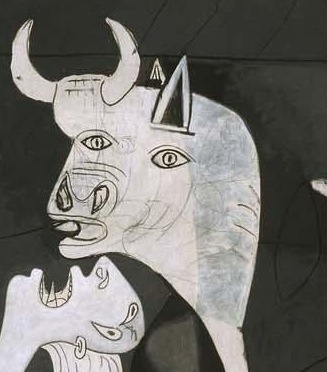
Above the mother stands a bull. It is the calmest creature in the picture. It looks out at us, almost bored, while everything around it falls apart.
For Picasso, a Spaniard who loved the bullfight, the bull meant Spain itself, but also brute force. People have asked for ninety years whether it stands for Franco, for fascism, or for the Spanish people who endure.
Picasso enjoyed refusing to answer. In 1945 he told an American soldier that the bull was brutality and darkness
and the horse was the people. Another time he said a bull was a bull and a horse was a horse. Between them sits a small bird, half hidden on a table, with its beak open in a cry of its own.
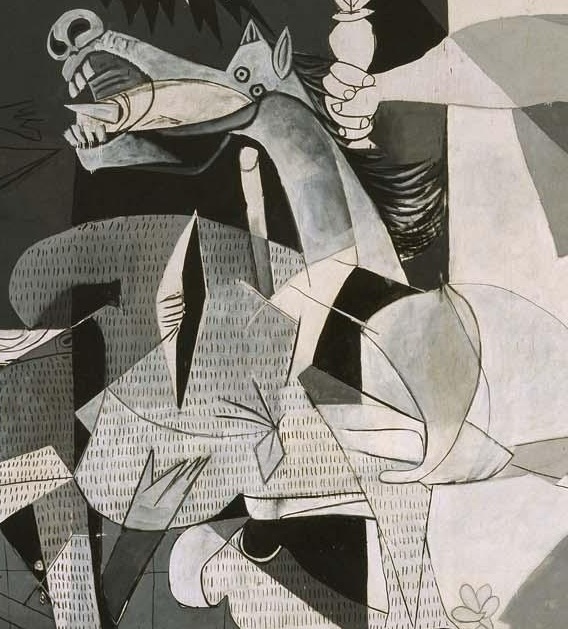
In the middle, a horse rears up in agony. A spear has gone through its body, and a wound gapes in its side. Its mouth is wide open and its tongue, like the mother’s, is a blade.
Look closely at its body. It is covered in rows of short marks, like the columns of a newspaper. The news Picasso read in Paris is printed on the dying animal.
In the bullring, the horse is the victim: blindfolded, gored, helpless. Here it becomes the innocent at the centre of the war, the people Picasso said it stood for.
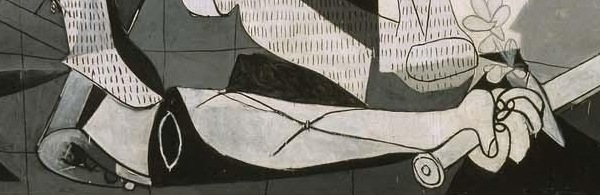
Along the bottom lies a soldier, broken into pieces like a smashed statue. His arms are flung wide. One hand is open, its palm crossed with lines. The other still grips a broken sword.
The sword is snapped. Old-fashioned courage is useless against planes.
And yet, out of his fist, a small flower grows. It is the only living, gentle thing in the whole painting. Picasso does not promise that it will survive. He simply puts it there, so small you could miss it.
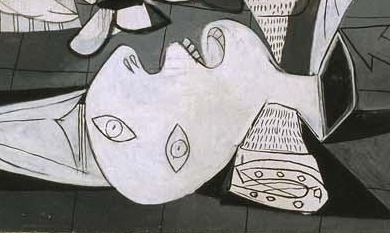
The soldier’s head lies on its side, cut off from the body. The eyes stare and the mouth is open. It is the face of a man who died a moment ago, lying at the feet of everyone still screaming.
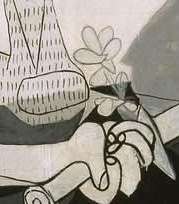
Here is the flower up close: a thin stem and a few petals beside the broken blade. In a painting about destruction, it is the one thing that is still growing.
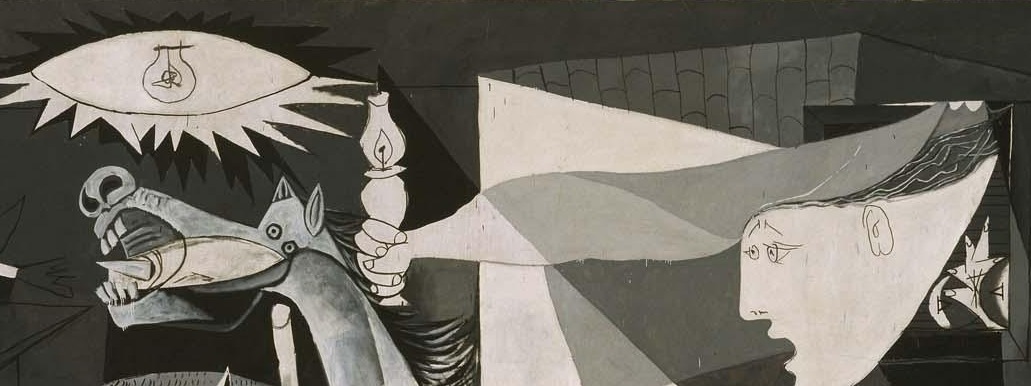
At the top, a bare electric bulb glares inside a jagged shape like an eye. Many people see a play on words here: in Spanish, a light bulb is a bombilla, and a bomb is a bomba.
Next to it, a woman leans through a window and pushes an old oil lamp into the room. Her arm is long and desperate. She wants to see what has happened.
So there are two lights. One is cold and modern, the light of the machine age that made the bombers possible. The other is small, human and old. Neither one can save anyone. Both only show us the horror.
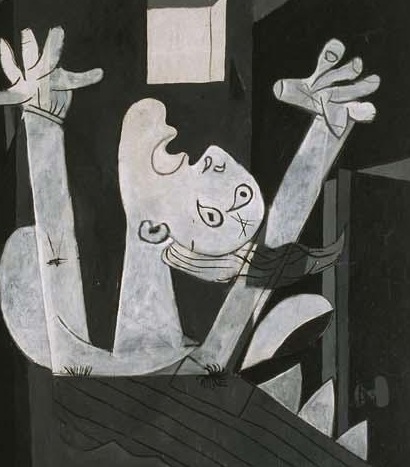
On the far right, a burning house. A figure is trapped inside, arms thrown up to the sky, flames climbing the walls around them. There is no door and no way out.
This is the firebomb. Guernica was not only blown apart, it was set on fire, and many of its wooden buildings burned to the ground.
The scene ends at this wall of fire. The painting has no exit, so your eye is pushed back into the crowd of bodies.
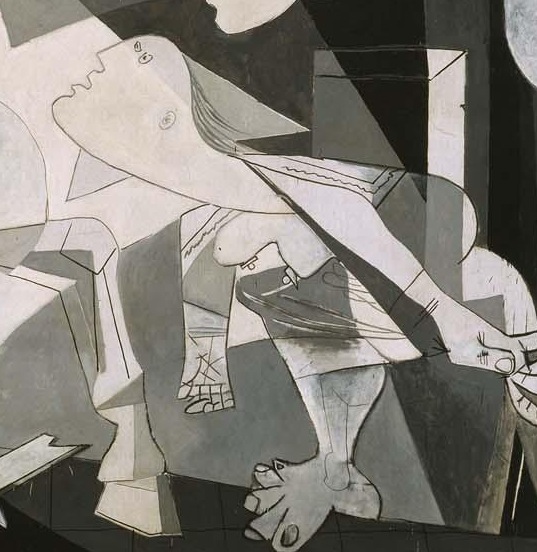
Below the lamp, a woman stumbles towards the centre. Her knee drags on the ground and her head is turned up towards the light. She is running into the disaster, not away from it, as if looking for someone.
Picasso had painted in glowing blues, roses and bright colours. For Guernica he used none. The whole canvas is black, white and grey.
That is how the world saw the bombing: in newspaper photographs and newsreels. By painting in the colours of the news, Picasso made his picture feel like a report, something that really happened.
The missing colour also removes any beauty. There is no red blood and no orange fire to admire. Only hard light and dark shadow, like a flash in the night.
In 1940 the German army took Paris. Picasso stayed. Officers sometimes came to his studio, and a famous story tells what happened when one of them saw a photograph of Guernica.
“Did you do that?” the officer asked. “No,” Picasso answered. “You did.”
Nobody can prove the story is true. But people have repeated it for eighty years, because it says exactly what the painting means. In 1945 Picasso put it another way: painting, he said, was not made to decorate apartments. It was an instrument of war
against the enemy.
Guernica opened at the Spanish pavilion in Paris in July 1937. Many visitors did not like it. Then it went on tour, to Scandinavia, then to Britain, where it was shown in London and in a Manchester car showroom to raise money for Spain.
In 1939 it crossed to New York to raise money for Spanish refugees. That same year Franco won the war. Picasso decided the painting would stay at the Museum of Modern Art in New York and would only go to Spain when the country was free again.
It waited for 42 years. Picasso died in 1973 and Franco in 1975. Spain held free elections, and in 1981, the year Picasso would have turned 100, Guernica finally flew to Madrid. It was shown behind bulletproof glass, guarded by police. In 1992 it moved to the Museo Reina Sofía, where it hangs today.
Its story never stopped. In 1974 a man spray-painted the words KILL LIES ALL across it in New York; the paint was removed. In 2003, a tapestry copy at the United Nations was covered with a blue curtain while the case for war in Iraq was presented in front of it.
New painting stories, straight to your inbox.
Guernica hangs in Room 206 of the Museo Reina Sofía in Madrid. It is huge: about 3.5 metres high and 7.8 metres wide, roughly 11 by 25 feet. On a phone it looks like a picture. In the museum it is a wall.
It no longer travels. The canvas is fragile after all its journeys, and the museum refuses every request to lend it, even from the Basque Country. To see it, you have to go to Madrid. Stand close and you can still see the drips, the pencil lines and the changes Picasso made in those five weeks of 1937.
On 26 April 1937, during the Spanish Civil War, German and Italian planes supporting Franco bombed the Basque town of Guernica on market day. The centre of the town was destroyed by bombs and fire.
About five weeks. He made his first sketch on 1 May 1937 and finished the canvas in early June.
Picasso never gave one answer. In 1945 he said the bull meant brutality and darkness and the horse meant the people, but he also refused to explain his symbols.
Picasso used only black, white and grey, the colours of the newspaper photographs through which the world learned about the bombing.
Picasso refused to let it go to Spain while Franco ruled. It stayed at the Museum of Modern Art until 1981, when Spain was a democracy again.
In Room 206 of the Museo Reina Sofía in Madrid. It is no longer lent to other museums.
The detail images are genuine crops of the historical painting. No painted forms have been added or upscaled.
Enjoyed this story?
Save articles to your collection
Log in or create a free account, and this article will be waiting in your Private Collection.
Log in or sign up
Man Writing a Letter
Gabriel Metsu, c. 1664
The gallery list
Every painting is already 50% off. Join the list and we will send you an extra $15 code, plus first access to new collections.
No spam. Unsubscribe anytime. · Privacy Policy
Welcome
Your $15 code is on its way. Explore the gallery while you wait.