Loading cart…
No products in the cart.

Pablo Ruiz Picasso was born on October 25, 1881, in Malaga, a port city in the Andalusian region of southern Spain. He was the first child of Jose Ruiz Blasco, a painter and art teacher, and Maria Picasso Lopez, whose…
Save articles to your collection
Log in or create a free account, and this article will be waiting in your Private Collection.
Log in or sign upPablo Ruiz Picasso was born on October 25, 1881, in Malaga, a port city in the Andalusian region of southern Spain. He was the first child of Jose Ruiz Blasco, a painter and art teacher, and Maria Picasso Lopez, whose surname Pablo would later adopt as his professional surname. From the very first years of his life, the household was saturated with art. His father recognized the exceptional drawing ability of the young Pablo at an unusually early age and began formal instruction almost immediately. By the time Pablo was thirteen years old, his father had enrolled him in the School of Fine Arts in Barcelona, known as La Llotja, where Jose himself taught. The young student completed the entrance examination in a single day, a task that typically required a full month. From Barcelona, Pablo advanced to the Royal Academy of San Fernando in Madrid, though he found academic convention stifling and spent much of his time at the Prado studying the works of Velazquez, Goya, and El Greco. These formative years in Spain gave him a rigorous technical foundation while simultaneously fueling a restless desire to move beyond it.
Picasso made his first visit to Paris in 1900 and relocated there permanently by 1904, settling in the bohemian enclave of Montmartre at a ramshackle building known as the Bateau-Lavoir. In Paris he encountered the avant-garde currents of Post-Impressionism, absorbed the formal innovations of Paul Cezanne, and formed friendships with poets and critics who would shape his intellectual outlook. His early career passed through what scholars have come to call the Blue Period, roughly 1901 to 1904, characterized by melancholic blue-toned canvases depicting social outcasts, followed by the warmer, more tender Rose Period of 1904 to 1906. The decisive rupture came in 1907 with the completion of Les Demoiselles d'Avignon, a painting that fractured the conventions of Western pictorial space and opened the door to Cubism. Working in close collaboration with Georges Braque between approximately 1908 and 1914, Picasso developed Analytic and then Synthetic Cubism, a visual language that would permanently alter the course of modern art. Throughout the following decades he moved with restless energy across Surrealism, Neoclassicism, and politically charged figuration, culminating in large-scale works that addressed the violence and suffering of the twentieth century. He continued to paint, sculpt, and create ceramics well into his eighties, producing a body of work of remarkable breadth before his death on April 8, 1973, in Mougins, France.
The technical range of Pablo Picasso is without parallel in twentieth-century art. During the Cubist years, he systematically dismantled the single viewpoint that had governed Western painting since the Renaissance, replacing it with a fragmented, multi-perspectival approach in which objects and figures are analyzed into geometric planes and reassembled on the picture surface in ways that acknowledge the flatness of the canvas while simultaneously evoking three-dimensional form. In Analytic Cubism, he and Braque reduced the palette to near-monochromatic tans, grays, and ochres so that attention would fall entirely on the spatial problem being solved rather than on color sensation. In Synthetic Cubism, the palette expanded and papier colle, the practice of affixing cut paper and other materials to the canvas, introduced a new tactile dimension into painting. Even within a single period, Picasso moved between densely worked surfaces and areas of deliberate simplicity, creating rhythmic tension that keeps the eye in constant motion across the composition.
Beyond Cubism, the stylistic vocabulary of Picasso encompassed a remarkable variety of approaches that he wielded with equal confidence. During the Neoclassical period of the early 1920s, he produced monumental figures drawn in clean, weighty contours that recall ancient Roman sculpture, executed with a control of line that demonstrated how thoroughly he had mastered academic draughtsmanship even while he was subverting it elsewhere. In the Surrealist-inflected works of the late 1920s and 1930s, human forms became biomorphic and distorted, eyes migrated to unexpected positions, and scale relationships defied anatomical logic to convey psychological states rather than physical appearances. His handling of paint was equally varied, ranging from thin, transparent washes to thick, heavily loaded passages of impasto. Color was deployed not for descriptive accuracy but as an emotional instrument, with acid greens, raw ochres, and cold blues chosen for their expressive charge. Taken together, these qualities define a body of work that rewarded both careful intellectual analysis and immediate visceral response.
Each card links to its own article with full analysis and reproduction details.
 #0
Enjoyed this story?
Save articles to your collection
Log in or create a free account, and this article will be waiting in your Private Collection.
Log in or sign up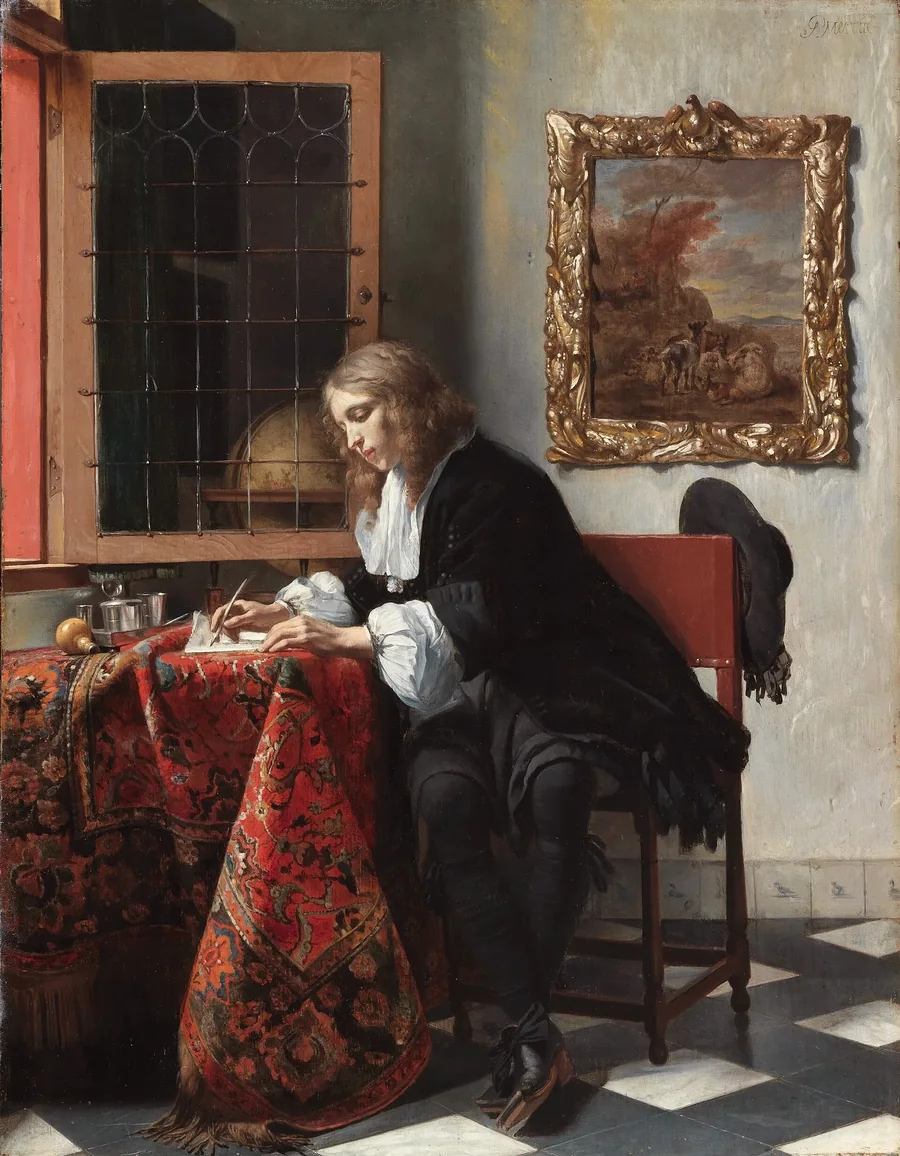
Man Writing a Letter
Gabriel Metsu, c. 1664
The gallery list
Every painting is already 50% off. Join the list and we will send you an extra $15 code, plus first access to new collections.
No spam. Unsubscribe anytime. · Privacy Policy
Welcome
Your $15 code is on its way. Explore the gallery while you wait.