Loading cart…
No products in the cart.

1859 · Oil on canvas · Private collection
Save articles to your collection
Log in or create a free account, and this article will be waiting in your Private Collection.
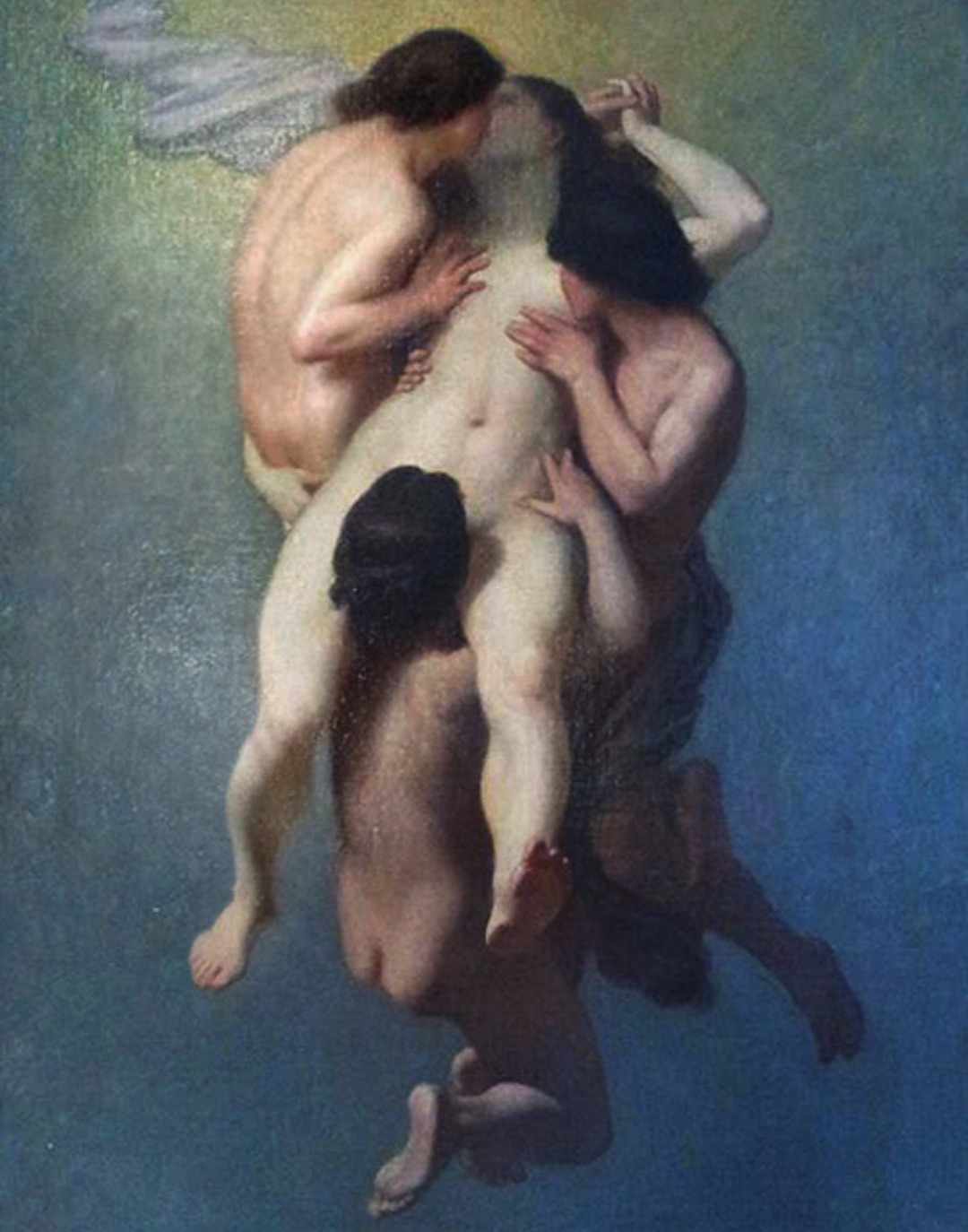
Log in or sign upBefore you look at the bodies, look at the top of the canvas. There is a patch of warm gold light up there, and a white veil drifting through it, the way a scarf floats after the person wearing it has gone. Everything else in the painting is moving away from that light.
Below the light, four women hang in empty blue air. There is no floor, no bed, no room and no sky. They are wrapped around each other, and they are clearly not unhappy. And the painter, Octave Tassaert, gave this picture one of the harshest titles a French painting could carry in 1859: La Femme damnée. The Cursed Woman. The Damned Woman.
Why would anyone paint pleasure this tenderly and then send it to hell in the title? The answer starts with a trial, runs through a poem, and ends in a small room in Paris fifteen years later.
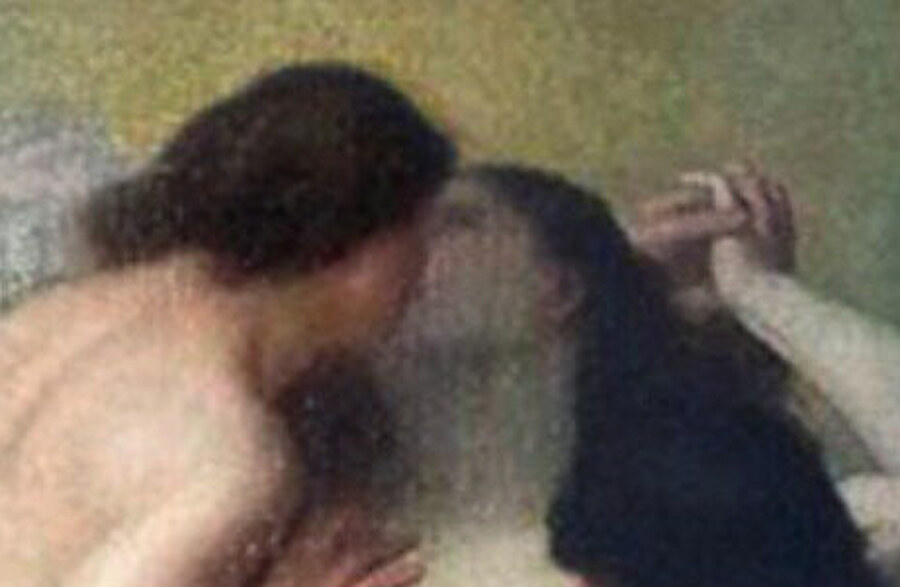
The woman at the centre is the palest thing in the picture. Her head is tipped back into a kiss, so we barely see her face; Tassaert gives us her throat, her body and her surrender instead. On the left, a woman seen from behind holds her. On the right, a dark-haired woman lifts her arms over her own head, her hands locked together, as if she were stretching after sleep or letting herself fall.
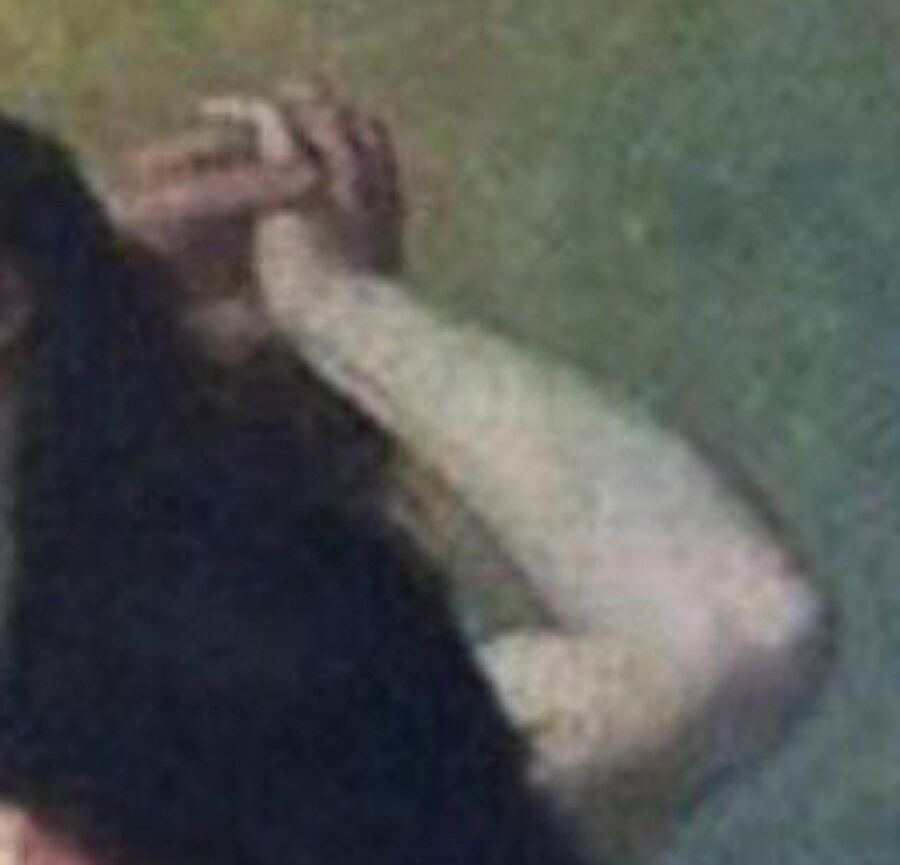
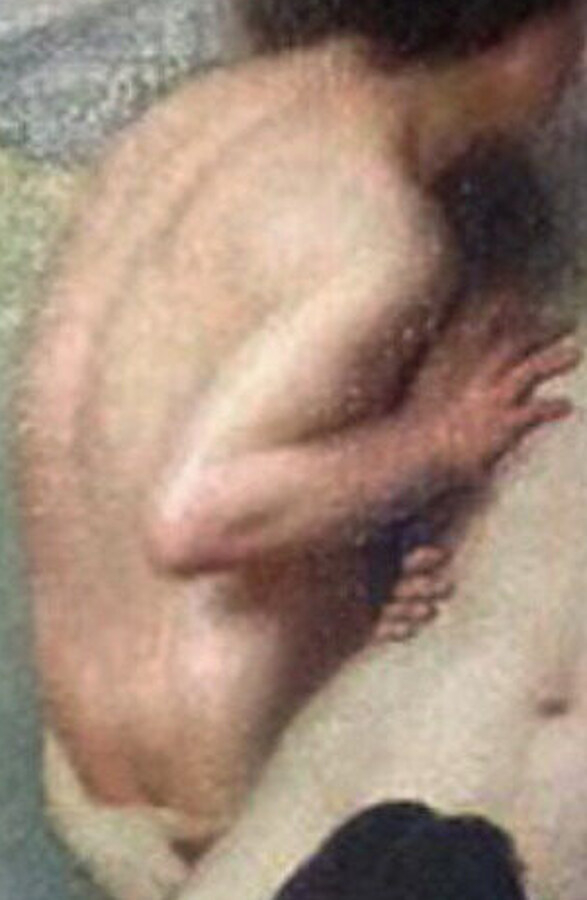
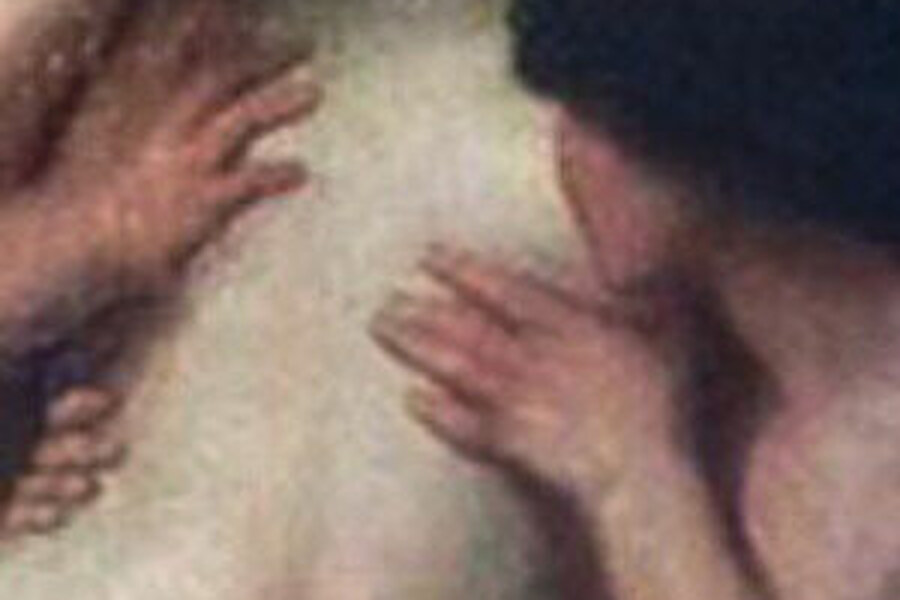
Look at the hands, because Tassaert did. They rest, they cup, they hold on. Nobody is grabbing and nobody is resisting. A fourth woman, below, has her back to us and her face hidden between the others. It is an openly erotic painting, and it never pretends otherwise.
Two years before this painting, in the summer of 1857, Charles Baudelaire published Les Fleurs du mal. Within weeks the book was in court. On 20 August 1857 the poet was fined 300 francs and six poems were ordered cut from the book. One of them was called Femmes damnées, Damned Women. It told the story of two lovers, Delphine and Hippolyte, and it ended with the poet sending them away:
Descend, descend, you pitiable victims,
Charles Baudelaire, Femmes damnées (Delphine et Hippolyte), 1857, our translation
Descend the road to everlasting hell.
A second poem with the same title escaped the censors and stayed in the book. It watches a group of women on a beach and ends in a very different voice:
Poor sisters, I love you as much as I pity you.
Charles Baudelaire, Femmes damnées, 1857, our translation
No letter survives in which Tassaert says he was thinking of Baudelaire. But the phrase femmes damnées was the most notorious title in Paris, and Tassaert used it, in the singular, two years after the trial. And his painting does what Baudelaire does: it calls the women damned and then looks at them with nothing but tenderness. The condemnation is in the title. The love is in the paint.
Tassaert knew exactly how to paint damnation, because he had done it before. At the Salon of 1850 he showed a large canvas called Ciel et Enfer, Heaven and Hell, now in the Musée Fabre in Montpellier. It is a long garland of naked women climbing and falling, with angels waiting at the top. At the bottom, the critic Théophile Silvestre wrote, a hideous monster coils around the damned women and waits, jaws open, for those about to drop back into its grip.
Nine years later, Tassaert painted the same kind of tangled bodies again, and took almost everything away. No angels. No flames. No monster. Only four women, a gold light above them and the blue dark below. Nothing in the picture punishes them. If they are damned, it is only because the title says so.
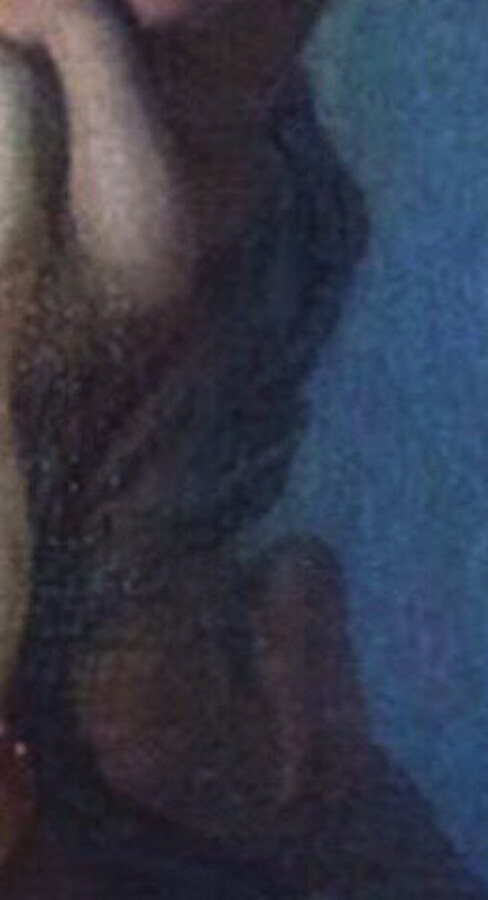
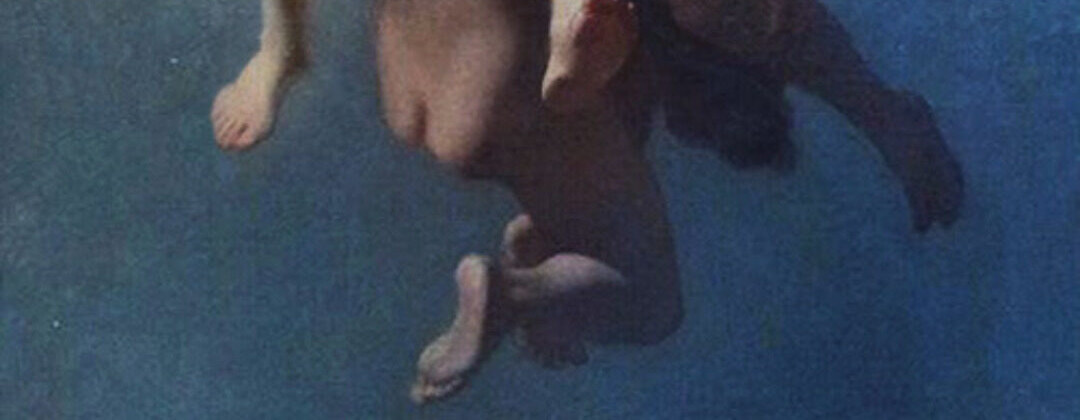
Now step back and follow the direction of the picture. The light is at the top and the women are below it. The feet point down. The lowest figure is already fading into the dark, her soles turned up to us like a diver going under. The whole group is drifting slowly downward, out of the gold and into the blue.

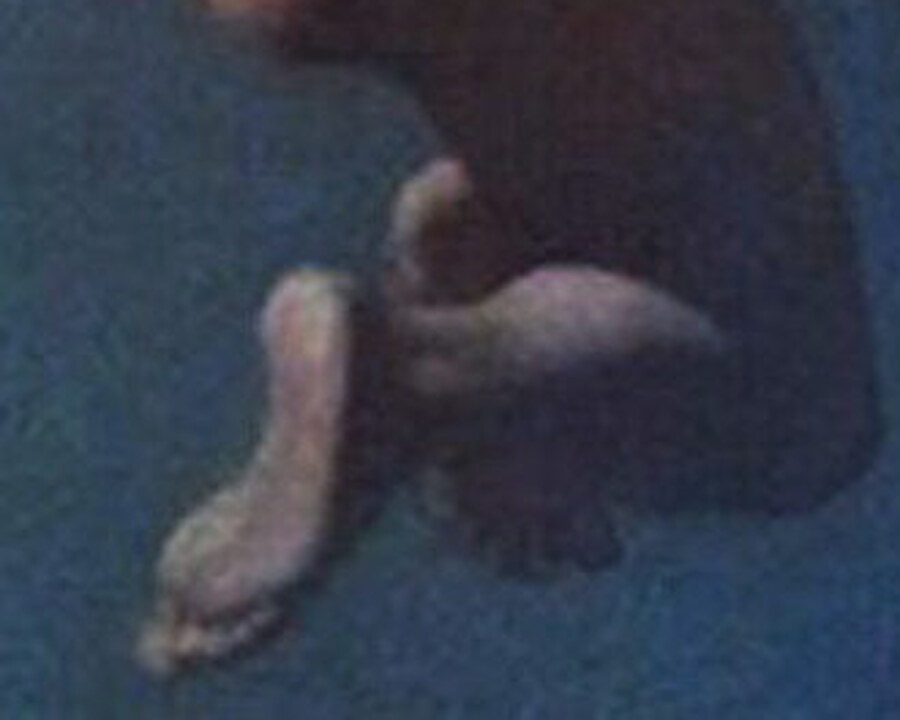
That is Baudelaire's line turned into a composition: descend, descend. But look at how slowly they go, and how little they seem to mind. Tassaert paints the fall as something closer to floating. The damnation is real, and it is also a kind of weightlessness.
Baudelaire had noticed Tassaert long before any of this. In his review of the Salon of 1846 he apologised for having overlooked him the year before, and gave him some advice:
M. Tassaert is a painter of the very greatest merit, whose talent would apply itself most happily to love subjects.
Charles Baudelaire, Salon of 1846, our translation
Tassaert did not always listen. His biggest public success was a tearjerker: Une famille malheureuse, An Unhappy Family, a mother and daughter in a freezing attic, commissioned by the French State and shown in 1850 and 1851. One critic said it was a success of pocket handkerchiefs. For years the public wanted poverty and tears from him, and he gave them plenty. But in private, for collectors like Alfred Bruyas in Montpellier and the writer Alexandre Dumas fils, he painted nymphs, bacchantes, lovers and temptations. The Cursed Woman belongs to that private side.
Three years after this painting, in May 1862, Tassaert gave up. He was losing his sight, he felt forgotten, and he sold the contents of his studio to the dealer Martin. When Martin brought a collector to him a few years later, he said only: Je ne m'occupe plus de ça. I do not deal with that any more. He lived for another decade in a small room on the chaussée du Maine, nearly blind, and took his own life on the night of 21 to 22 April 1874. He was seventy-four.
On the board of his bedside table he had written four lines in chalk, lines he had first written as a poem in 1865:
My eyes, covered in thick fog,
Octave Tassaert, written in chalk by his bed, our translation
leave me groping on the earth.
Farewell, so many things so dear.
Farewell, poetry and fine arts!
His furniture sold for 38 francs. Alexandre Dumas fils, his loyal collector, paid for his grave, and later summed up his whole work in one sentence:
Poverty, death and love: those are his muses.
Alexandre Dumas fils, preface to Bernard Prost's catalogue of Tassaert's work, 1886, our translation
The Cursed Woman is the love. It is also, if you read the title, a little bit of the other two.
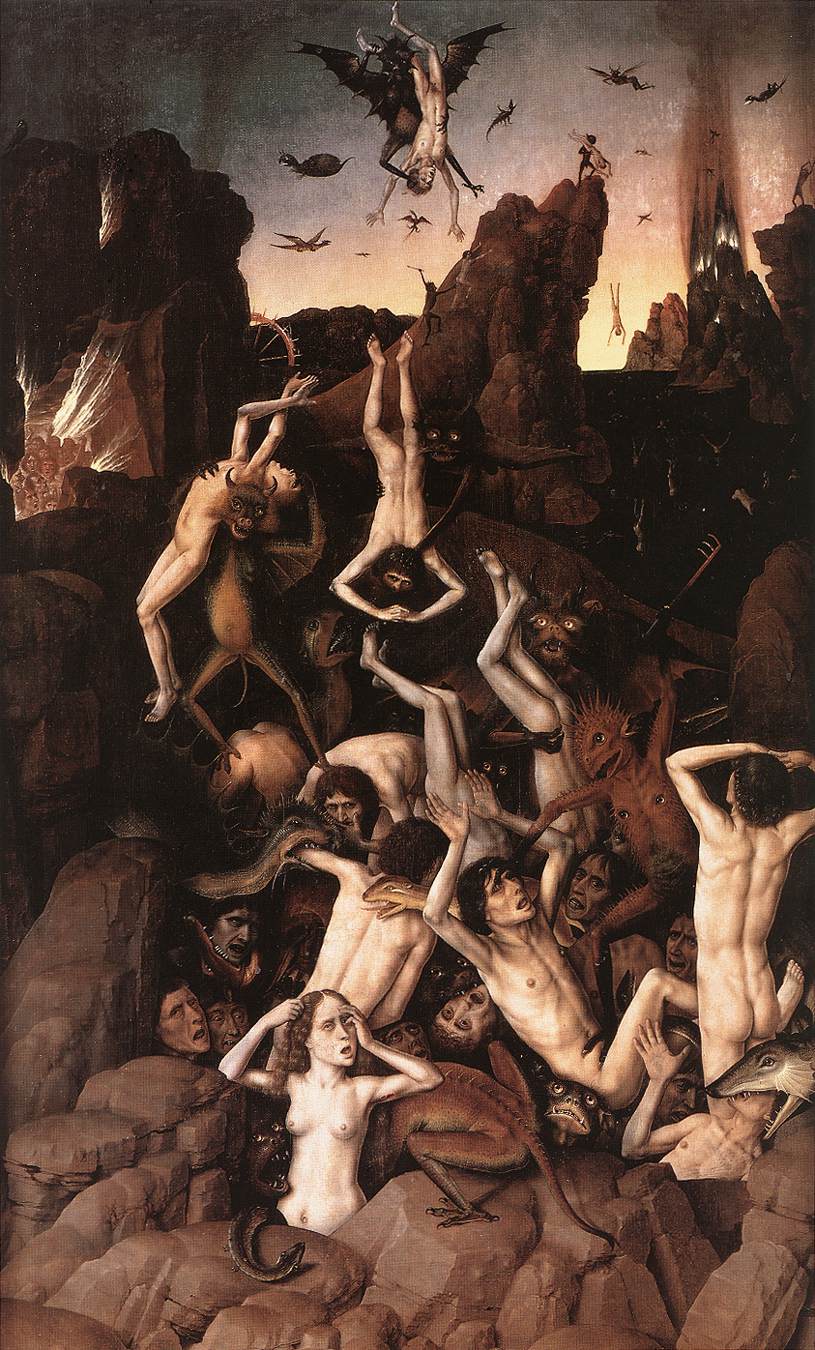
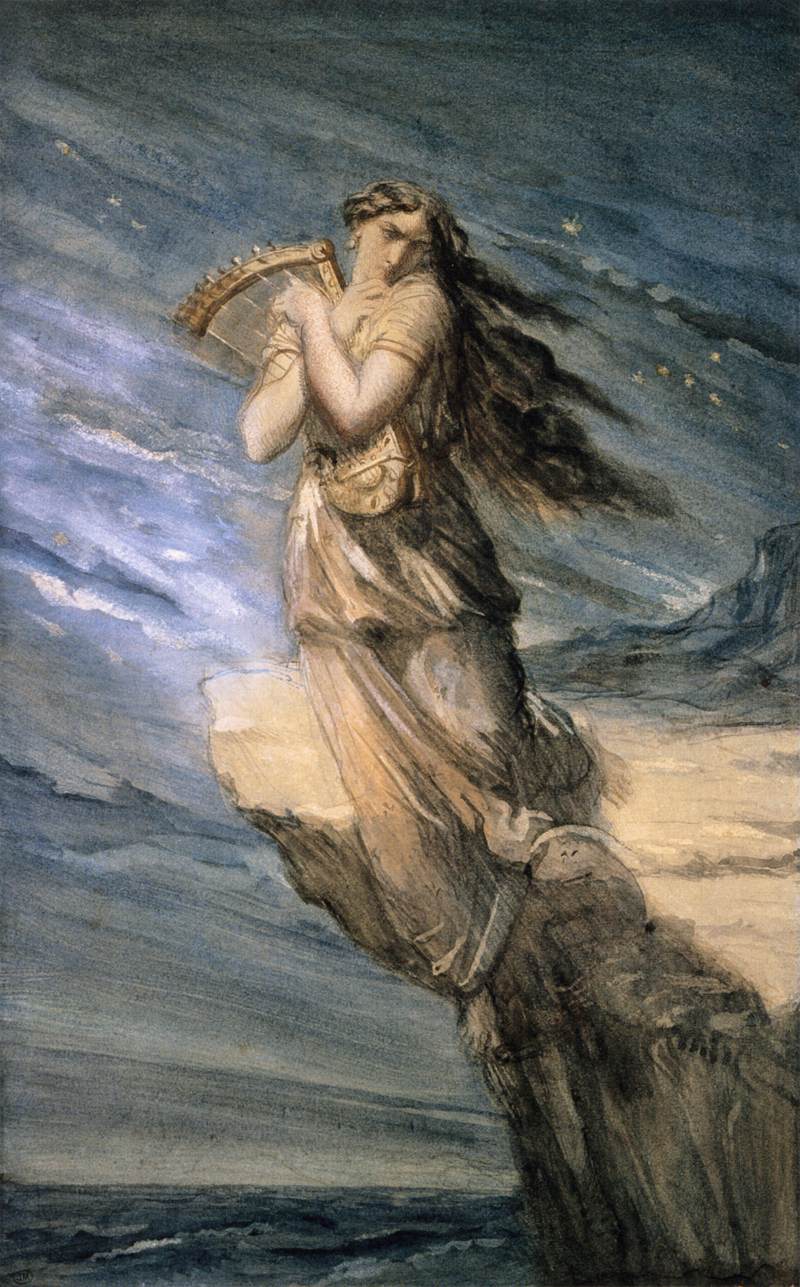
Seven years after Tassaert's painting, Gustave Courbet painted two women asleep in each other's arms for a private collector, and gave them no damnation at all. Four centuries before, Dieric Bouts had painted the fall of the damned as bodies tumbling into a pit full of demons, exactly the hell Tassaert chose to leave out. And Chassériau's Sappho, the poet of Lesbos, stands at the edge of the cliff where the whole tradition began.
La Femme damnée was painted in oil on canvas in 1859. It is generally listed as being in a private collection, so it is rarely seen in person, and it does not appear under this title in the 1886 catalogue of Tassaert's work, which may simply mean it stayed hidden, as pictures like this often did. His Heaven and Hell and many of his other paintings can be seen at the Musée Fabre in Montpellier, where Alfred Bruyas left his collection.
We paint The Cursed Woman by hand in oil on canvas, with the gold light, the blue depths and the soft, outline-free flesh that make the original float. See the hand-painted reproduction.
Enjoyed this story?
Save articles to your collection
Log in or create a free account, and this article will be waiting in your Private Collection.
Log in or sign up