Loading cart…
No products in the cart.

1850 · Oil on canvas · State Russian Museum, Saint Petersburg
Save articles to your collection
Log in or create a free account, and this article will be waiting in your Private Collection.
Log in or sign up Explore the artistIvan Aivazovsky →
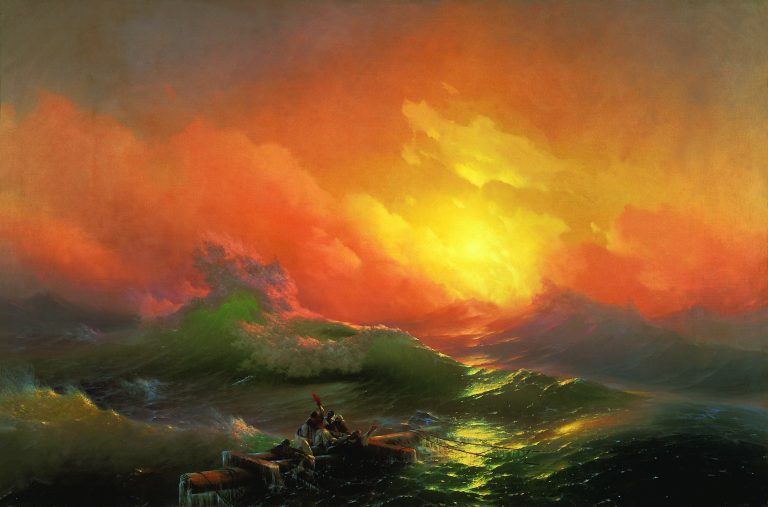
The ship is gone. A handful of survivors cling to its broken mast while a green wall of water rises behind them. One person lifts a red cloth. Beyond the wreckage, the sky burns yellow and orange. Morning has arrived, but safety has not.
Ivan Aivazovsky painted The Ninth Wave in 1850. Its drama comes from holding two possibilities together: the sea could overwhelm these people, and the sunrise could be the beginning of their survival. The painting gives us the crisis and leaves us to imagine what follows.
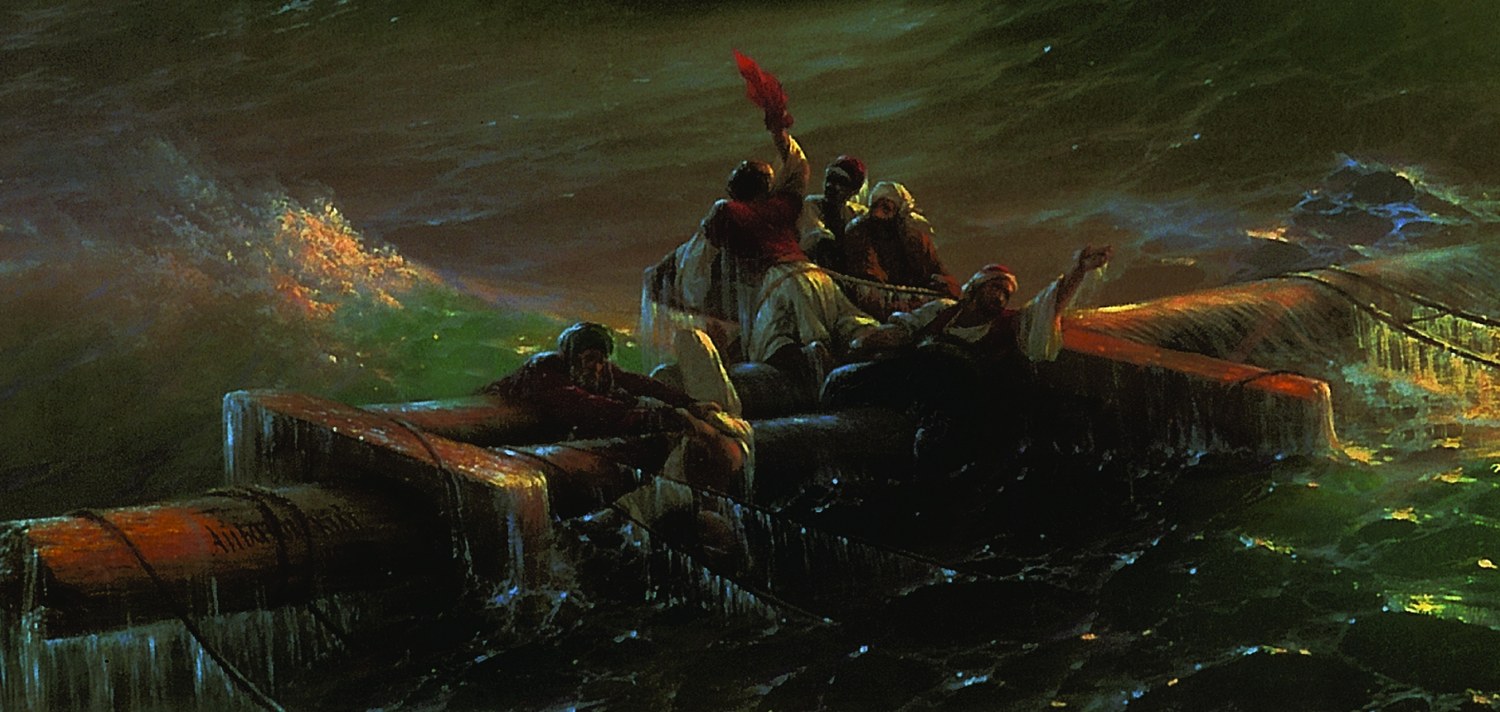
Move closer and the survivors become more than a distant patch of colour. Bodies lean across the timber, hands grip the wreckage, and clothing catches the light. They have almost nothing to hold onto, but they are still holding on.
The title refers to a popular sailors’ legend that the ninth wave is the most powerful and destructive. The Russian Museum identifies that belief as the subject behind the painting’s approaching wave. Aivazovsky turns the idea into a moment when the worst danger appears still to be ahead.
The title should be understood as folklore. It does not establish a scientific rule that every ninth wave must be the largest. Nor does the canvas show nine waves that a viewer can count in sequence. It gives an immense, moving sea a name that makes its threat feel personal.
That is why the title changes the way we look. Without it, we might see the morning after a storm. With it, the same scene becomes a test: after everything the survivors have already endured, another ordeal is approaching.
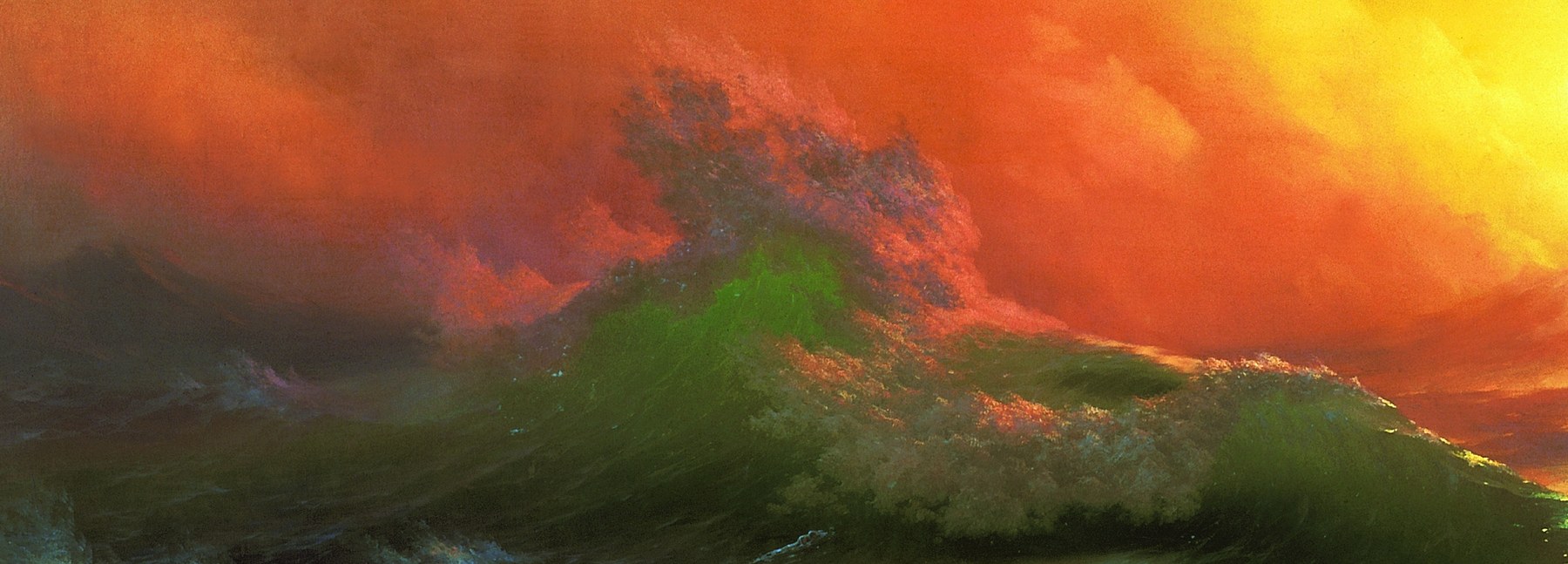
Look along the rising crest. Dark green gathers beneath it, while the thinner edge turns almost yellow. Above that edge, spray dissolves into the orange atmosphere. The changes of colour make the water appear to have thickness, transparency and motion.
The effect depends on contrast. The foreground is heavy and dark; the crest is comparatively light. Small streaks of foam make the surface feel restless, while broad passages of colour give the wave its weight. Aivazovsky makes the sea convincing through these relationships rather than through a uniform account of every ripple.
The same light that makes the water beautiful also reveals how high it rises above the people. Beauty and danger occupy the same part of the canvas. Looking at the glowing crest can momentarily make us forget what it could do to the survivors below.

The sky takes up much of the picture. Its brilliant centre opens between darker clouds, and warm reflections travel across the water toward the wreckage. Your eye can follow that light away from the people and into the distance.
The Russian Museum reads the dawn as a sign of hope and the survivors’ struggle as an image of human endurance. That is a persuasive interpretation of the composition: darkness remains, but it no longer fills the world.
Hope is different from certainty. There is no rescuing ship clearly arriving beside them, and the painting never shows land beneath their feet. The warmth of the sky changes the emotional balance of the scene while leaving its immediate danger intact.
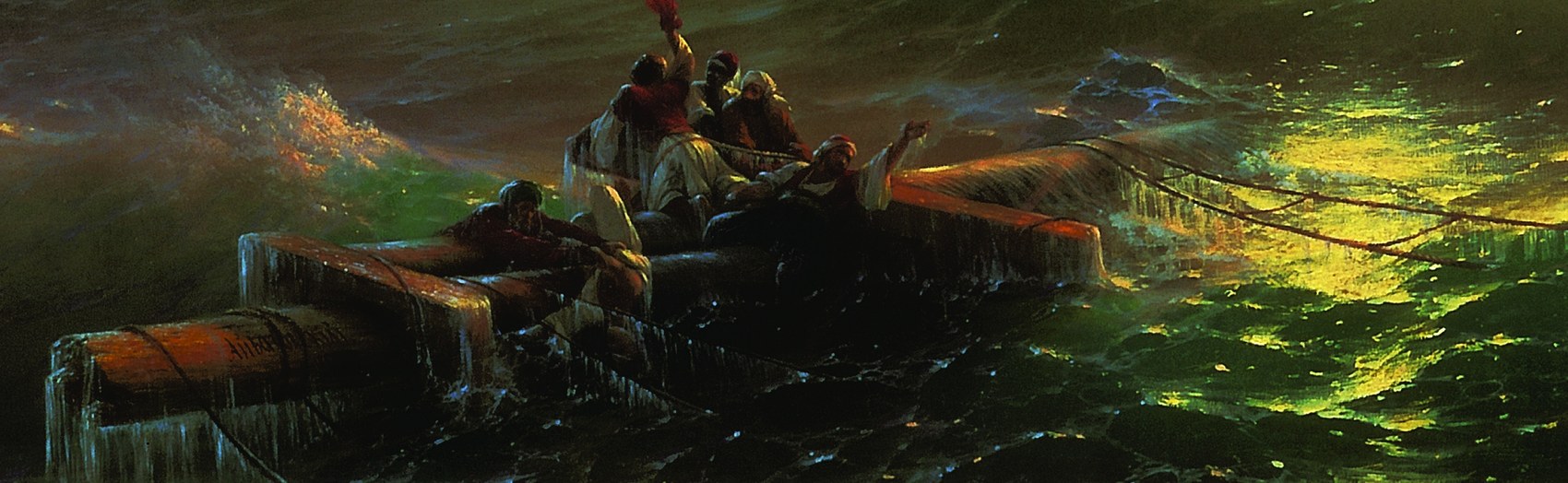
The timber is both a remnant of disaster and the means of staying alive. Parts of a ship that failed now form a fragile refuge. The trailing ropes emphasise how far the wreckage extends into the surrounding water.
The intersecting pieces can also suggest a cross. In a scene of suffering, endurance and dawn, a viewer may connect that shape with Christian ideas of salvation. This is a possible reading of a visible form, rather than proof that Aivazovsky intended a specific religious message.
The most immediate meaning needs no hidden code: the survivors depend on one another and on the little material support left to them. Their small scale makes that dependence especially moving.
Aivazovsky was born in Feodosia in 1817 and trained at the Imperial Academy of Arts in Saint Petersburg. He became known for marine painting, with a career that included coastal views, storms and naval subjects.
The museum’s account of this painting explains his practice of composing seascapes in the studio from memory. A moving wave cannot hold its pose. Observation supplies experience, while memory and imagination allow a painter to arrange a fleeting effect into a complete picture. This does not mean he never studied nature.
The Ninth Wave belongs to Romanticism. Its vast natural forces, dramatic colour and vulnerable human figures create an experience often called the sublime: awe mixed with fear before something far larger than ourselves. The viewer can contemplate the storm from a position of safety, even while the figures inside it cannot.
Seen this way, the painting’s subject extends beyond a shipwreck. It asks how a person keeps acting when the world offers no assurance of success. The raised cloth, gripping hands and opening light make endurance visible.
The original belongs to the State Russian Museum in Saint Petersburg. Painted in oil on canvas, it measures 221 by 332 centimetres and has the accession number Ж-2202. At more than three metres wide, the original gives the sea a physical presence that a small reproduction cannot convey.
It was originally acquired for the Imperial Hermitage and entered the Russian Museum’s collection in 1897. The museum’s collection record is the reference for its dimensions, date and ownership; visitors should check current display information before travelling.
ByMuseum offers a hand-painted oil reproduction of The Ninth Wave, made to order with size and framing options. You can explore the painting and other seascapes in our Ivan Aivazovsky collection.
Ivan Aivazovsky painted The Ninth Wave in 1850. It is one of his best-known seascapes.
The painting shows shipwreck survivors facing a threatening wave at dawn. The title refers to a sailors’ legend, while the rising light and the figures’ struggle support a reading about hope and endurance.
No. In this painting, the ninth wave belongs to a popular maritime legend, not a fixed scientific sequence that makes every ninth wave the largest.
The painting does not show their eventual fate. The Russian Museum emphasises hope and human endurance, but the image stops before a rescue or an outcome.
The museum records cited here do not identify a specific shipwreck as the event depicted. It is safest to describe it as a composed shipwreck scene rather than a documented incident.
The canvas measures 221 centimetres high by 332 centimetres wide, according to the State Russian Museum.
It belongs to the State Russian Museum in Saint Petersburg, Russia. The museum received it from the Imperial Hermitage in 1897.
The close-ups are faithful crops of the same source image. Visual descriptions and possible symbolic readings are distinguished from documented history. The cross-shaped timbers are discussed as interpretation, not a confirmed statement of the artist’s intention.
Enjoyed this story?
Save articles to your collection
Log in or create a free account, and this article will be waiting in your Private Collection.
Log in or sign up
Man Writing a Letter
Gabriel Metsu, c. 1664
The gallery list
Every painting is already 50% off. Join the list and we will send you an extra $15 code, plus first access to new collections.
No spam. Unsubscribe anytime. · Privacy Policy
Welcome
Your $15 code is on its way. Explore the gallery while you wait.