Loading cart…
No products in the cart.

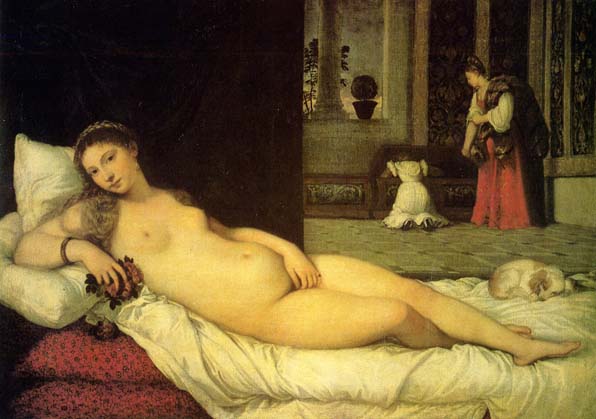
1538 · Oil on canvas · Uffizi Gallery, Florence, Italy
Save articles to your collection
Log in or create a free account, and this article will be waiting in your Private Collection.
Log in or sign upTitian painted the Venus of Urbino in Venice around 1538 and it was commissioned by Guidobaldo della Rovere, who later became the Duke of Urbino. Documentary evidence in the form of letters between Guidobaldo and his agent in Venice confirm the commission and reveal that the young nobleman was impatient to receive the finished work. Titian, who was by this time the dominant painter in Venice and among the most sought-after portraitists in Europe, delivered a painting that drew directly on the precedent established by Giorgione in his Sleeping Venus, completed around 1510, but transformed it fundamentally by having the figure awake and looking directly outward. The painting was acquired by the Medici family in 1631 when Vittoria della Rovere married Ferdinando II de Medici, entering the Florentine collection where it has remained ever since. The Uffizi Gallery received it as part of the entire della Rovere inheritance. The work was famously described by Mark Twain in his travel memoir as the vilest painting in the world, a comment more revealing of Victorian attitudes to the nude than of the painting itself, and one that perversely helped to cement its notoriety.
Titian divided the composition horizontally into two zones by means of a dark curtain that separates the reclining figure in the warm foreground from the domestic interior in the cooler background. The figure reclines on white sheets and a red cushion, her body aligned with the horizontal axis of the canvas in a pose that invites the viewer to read from left to right following the line of her gaze, which engages the viewer directly and without evasion. In her right hand she holds a small bunch of roses, and a small dog sleeps at her feet, both of which are elements that were understood in the Renaissance as symbols of love and fidelity. In the background, two female servants attend to a cassone, a type of wedding chest, suggesting the painting was connected to a domestic and possibly nuptial context. The warm, golden tonality of the flesh against the red and white textiles demonstrates Titian celebrated mastery of color, achieved through multiple thin glazes of oil that create a sense of luminous depth in the skin. The directness of the figure gaze was an innovation that shifted the figure from object of contemplation to active participant in the exchange between painting and viewer.
The Venus of Urbino occupies a significant place in the history of the painted nude, establishing conventions that would be followed, contested, and transformed by painters from Velazquez and Goya to Manet, whose Olympia of 1863 was painted in direct dialogue with Titian composition. The question of whether the figure is a goddess or a woman, idealized or particular, has been debated for centuries and remains productively unresolved. The domestic setting and the engaged gaze push the work toward the particular and human, while the title and pose associate it with the idealized tradition of the classical Venus. The work was understood in the Renaissance within a tradition of painted nudity that was connected to ideas of beauty, desire, and conjugal love, and the domestic objects surrounding the figure support the interpretation of the painting as a gift or instruction connected to marriage. Its legacy as a template for subsequent nudes is its most significant cultural contribution, demonstrating the power of a single compositional formula to structure centuries of subsequent artistic practice.
Enjoyed this story?
Save articles to your collection
Log in or create a free account, and this article will be waiting in your Private Collection.
Log in or sign up