Loading cart…
No products in the cart.

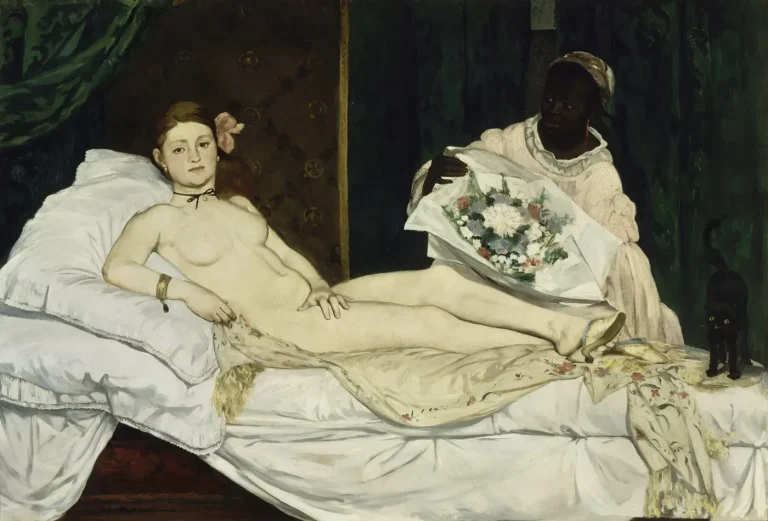
1863 · Oil on canvas · Musée d’Orsay, Paris
Save articles to your collection
Log in or create a free account, and this article will be waiting in your Private Collection.
Log in or sign up Explore the artistÉdouard Manet paintings →
Collection reference: Musée d’Orsay, Paris.
The woman on the bed has already noticed us. Her head is raised, her eyes are open, and her hand rests firmly across her body. A bouquet arrives beside her, but she does not turn towards it. The encounter remains between the woman and whoever stands before the canvas.
Édouard Manet painted Olympia in 1863 and exhibited it at the Paris Salon in 1865. Its reception was hostile. The picture challenged expectations about both the female nude and the smooth finish associated with prestigious painting.
Today it belongs to the Musée d’Orsay. Looking closely helps separate the painting itself from the simplified story that it shocked people merely because it showed a naked woman. Parisian audiences already knew painted nudes. Manet made the conventions around them newly uncomfortable.
The reclining figure recalls Titian’s Venus of Urbino. Manet borrows a familiar arrangement and changes the encounter it produces. A ribbon, bracelet, flower and slipper place his woman within a specific, contemporary world rather than a safely distant mythology.
The name Olympia and the surrounding details encouraged nineteenth-century viewers to read the figure as a courtesan. The flowers suggest a social exchange extending beyond the picture. Yet the painting gives us no complete account of a client or an appointment.
The distinction between a painted role and an actual person matters. Victorine Meurent, the model for the reclining figure, should not simply be identified with the character she poses as. A picture can construct a social identity without documenting its model’s private life.
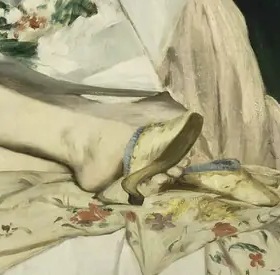
The slipper belongs to the same everyday register as the jewellery, ribbon and bouquet. These small things matter because they stop the inherited reclining pose from floating free of its setting. The figure occupies a furnished room, surrounded by possessions and the signs of a social exchange.
The painting does not abandon older art. It asks what happens when a familiar pose is made to share a world with contemporary clothing, paid work and a visitor who may be standing where we stand.
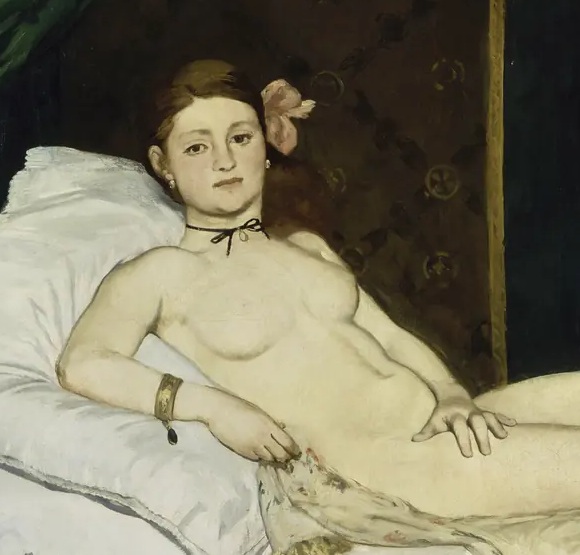
Olympia’s gaze is level and alert. Her head is not thrown back in sleep or turned away in modesty. The dark eyes and sharply defined features make her expression feel unusually direct against the light bedding.
Her hand introduces another boundary. It is not loosely dropped across the body; its shape is emphatic. Viewers often read it as a sign of control over access to her body. That is an interpretation of the gesture, rather than an explanation supplied by the sitter.
The encounter is therefore difficult to make one-sided. We can look at the nude, but the figure’s apparent awareness makes our own position part of the picture. The setting is intimate without seeming available for an entirely unobserved inspection.
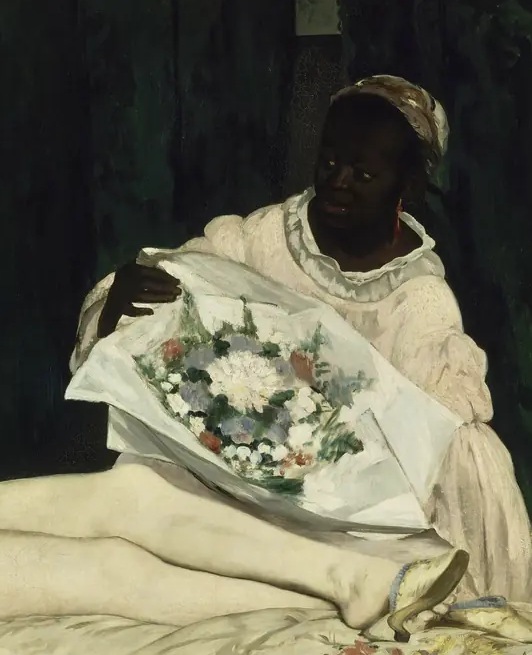
The standing woman holds a large bouquet wrapped in pale paper. Her white clothing and the flowers create a second concentration of brightness beside the bed. She turns towards Olympia while Olympia continues to look outward.
The model is known as Laure. The painted figure occupies a servant’s role, but Laure was a person whose identity extends beyond that role. Attending to her changes a reading that treats the entire right-hand side as an accessory to the nude.
Their positions make differences of race, class and work visible within an intimate room. They do not establish what either woman is thinking. The standing figure’s face remains partially in shadow, and the painting leaves the relation between the two women open to sustained attention.
The bouquet also complicates the scene’s stillness. Something has arrived from outside. Its freshness and crowded colours suggest an exchange that the central figure has not yet acknowledged, at least within the moment Manet gives us.
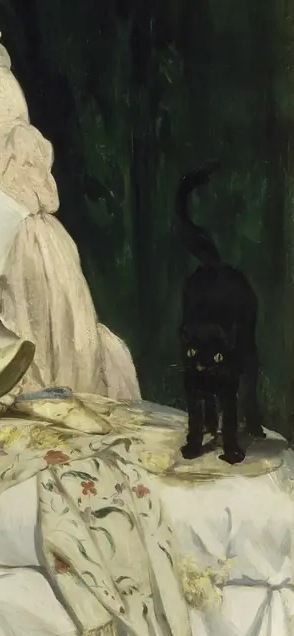
At the right edge, a black cat lifts its tail against the pale bedspread. Its silhouette is small but distinct. The animal interrupts the horizontal arrangement of bedding and legs with a sudden upright accent.
The contrast with the resting dog in Titian’s Venus of Urbino has encouraged symbolic readings. The cat can contribute associations of alertness, sexuality or unease, but it does not provide a single code that explains the whole painting.
Notice how much depends on paint rather than symbolism. A dark shape against white cloth becomes visible immediately. The bedspread’s patterns then pull our eye back across a surface that might otherwise feel like an empty platform beneath the figure.
The contemporary courtesan was one source of discomfort. Manet withheld the mythological explanation that could make a nude acceptable as a Venus or a nymph. The woman’s direct gaze also offered little reassurance that the viewer could remain unnoticed.
The manner of painting mattered as well. Strong light-dark contrasts, comparatively flat areas and abrupt outlines challenged expectations of rounded flesh and carefully blended transitions. The figure can seem cut out against her surroundings instead of dissolving into atmospheric space.
These choices work together. The bluntness of the paint gives the modern encounter a physical insistence. Reducing the scandal to either subject matter or technique alone misses the way each reinforces the other.
Manet was closely connected with the Impressionists, but he did not exhibit in their eight group exhibitions. His work helped make contemporary subjects and visible decisions in paint central to the arguments that surrounded them.
That is why Olympia belongs in discussions of Impressionism’s beginnings while requiring a distinction from the group’s exhibition history. The painting was shown at the Salon, and its confrontational interior is different from a landscape painted to register shifting weather.
Compare Manet’s Luncheon on the Grass, also dated 1863. There, a nude woman among clothed men unsettles an outdoor gathering. In A Bar at the Folies-Bergère, the woman behind a counter and her displaced reflection create another uncertain relation between a figure and the viewer.
The original belongs to the Musée d’Orsay in Paris. The museum records its dimensions as 130.5 by 191 centimetres. Its history includes the public subscription organised by Monet in 1890 to secure it for the French state.
That later intervention shows how far its standing had changed since the Salon controversy. A painting once treated as an offence became a work fellow artists wanted preserved in a public collection.
Its force still depends on looking. The gaze, the delivered flowers, Laure’s presence and the alert cat do not settle into one comfortable story. They keep the room, and our position before it, open to question.
Édouard Manet painted Olympia in 1863. The original is an oil painting on canvas in the Musée d’Orsay, Paris.
Its contemporary courtesan, direct gaze and abrupt contrasts challenged conventions of the idealised nude and polished Salon painting. It was exhibited at the Salon in 1865.
Victorine Meurent posed for the reclining woman. Laure posed for the standing woman holding the bouquet. Their identities should be distinguished from their painted roles.
It can suggest alertness or sexual associations and contrasts with the resting dog in Titian’s Venus of Urbino. Its meaning is interpretive, rather than a confirmed explanation of the whole scene.
It is central to the history around Impressionism, but Manet never joined the group’s eight exhibitions. The painting was shown at the official Salon.
It belongs to the Musée d’Orsay. Check the museum’s collection record for current display information and loans.
Detail images are crops of the historical painting, with no painted forms added.
Continue with our guide to ten famous Impressionist paintings.
Enjoyed this story?
Save articles to your collection
Log in or create a free account, and this article will be waiting in your Private Collection.
Log in or sign up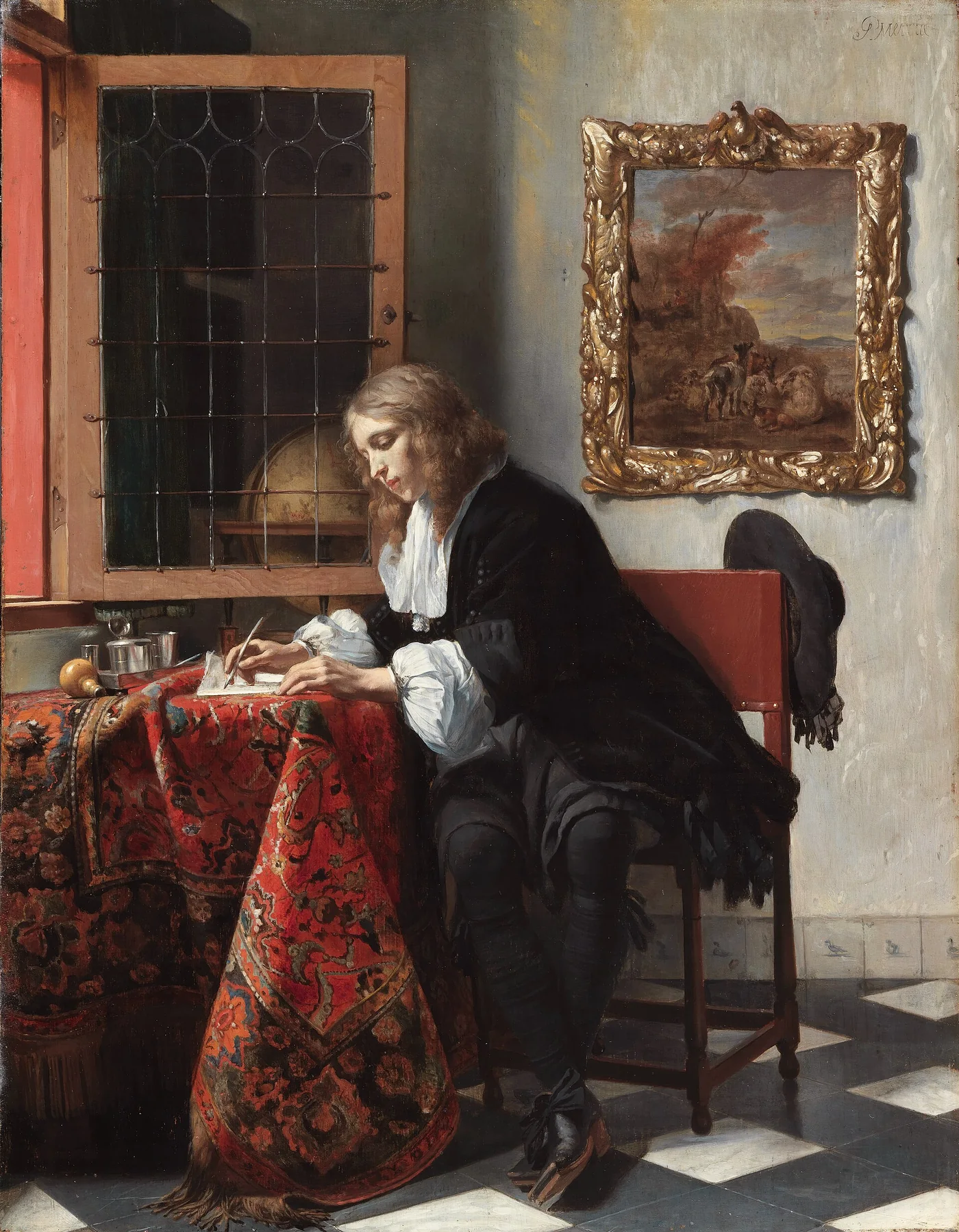
Man Writing a Letter
Gabriel Metsu, c. 1664
The gallery list
Every painting is already 50% off. Join the list and we will send you an extra $15 code, plus first access to new collections.
No spam. Unsubscribe anytime. · Privacy Policy
Welcome
Your $15 code is on its way. Explore the gallery while you wait.