Loading cart…
No products in the cart.

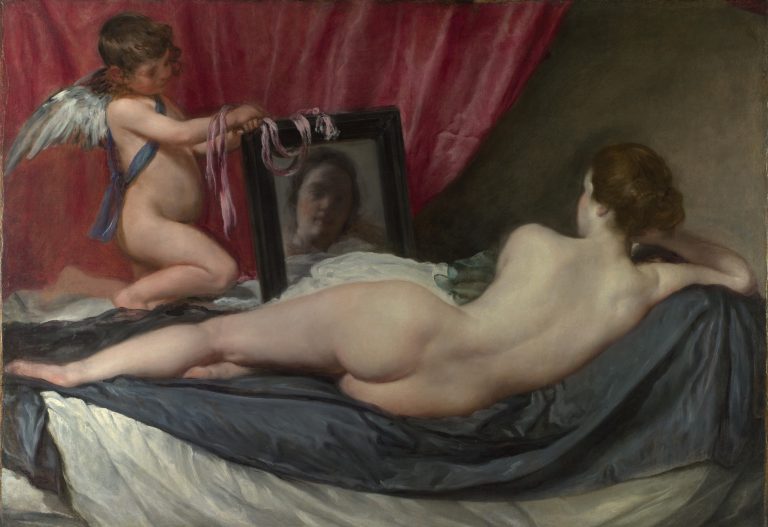
1647–1651 · Oil on canvas · National Gallery, London
Save articles to your collection
Log in or create a free account, and this article will be waiting in your Private Collection.
Log in or sign up Explore the artistDiego Velazquez →
Venus turns her back towards us. Her face appears elsewhere, inside the dark rectangle held by Cupid. We seem to have been given two views of the same woman, yet the reflected features remain indistinct. The mirror offers an answer and withholds it at the same time.
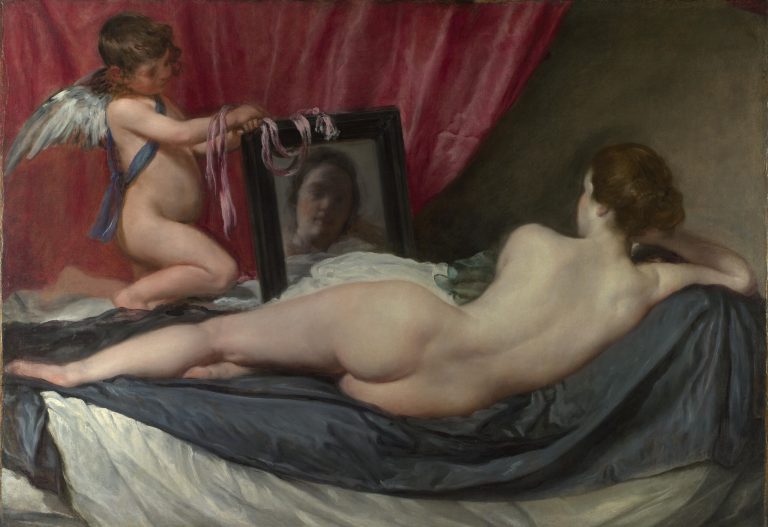
Diego Velázquez’s The Toilet of Venus, usually called The Rokeby Venus, was painted between 1647 and 1651. Its subject is the goddess of love, but its tension comes from ordinary acts of looking: a body faces away, a mirror faces outward, and the viewer tries to connect the two.
The original is an oil painting on canvas in the National Gallery, London, measuring 122.5 × 177 centimetres. It is the only surviving female nude by Velázquez. The word “surviving” matters. It describes the works known today, not proof that he never painted another.
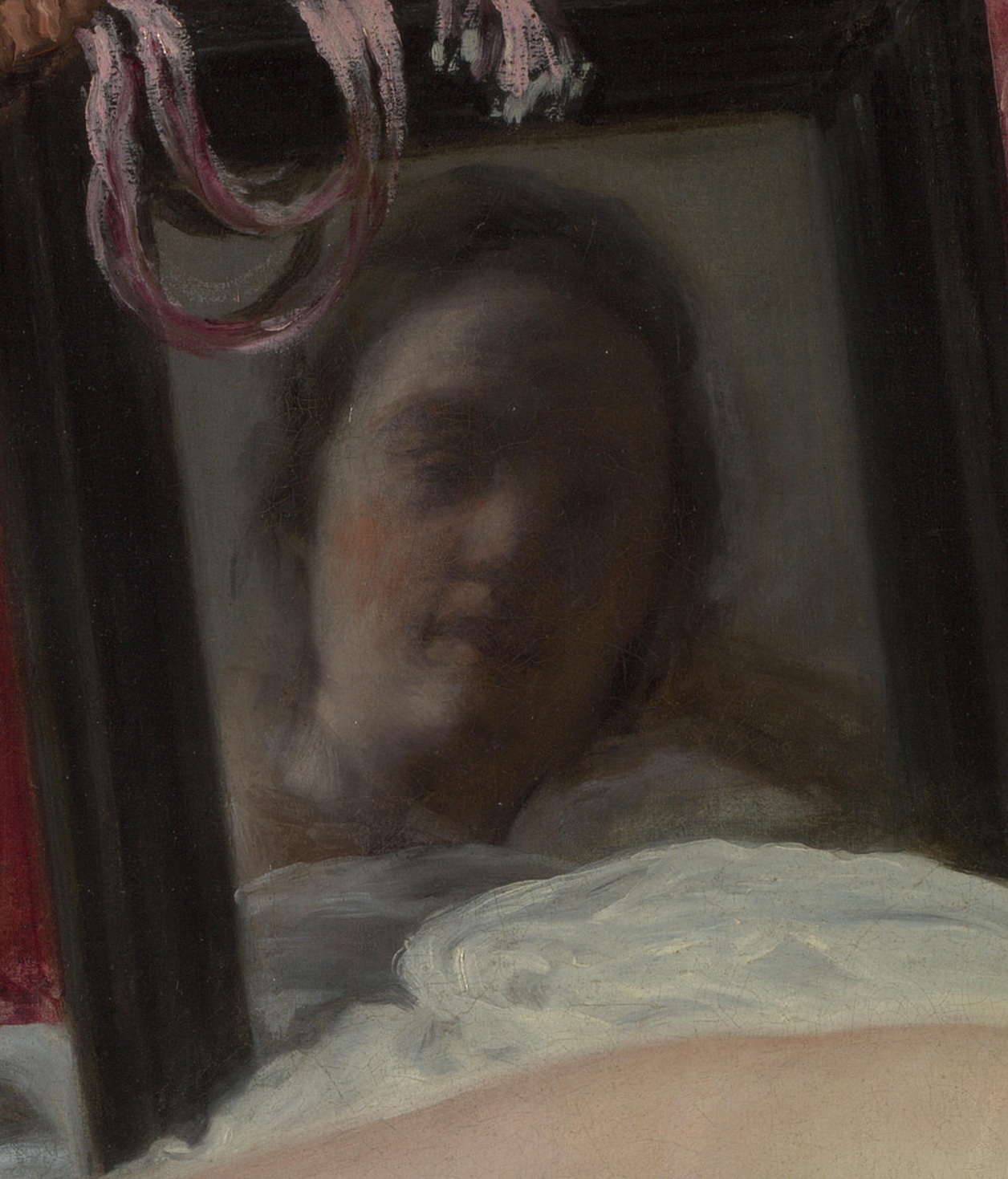
The reflection is enough to suggest a face but not enough to secure an identity. Dark eyes, a nose and a mouth emerge from the muted paint. The reflected head has a weight and scale of its own, quite different from a miniature likeness tucked into a corner.
That uncertainty makes the mirror the painting’s most active object. We turn to it because the woman’s visible head is directed away from us. Once there, we still cannot confidently name the person we are seeing.
The sitter is unknown. Identifying her as a particular lover, actress or woman encountered in Italy requires evidence that the painting does not provide. The National Gallery presents the lack of a distinct likeness as part of the work’s fascination, while treating any explanation of Velázquez’s intention with appropriate caution.
There is a similar uncertainty about the gaze. A reflected face appearing to address us does not establish exactly what Venus would see from her position in a real room. The picture organises an encounter for its viewer; it need not behave like a diagram of a perfectly measured optical experiment.
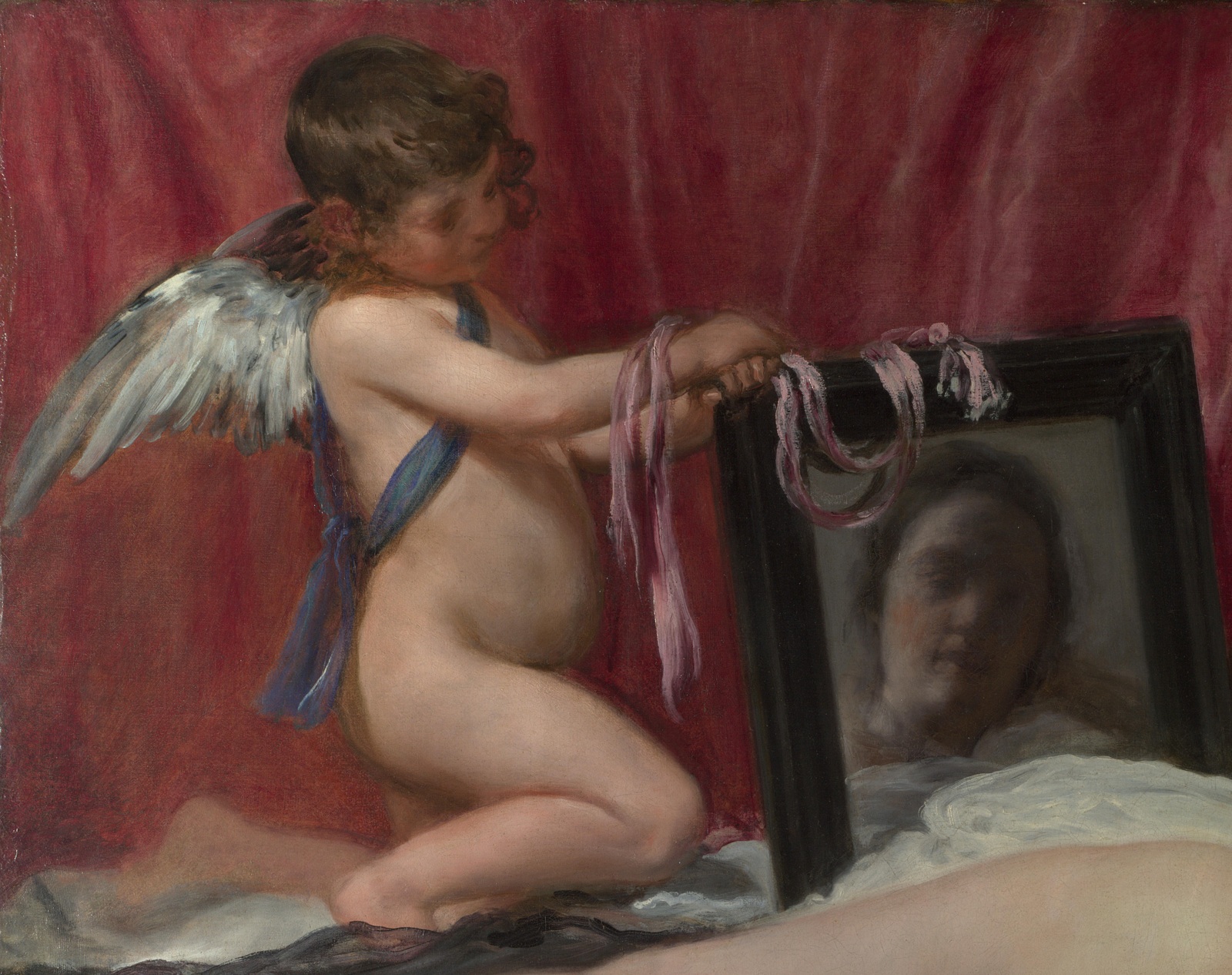
Cupid is occupied with a practical task. He kneels behind the bed, both hands engaged with the mirror, while his wings distinguish him from an ordinary child. His presence identifies the reclining woman as Venus rather than an anonymous figure at rest.
The arrangement gives him an unusual responsibility. He controls the object through which we gain access to her face. His arms make a bridge between the small reflection and the much larger reclining body.
Look at the difference between his face and hers. Cupid’s features are visible directly, though loosely brushed. Venus’s face is available only through another surface. This contrast keeps our attention moving between a clear action and an uncertain identity.
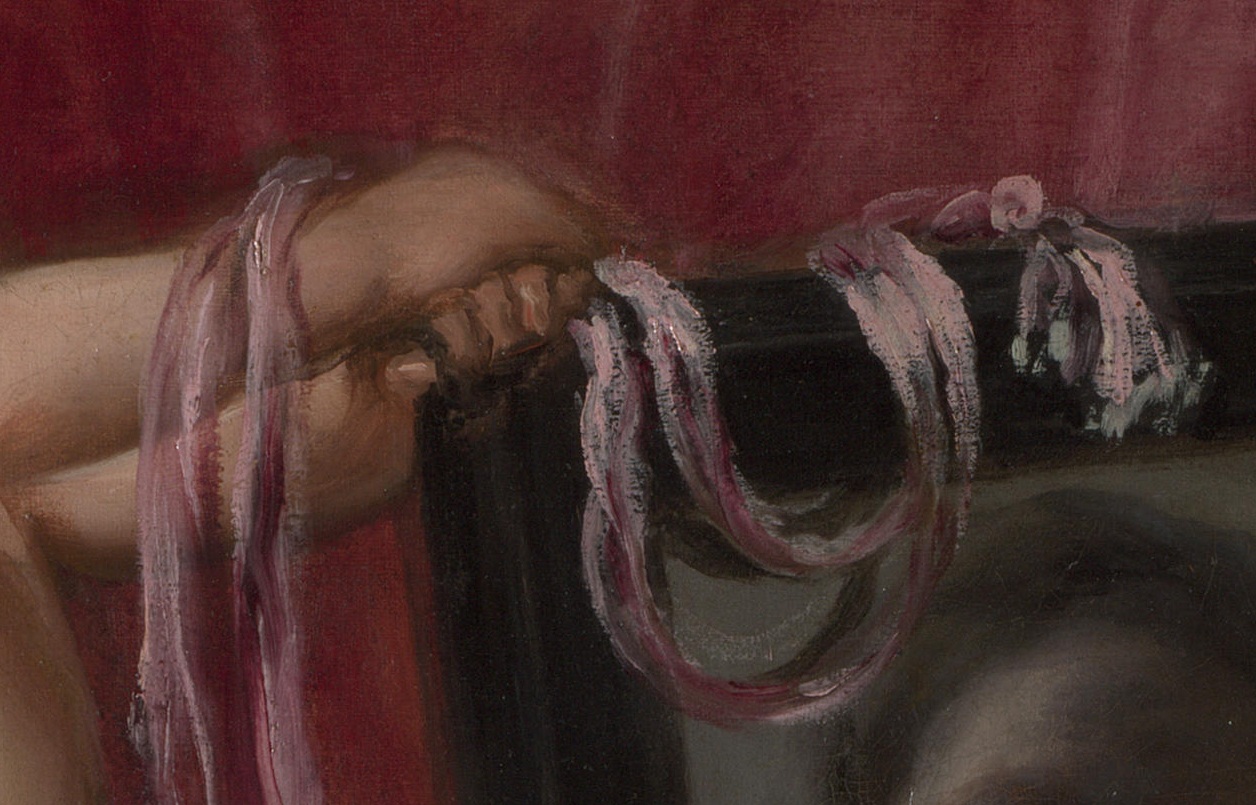
The pink ribbons loop over the mirror’s upper edge and cross near Cupid’s wrist. Their curves interrupt the rigid frame, giving the object a delicate, almost unstable attachment to his hands.
The National Gallery notes that these are the kind of ribbons used to suspend a mirror. It also discusses possible associations with Cupid’s blindfold or the bonds of love. Those are readings of the crossing ribbons, not a certainty that every loop has one fixed symbolic translation.
Even without that symbolism, their visual role is clear. They pick up the warm curtain behind Cupid and soften the meeting of skin, glass and dark wood. The mirror is being held, not magically floating in an empty allegorical space.
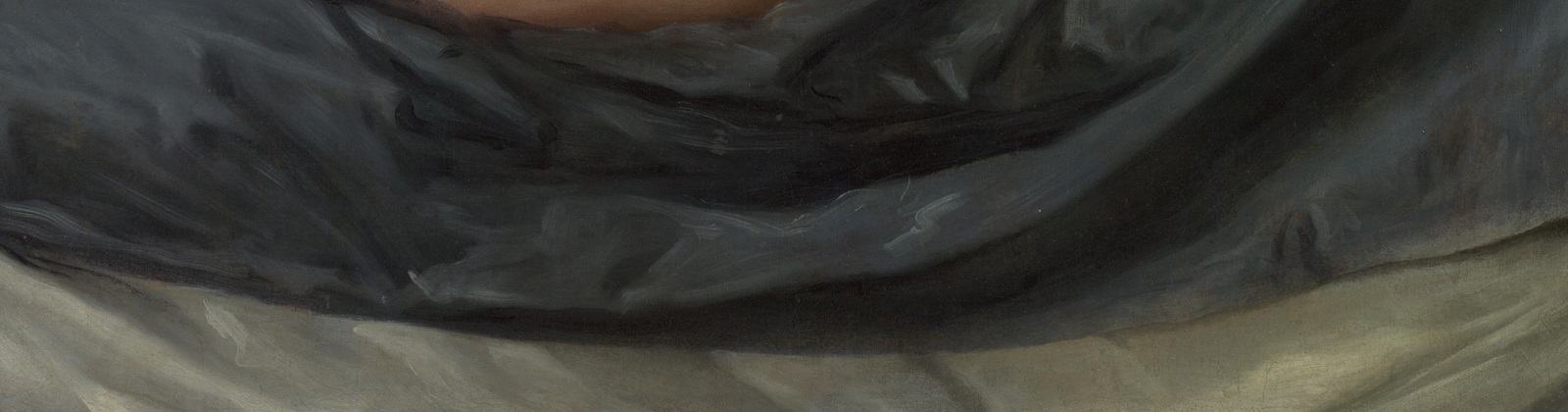
The longest movement in the picture runs horizontally. The extended legs lead towards the rising hip and shoulder. Below them, the satin gathers into another long sweep, then breaks into ridges and folds.
The contrast is not simply between pale skin and dark cloth. The body is painted with relatively continuous transitions, while the sheet separates into visible strokes and changes of direction. The fabric offers a different kind of energy beneath the still figure.
There is almost no descriptive furniture to interrupt this relationship. We do not need a detailed bedstead, patterned wall or view through a window to understand the space. The folds support the body while the red curtain provides a separate vertical weight at the left.
Distance changes what we see. From farther away, the folds cohere into a luxurious surface. In a detail, individual light marks become more apparent. Velázquez makes a material seem touchable without describing every thread.
A conventional scene of Venus might display the face as openly as the body. Here, the turn away creates a second route through the painting. We first encounter the visible figure, then travel to the mirror, then return to the head that the mirror is supposed to explain.
This is a reading of the composition, rather than a documented statement of the painter’s intention. Its effect is nevertheless available to anyone following those lines of sight. The body is close, but the person remains difficult to know.
Mythology also offered a setting for images that were sensitive in seventeenth-century Spain. Religious disapproval did not prevent wealthy collectors from owning paintings of nude mythological figures. Venus gave the subject a classical identity within that world of private collecting.
The painting is often associated with Velázquez’s second Italian journey, but its date range does not establish exactly where he painted it. The National Gallery allows for work before, during or after that visit. A confident story about a specific Roman studio would outrun what is known.
“Rokeby” is not the name of the sitter or a place in the myth. It comes from Rokeby Park in County Durham, where the painting hung during the nineteenth century. That later ownership history became so familiar that it now competes with the formal title.
The different names draw attention to different things. Venus at Her Mirror describes the encounter with the reflected face. The Toilet of Venus uses the older meaning of toilette, preparing or arranging one’s appearance. The Rokeby Venus tells us about the painting’s later life as a collected object.
Whichever title we use, the central uncertainty remains. We have spent time looking at a woman who seems completely exposed, only to discover how much of her identity the painting keeps beyond our reach.
Diego Velázquez painted it between 1647 and 1651.
It is in the National Gallery, London, inventory number NG2057.
Cupid, the winged god of love and son of Venus, holds it.
No secure identification of the sitter has been established.
That title is also used for this Velázquez painting. Other artists painted Venus with mirrors too, so the artist’s name is essential when identifying it.
Faithful public-domain reproduction of The Rokeby Venus, via Wikimedia Commons. Detail images are crops of the same historical painting; no reconstruction or upscaling.
Enjoyed this story?
Save articles to your collection
Log in or create a free account, and this article will be waiting in your Private Collection.
Log in or sign up
Man Writing a Letter
Gabriel Metsu, c. 1664
The gallery list
Every painting is already 50% off. Join the list and we will send you an extra $15 code, plus first access to new collections.
No spam. Unsubscribe anytime. · Privacy Policy
Welcome
Your $15 code is on its way. Explore the gallery while you wait.