Loading cart…
No products in the cart.

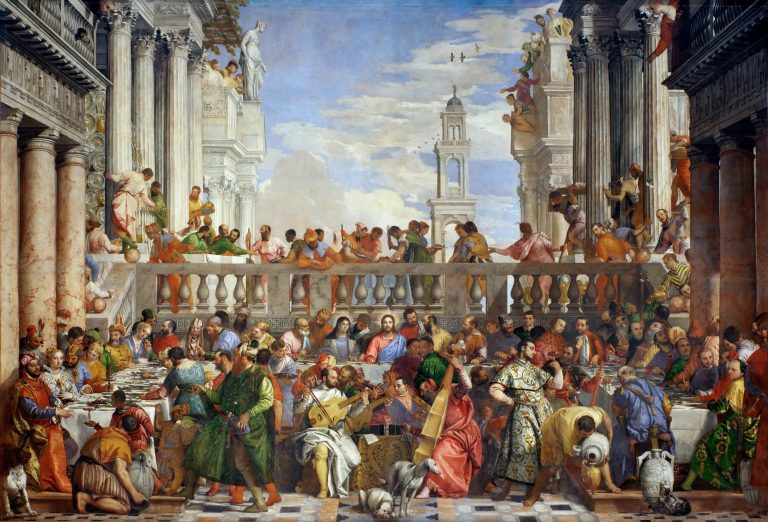
1562 to 1563 · Oil on canvas · Musée du Louvre, Paris
Save articles to your collection
Log in or create a free account, and this article will be waiting in your Private Collection.
Log in or sign up Explore the artistPaolo Veronese →
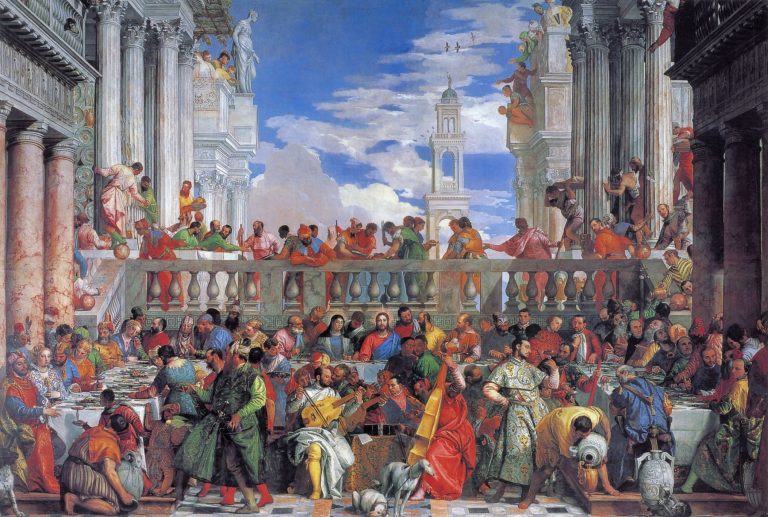
There are guests, musicians, servants, dogs, shining vessels and people leaning from balconies. The event seems too large to have one centre. Then, toward the front at the right, a man bends over a jar and pours.
Paolo Veronese’s The Wedding at Cana turns a biblical miracle into a world of visible activity. Painted in 1562 to 1563 for the Benedictine refectory of San Giorgio Maggiore in Venice, the canvas is now in the Louvre. Its original dining-room setting helps explain the attention given to eating, drinking and service.
The subject is Christ changing water into wine at a wedding. Veronese does not isolate the transformation in a burst of supernatural spectacle. He places it within a gathering that continues talking, listening, working and looking in different directions.
To find the story, follow what moves through the feast: vessels, hands, glances, music and food. The painting makes the act of searching part of its pleasure.
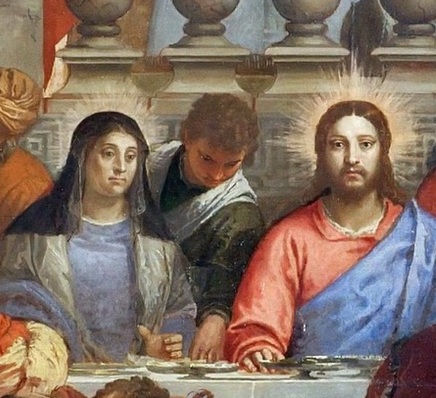
Christ sits near the horizontal centre of the gathering, his face turned outward. Red and blue clothing distinguish his body, but his pose is remarkably restrained. Nearby guests incline their heads or turn toward neighbours; his stillness makes another kind of claim on attention.
Mary sits beside him. Her pale veil and darker outer garment make a quieter silhouette than some of the more elaborate costumes around the table. The sacred figures remain part of the meal rather than hovering over it.
The biblical story begins with a shortage of wine. Mary brings the difficulty to Christ, and servants become essential to what follows. Veronese’s crowded arrangement makes that involvement understandable: a feast requires the work of people whose actions can be overlooked.
The vertical alignment above Christ is also significant to how we look. His head lies beneath the central activity on the terrace. A busy picture can hold a stable centre even when the people within it do not all acknowledge that centre.
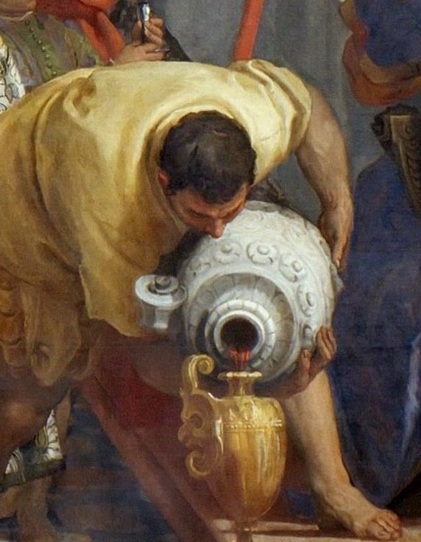
The large pale jar is tilted downward. One hand supports it, another steadies the vessel, and the servant’s head drops close to the work. A red stream runs toward the golden container below.
The pouring does not look effortless. Veronese gives the jar a curved, substantial body and places the servant in a bent posture suited to carrying weight. A miracle reaches the table through ordinary movements that the viewer can recognise.
The decorated surface matters too. Light picks out the jar’s raised patterns while the opening remains dark. The object attracts attention before its role in the narrative has been explained.
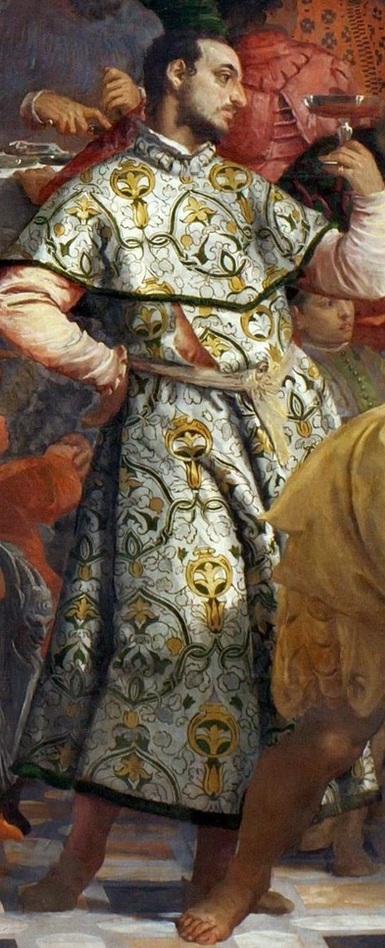
Beside the pouring, a richly dressed figure holds up a glass. His body is upright, his head turned toward the vessel. The contrast between bending to serve and standing to inspect gives two stages of the wine’s movement different shapes.
A painting cannot make the viewer taste what is in the glass. Instead, it uses the raised vessel, the surrounding attention and the pouring stream to make the change intelligible.
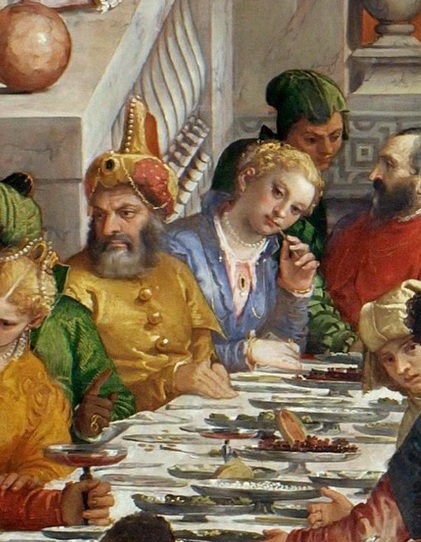
The bride and groom belong to the left end of the table. Their placement can be surprising when the title has led us to expect a conventional wedding portrait. They are participants in a larger story rather than the picture’s largest or most central figures.
The bride’s inclined head creates a small, reflective pause amid the surrounding guests. Beside her, richly coloured clothing and objects give the group the same material splendour that extends across the feast.
Looking for the couple is a useful exercise because it slows the rush toward identifying every famous face. The image’s organisation is not determined simply by social rank or by the occasion named in the title. Its arrangement must also accommodate Christ, the miracle and an expansive Venetian spectacle.
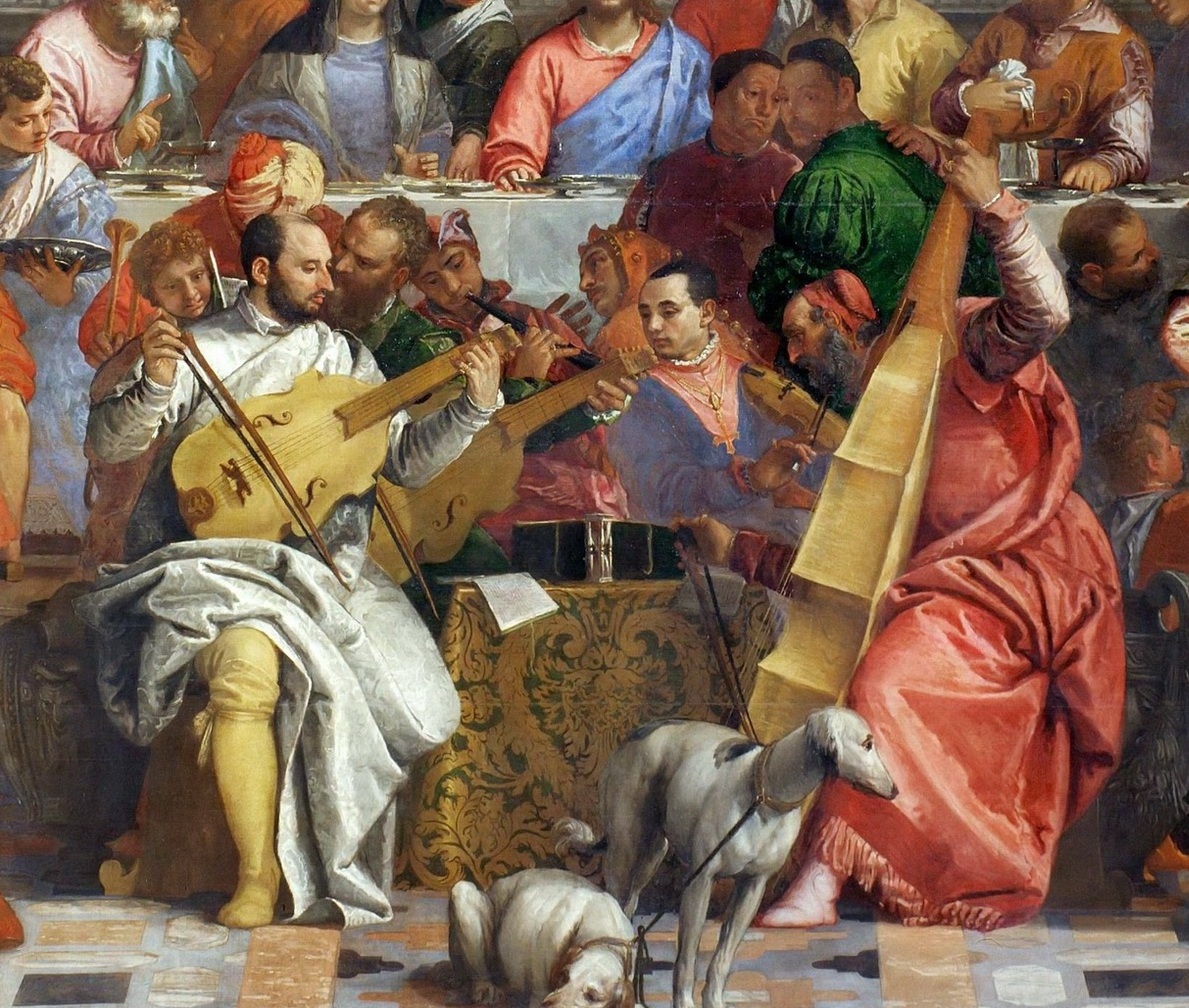
The long table wraps around an open central area. Veronese puts the musicians there, close to the edge of the canvas. Bowed and plucked instruments spread across bodies dressed in white, green, blue and red.
Hands do different kinds of work. One draws a bow, another rests against strings, and another supports an instrument’s neck. Those movements make the group feel occupied rather than merely arranged for a portrait.
Their proximity changes the imagined experience of the feast. We approach through the performers’ space, not through an empty doorway far behind the guests. A banquet that cannot make a sound nevertheless gives us enough evidence to imagine several kinds of sound at once.
Portrait identifications of the musicians as famous Venetian artists have circulated widely. Such identifications should not be treated as labels securely supplied by the painting itself. The visible relationships between player, instrument and listener remain compelling without naming every sitter.
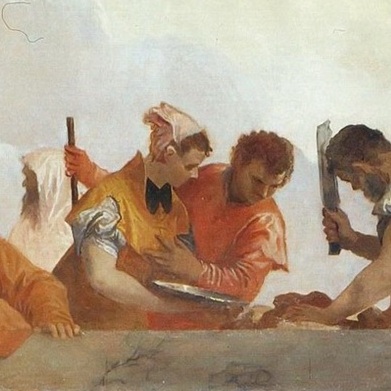
On the upper terrace, a servant works with a knife over food. His forearms lean across the preparation area while other figures remain close to the task.
This passage connects the spectacle below to the labour that supplies it. The finished meal is not an isolated display of abundance; people continue handling, carrying and preparing things elsewhere in the same architecture.
The location directly above Christ invites religious interpretation. It is reasonable to notice the visual relationship between food preparation, sacrifice and the sacred figure below. It is less responsible to assign every visible tool a fixed symbolic meaning without documentation. Veronese allows a practical action and a possible theological association to occupy the same space.
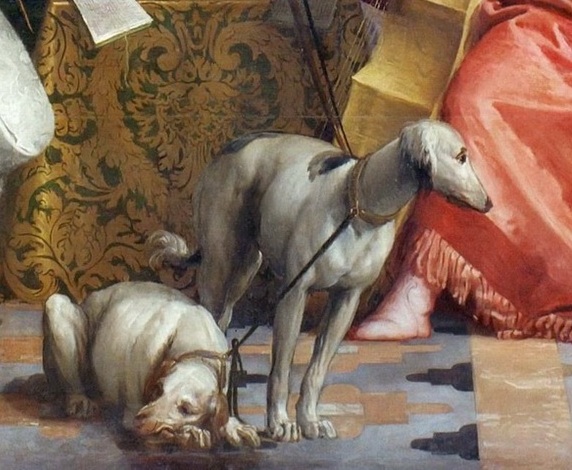
Two dogs occupy the patterned floor near the musicians. One is upright, its long legs giving it a slender outline; the other lowers its head close to the ground.
Their attention belongs to a level of the scene largely ignored by the seated guests. They introduce another scale of action beneath the long table and elaborate costumes. A viewer following their bodies briefly leaves the hierarchy of the human gathering.
These animals need not stand for one abstract quality to justify their place. They make the gathering feel inhabited beyond its central narrative. The contrast between the crouching and standing bodies also continues Veronese’s interest in small variations of posture.
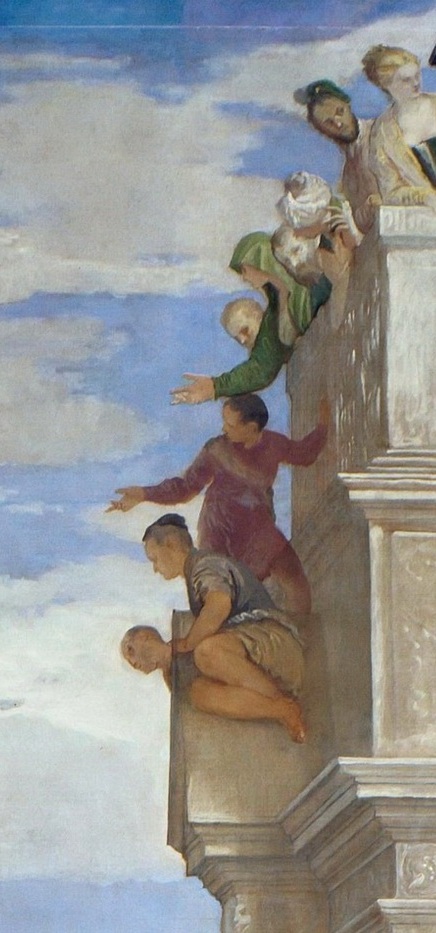
People lean from the upper openings, looking down and across the feast. Their smaller bodies give the columns and surrounding buildings an impressive scale.
The architecture guides attention along several routes. Strong verticals frame the lower gathering. A balustrade separates levels, while the open sky prevents the upper half from becoming a closed ceiling. The scene feels ordered enough to hold an enormous crowd.
This is a sixteenth-century Venetian visual world applied to a Gospel story. The contemporary richness is part of the painting’s invention. It is not an archaeological reconstruction of the marriage feast described in John.
Its intended refectory setting added another relationship. Monks dining before the canvas would encounter a painted meal beyond their own meal. The image’s scale and architecture helped extend that shared space imaginatively.
The Louvre records the painting’s removal from Venice in 1797 and its arrival in Paris in 1798 as the result of military conquest. The canvas’s present location is therefore part of its history, not the place for which Veronese designed it.
In 2007, a facsimile made by Factum Arte was installed in the Palladian refectory at San Giorgio Maggiore. The Fondazione Giorgio Cini’s account distinguishes that carefully produced facsimile from the original painting, which remains in the Louvre.
The two locations offer different kinds of encounter. Paris preserves the original canvas within a museum collection. Venice restores a sense of the relationship between the image, the dining room and its architecture. Neither fact needs to be confused with the other.
The painting itself already asks us to compare different levels of experience. A biblical sign appears within social ceremony; humble service operates beside display. Its later history adds another question about what changes when a work made for one room is encountered in another.
Paolo Veronese, also known as Paolo Caliari, painted this version in 1562 to 1563 for San Giorgio Maggiore in Venice.
It represents the wedding at Cana, where Christ changes water into wine. The servants and wine vessels help make the event visible within the banquet.
The Louvre’s collection record gives 677 centimetres in height and 994 centimetres in width, nearly ten metres across.
The original is in the Louvre. The version installed in the refectory at San Giorgio Maggiore in 2007 is a facsimile.
Paolo Veronese, The Wedding at Cana, 1562–1563. Musée du Louvre, INV 142. Public-domain historical artwork, faithful reproduction via Wikimedia Commons/Yorck Project.
Enjoyed this story?
Save articles to your collection
Log in or create a free account, and this article will be waiting in your Private Collection.
Log in or sign up
Man Writing a Letter
Gabriel Metsu, c. 1664
The gallery list
Every painting is already 50% off. Join the list and we will send you an extra $15 code, plus first access to new collections.
No spam. Unsubscribe anytime. · Privacy Policy
Welcome
Your $15 code is on its way. Explore the gallery while you wait.