Loading cart…
No products in the cart.

Original price was: $518.00.$259.00Current price is: $259.00.
Riviere renders the body of the Trojan hero Hector laid out in death, accompanied by faithful hounds that mourn beside their fallen master.
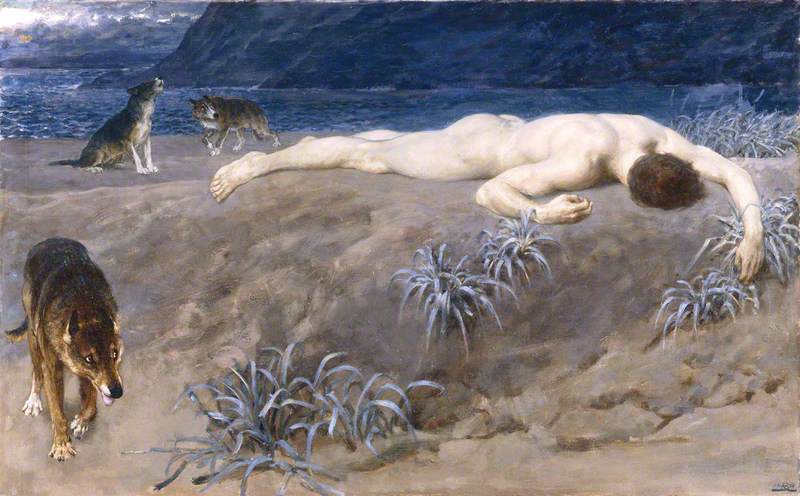
Briton Riviere’s Dead Hector, painted in 1892 and exhibited at the Royal Academy, stands as one of the most quietly affecting treatments of a classical subject in Victorian art. Rather than depicting glory or violence, Riviere turns toward stillness, grief, and the private cost of heroism, making this a painting that continues to resonate with audiences far beyond its original moment.
The scene draws from Homer’s Iliad, placing the body of the fallen Trojan champion Hector on an open plain, attended not by human mourners but by his dogs. Their lowered heads and bodies pressed close to their master communicate a grief that is instinctive and unconditional, qualities that Riviere understood animals could convey without the risk of theatrical excess. The choice transforms an epic subject into something intimate and personal, a meditation on what war takes from those who cannot comprehend its reasons.
Riviere renders Hector with careful anatomical attention, the musculature of a warrior visible even in the relaxation of death. A cool palette of greys, pale ochres, and muted earth tones runs throughout the composition, and the diffuse, even lighting resists drama in favor of solemnity. The spare background, suggesting open rocky terrain, keeps all attention on the figures in the foreground and strengthens the painting of human and animal bond at the center of the work.
Every ByMuseum reproduction of Dead Hector is created entirely by hand in oil on canvas by skilled studio artists. Each brushstroke is applied with close reference to the original held at the Lady Lever Art Gallery, preserving the texture, tonal range, and surface quality that make this work distinctive. The result is a hand-painted oil reproduction, not a print, that carries the physical presence of painting rather than the flatness of mechanical reproduction.
| artists |
|---|
Artwork guide
Explore the painting’s history, composition and meaning in the ByMuseum art guide.
Read the history and meaning of Dead HectorEmpty walls flatten a room. A classical artwork restores structure and visual hierarchy. One painting defines the space, anchors furniture, and establishes identity.
Worldwide shipping included. Each painting is produced to order and safely packed for international transport.
All payments are encrypted and processed through trusted payment providers.
Real brushwork, layered oil paint, and durable pigments on museum-quality canvas.
If the result does not meet expectations, return it for a full refund.


Your artwork is painted on premium cotton canvas, then shipped safely rolled in a rigid tube with extra blank canvas border — ready for stretching or framing locally.
Select a handcrafted frame and we’ll deliver your painting fully assembled, protected, and ready to hang.
For safe shipping, framing is available up to a maximum size. Larger sizes will automatically disable the frame option.


Choose “Stretched” to receive your canvas mounted on wooden stretcher bars — perfect if you’ll frame it later or display it as-is.
Gallery Wrap is a deeper, 1.5" style stretcher. The canvas wraps around the sides and is stapled on the back for a clean, modern, frameless look.
We ship with UPS, FedEx, or DHL straight to your door. You’ll receive a tracking number as soon as your order leaves our studio. Typical delivery is 4–5 business days after dispatch; large, framed, or stretched pieces may take longer depending on the safest shipping route.


Unframed canvases are protected with a film, carefully rolled, and secured inside a rigid shipping tube.

Stretched, Gallery Wrapped, and Framed paintings are wrapped, cushioned with foam protection, and boxed for safe transit.
Reviews
There are no reviews yet.