Loading cart…
No products in the cart.

1877 · Oil on canvas · Royal Holloway, University of London, Egham, United Kingdom
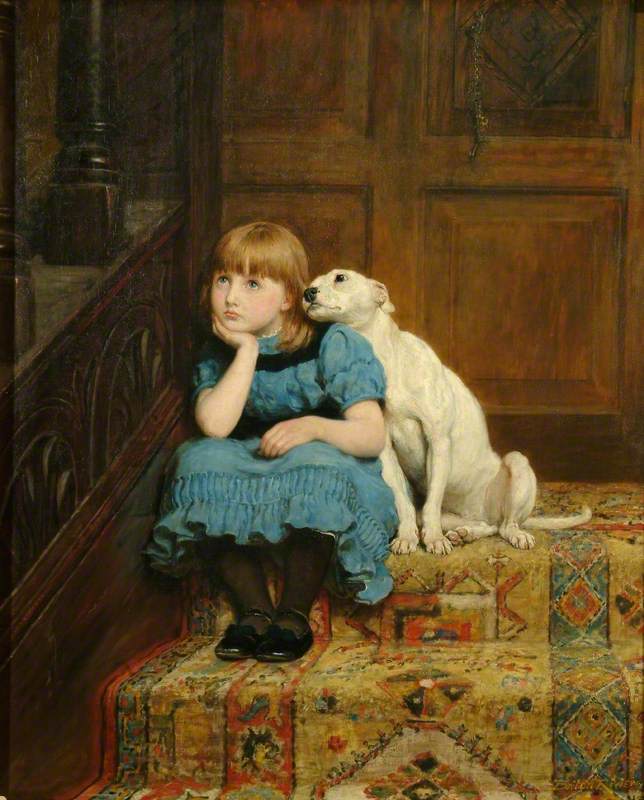
Sympathy was completed in 1877 and exhibited at the Royal Academy that same year, where it attracted immediate and widespread admiration from critics and the public alike. The painting was produced during a particularly productive period in the career of Rivière, coinciding with his election as an Associate of the Royal Academy. The work was subsequently acquired for the collection at Royal Holloway, University of London, as part of the remarkable group of Victorian paintings assembled by the college founder Thomas Holloway, who purchased significant Royal Academy exhibits with the intention of creating an uplifting and instructive gallery for students. The decision to include Sympathy in that collection speaks to the painting's standing as one of the defining images of Victorian sentiment.
The subject of the work, a young girl who has evidently been sent to sit on the stairs as a form of domestic punishment, accompanied by her loyal dog, tapped directly into the emotional preoccupations of the Victorian era. The period saw a profound cultural investment in the idea of childhood innocence and in the loyalty of pet animals as an emblem of uncomplicated devotion. Rivière had already demonstrated his ability to paint animals with extraordinary sensitivity, and in Sympathy he fused that skill with a narrative of human vulnerability to produce a scene of quiet emotional power that resonated with viewers across all social classes. The painting was reproduced widely as a photographic print during the late Victorian period and became one of the most recognisable images associated with the artist.
The composition of Sympathy is carefully constructed around a diagonal formed by the staircase, which draws the eye down from the upper left of the canvas toward the two central figures. The girl is positioned with her back slightly turned, her knees drawn up and her head resting in a posture of resignation rather than anger, suggesting vulnerability rather than defiance. The large dog presses close to her, its head tilted slightly in a gesture that reads unmistakably as concern and companionship. Rivière renders the texture of the dog with the same meticulous attention he brought to all his animal subjects, each strand of fur suggesting warmth and weight, reinforcing the physical comfort the animal offers its young mistress.
The handling of light in this painting is particularly accomplished. A soft, diffuse illumination falls across the scene from an unseen source, picking out the pale fabric of the girl's dress and the warm tones of the dog's coat against the cooler shadow of the staircase interior. This careful tonal contrast gives the image a sense of intimacy and enclosure that heightens the emotional impact. Rivière avoids the sentimental excess that might have overwhelmed a lesser painter working with such a subject, maintaining instead a restraint and naturalism that invites the viewer into the scene rather than overwhelming them with overt pathos. The result is a work of sustained technical and emotional intelligence. You can own this as a hand-painted oil reproduction through ByMuseum, capturing every nuance of light and texture in a format suited to any home.
Sympathy operates on multiple levels of meaning that speak directly to the values and anxieties of the Victorian era. On its most immediate level the painting is an image of childhood loneliness met by animal loyalty, a subject that would have resonated deeply with a society that placed enormous cultural value on the faithfulness of dogs as a model for human virtue. The dog in the painting does not judge, does not scold, and does not abandon; it simply stays, offering its physical presence as a form of unconditional comfort. This quality of animal loyalty was widely celebrated in Victorian culture, and Rivière understood how powerfully such imagery could move his audience.
At a deeper level the painting raises quietly unsettling questions about justice, power, and the emotional lives of children. The girl has been punished, placed on the staircase as a way of separating her from the warmth of domestic life, yet the dog refuses to observe that boundary. The animal crosses the divide between adult authority and childhood vulnerability to offer solidarity. This gentle subversion of the domestic order gives the painting a layer of social commentary that elevates it above simple sentiment. The lasting impact of Sympathy lies in its ability to combine superb painterly craft with a subject of genuine emotional complexity. It remains one of the most beloved works in the Royal Holloway collection and a touchstone for any discussion of Victorian narrative painting. Commission your own hand-painted oil reproduction of this iconic scene through ByMuseum and bring its quiet emotional power into your own space.