Loading cart…
No products in the cart.

$1,199.00
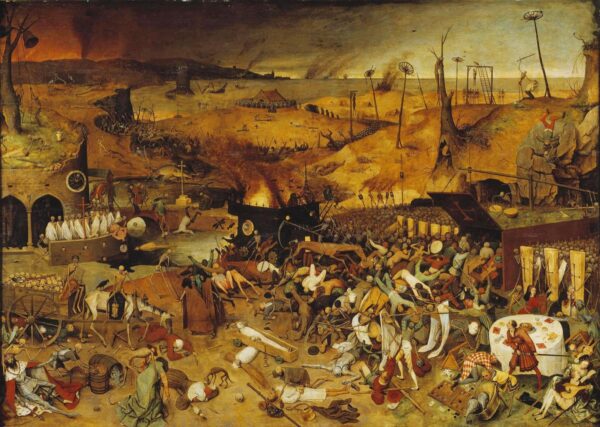
An unflinching vision of mortality rendered as a hand-painted replica: The Triumph of Death by Pieter Brueghel the Elder, painted in oil on canvas with genuine brushwork and depth.
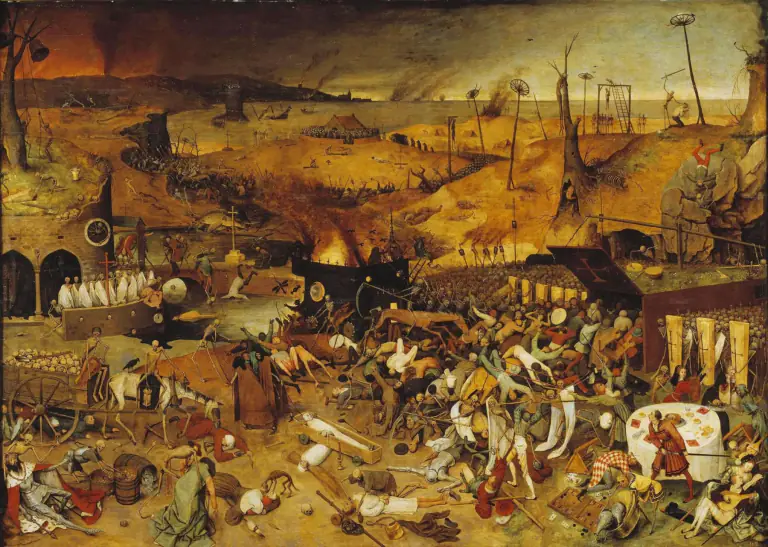
About the painting. The Triumph of Death shows an army of skeletons overrunning a burning landscape and driving the living, king, cardinal, soldier, peasant and lovers alike, into a huge coffin-lidded trap. Painted by Pieter Bruegel the Elder around 1562, it is the medieval Dance of Death remade as a panorama, and the Prado's great picture of the end of the world. Painted c. 1562. Oil on panel, 117 x 162 cm. Original in the Museo del Prado, Madrid.
An army of skeletons drives humanity toward a black coffin-shaped trap in this vision of universal ruin, painted by Pieter Brueghel the Elder at a moment when war, plague, and religious upheaval had made mortality an everyday presence in the Low Countries. No rank escapes: kings, cardinals, lovers, and beggars are herded together across a scorched landscape, and it was this refusal to spare anyone, however powerful, that seems to have gripped the artist as he built the scene.
The composition unfolds as a vast frieze of incident rather than a single dramatic focus. A blasted horizon of dead trees, burning ships, and distant gallows sets a tone of exhausted desolation, while skeleton armies advance with military discipline, pushing the living into a coffin lid held open like a trap door. Brueghel controls the eye through a low, ashen palette punctuated by small passages of red and white, so that the composition reads first as an overwhelming mass and only gradually resolves into dozens of separate, terrible stories.
Working in the tradition of Netherlandish panel painting, Brueghel handles the surface with the fine, exacting brushwork typical of his early career, when he was still closely tied to the graphic precision of print design. Figures no larger than a fingernail are rendered with individual gestures and expressions, evidence of a technique built on patient, almost miniaturist observation even within a composition of this scale. Our studio approaches the same challenge by hand: a trained painter builds up the picture in oil on canvas, layer by layer, matching the cool greys and smoky ochres of the original while preserving the texture of real brushwork across the crowded surface. The result is a hand-painted oil painting reproduction, not a mechanically produced replica painting, so the canvas carries genuine paint depth rather than a flat printed surface.
Hung in a room with good light, the painting rewards a slow, returning eye. Details that pass unnoticed at first, a drowning man, a card game interrupted, a fool hiding under a table, surface on later viewings, and the picture keeps offering new incident long after the first impression has settled.
Artwork guide
Explore the painting’s history, composition and meaning in the ByMuseum art guide.
Read the history and meaning of The Triumph of Death by BruegelEmpty walls flatten a room. A classical artwork restores structure and visual hierarchy. One painting defines the space, anchors furniture, and establishes identity.
Worldwide shipping included. Each painting is produced to order and safely packed for international transport.
All payments are encrypted and processed through trusted payment providers.
Real brushwork, layered oil paint, and durable pigments on museum-quality canvas.
If the result does not meet expectations, return it for a full refund.


Your artwork is painted on premium cotton canvas, then shipped safely rolled in a rigid tube with extra blank canvas border — ready for stretching or framing locally.
Select a handcrafted frame and we’ll deliver your painting fully assembled, protected, and ready to hang.
For safe shipping, framing is available up to a maximum size. Larger sizes will automatically disable the frame option.


Choose “Stretched” to receive your canvas mounted on wooden stretcher bars — perfect if you’ll frame it later or display it as-is.
Gallery Wrap is a deeper, 1.5" style stretcher. The canvas wraps around the sides and is stapled on the back for a clean, modern, frameless look.
We ship with UPS, FedEx, or DHL straight to your door. You’ll receive a tracking number as soon as your order leaves our studio. Typical delivery is 5 to 7 days after dispatch; large, framed, or stretched pieces may take longer depending on the safest shipping route.


Unframed canvases are protected with a film, carefully rolled, and secured inside a rigid shipping tube.

Stretched, Gallery Wrapped, and Framed paintings are wrapped, cushioned with foam protection, and boxed for safe transit.

Man Writing a Letter
Gabriel Metsu, c. 1664
The gallery list
Every painting is already 50% off. Join the list and we will send you an extra $15 code, plus first access to new collections.
No spam. Unsubscribe anytime. · Privacy Policy
Welcome
Your $15 code is on its way. Explore the gallery while you wait.