Loading cart…
No products in the cart.

c. 1562 · Oil on panel · Museo del Prado, Madrid
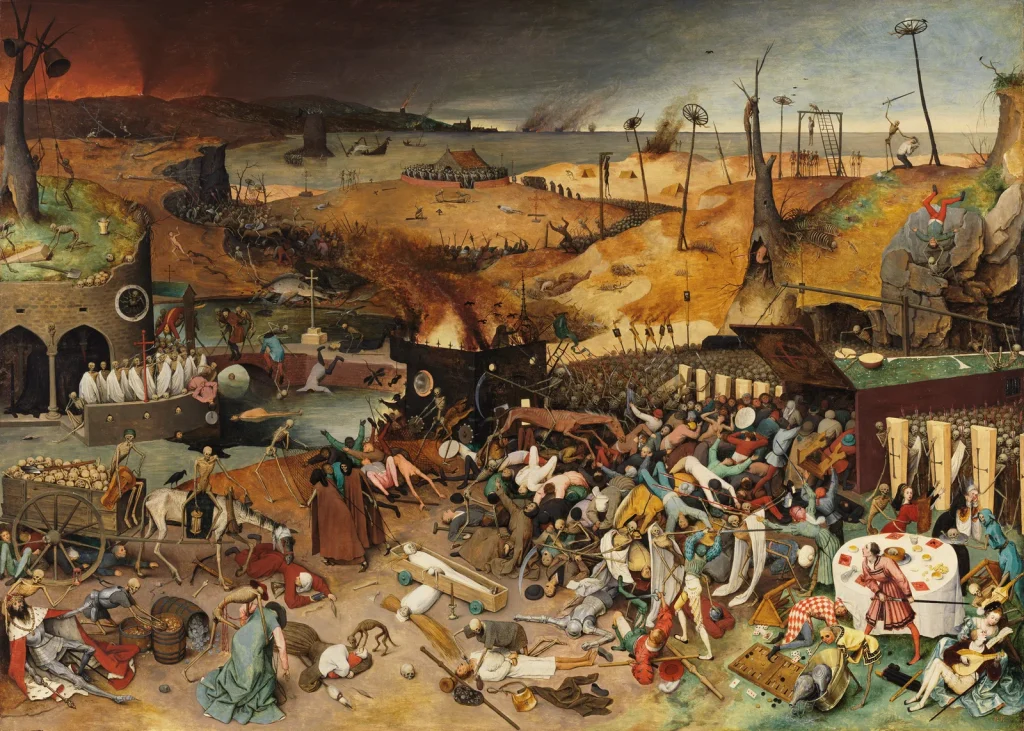
An army of skeletons has come over the hill and is killing everyone. Not a village, not a city: everyone. The king with his gold, the cardinal in his red, the soldier with his sword, the peasant with his cart, the lovers with their lute, the dinner party with its cards. The ships are burning, the fields are burning, the bells are ringing, and the living are being driven into a huge box with a coffin lid for a door. There is no hero, no hope and no exit. It is one of the most cheerful paintings you will ever see.
That is not a joke. Bruegel painted the end of the world with such energy, invention and black humour that people have been standing in front of it grinning for four hundred and sixty years. The Triumph of Death is the medieval Dance of Death, the plague, the wars of religion and Bosch's hell, put through one man's imagination on one panel a metre and a half wide.
In the centre a skeleton on a thin red horse swings a scythe through the crowd, herding the living toward the trap on the right. Behind him another skeleton drives a cart piled with skulls, pulled by a bony nag, with a bell hanging from it. This is Death from the Book of Revelation, the rider on the pale horse, and Bruegel has given him a colour that is not pale at all.
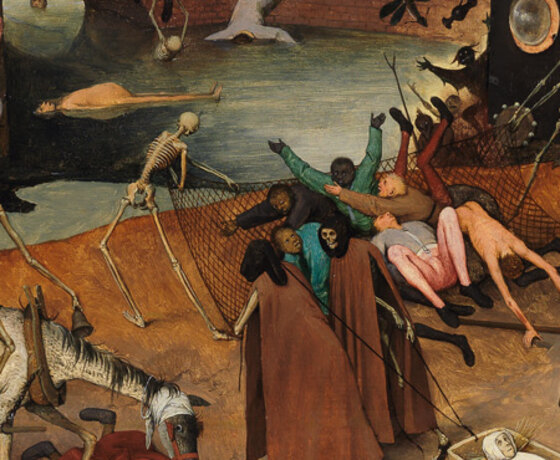
Look at how the crowd moves. Everyone is running the same way, toward the right, toward the box with the crosses on it, and the skeletons form a wall of coffin-lid shields to stop them going anywhere else. There are more skeletons than people. That is the point.
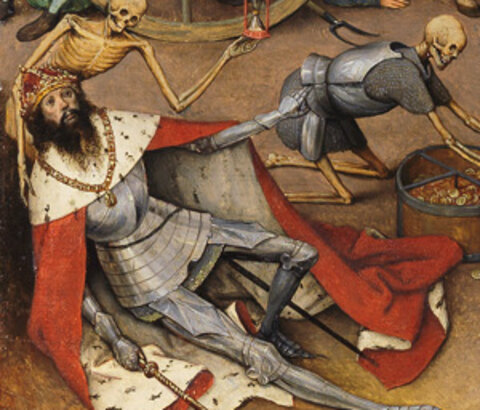
Bottom left, a king in ermine and armour is going down. One skeleton holds an hourglass in front of his face: your time is up. Another has its arm in his barrel of gold coins. Beside him a cardinal in red is being helped along by a skeleton wearing a cardinal's hat of its own, which is the kind of joke Bruegel could not resist.
This is the oldest idea in the picture, the Dance of Death that had been painted on church walls since the Black Death: the skeleton comes for the pope, the emperor, the merchant and the ploughman alike, and their rank does not help. Bruegel keeps the idea and drops the dance. His skeletons do not lead the living by the hand. They mow them down.
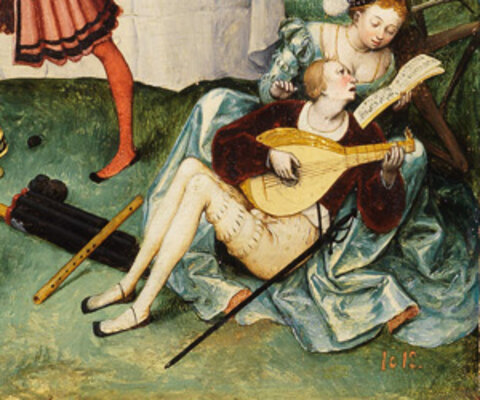
In the bottom right corner, out of the crowd, a young man in a striped doublet plays the lute while a girl sings from the music on her lap. Behind them, unseen, a skeleton is playing a fiddle along with the tune. They are the only people in the painting who have not noticed what is happening. In a minute they will.
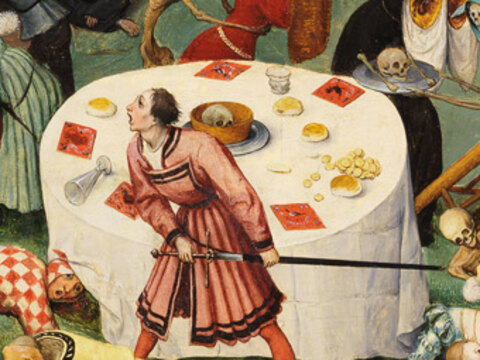
Next to them the dinner table has gone over, with the cards and the dice and the backgammon board, and a jester is crawling underneath it to hide. A soldier has drawn his sword to fight, which is brave and useless. A skeleton in a mask carries in a dish with a skull on it. Bruegel fills the corner with the pleasures people were enjoying when Death arrived: music, love, wine, gambling, dinner. He is not saying they were wrong to enjoy them. He is saying it did not matter.
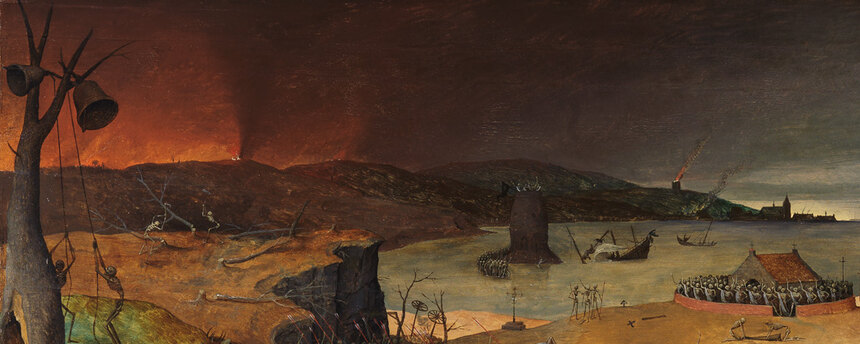
Above the crowd the whole country is dying. Ships burn on a black sea. A city smokes on the horizon. A man hangs from a gallows, another is broken on a wheel on a pole, and skeletons ring the bells of a ruined church. A skeleton army marches in the distance. The trees are dead. Even the sky is the colour of ash.
Bruegel painted this around 1562, in Antwerp, the richest city in northern Europe, with the plague never far away, Spanish troops in the Netherlands and the wars of religion beginning. His viewers did not need the picture explained. They had seen most of it. What they had not seen was all of it at once, in a single sweep, with the skeletons winning.
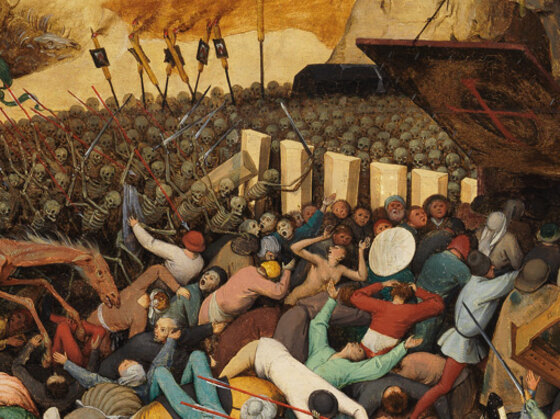
On the simplest level it is a sermon: death comes for everyone and nothing you own will help. Every medieval viewer knew that. What Bruegel adds is scale and glee. The painting is not sad. It is a spectacle, a carnival of endings, and its energy is the energy of someone who found the end of the world interesting.
That is also why it has meant so much to people in bad centuries. It was painted under the shadow of religious war and looked at, four hundred years later, in the shadow of the atomic bomb. Artists from Bosch's heirs to the Surrealists have raided it; heavy metal has taken it for album covers; horror films have quoted its skeleton army. It is the great picture of catastrophe because it refuses to look away, and because it is, in some indefensible way, fun.
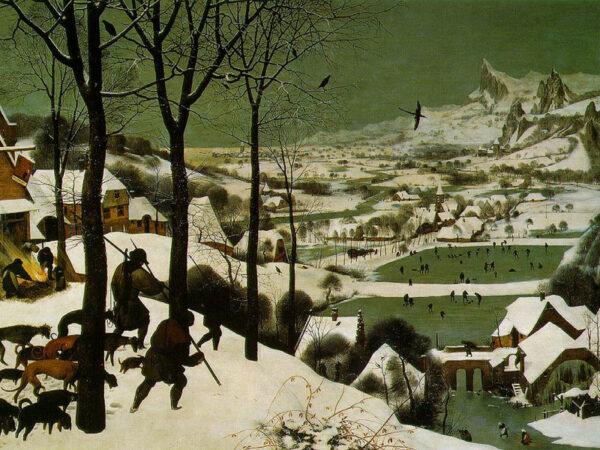
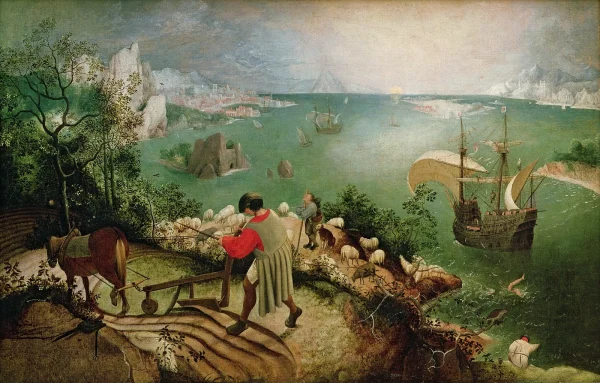
Bruegel painted very differently the next year: The Hunters in the Snow, the calmest picture of winter ever made, and the Fall of Icarus, where one death goes unnoticed in a peaceful world. Same painter, same decade. The Triumph of Death is what happens when nobody gets to plough.
In the Museo del Prado in Madrid, which has owned it since 1827, in the same building as Bosch's Garden of Earthly Delights and Goya's Black Paintings, which makes the Prado the world's best museum for the end of the world. It is oil on panel, 117 by 162 centimetres, and it was cleaned in 2018, which brought back the colours: the red of Death's horse, the pink of the sky, the green of the dying grass.
It is not a painting for every room, and the people who order it know that. It goes in studies, games rooms and the homes of people who like to be asked what on earth that is. Our hand-painted reproduction of The Triumph of Death is painted in oil on canvas from the Prado composition, and it is one of the most detailed pictures our painters take on: several hundred figures, each of them doing something. Give it a wide wall, a plain dark frame and a light, so that visitors can find the lute player.
More Bruegel in our Pieter Bruegel the Elder collection, and the wider Northern Renaissance archive.
Visible details, documented facts and interpretation are kept separate throughout this article.