Loading cart…
No products in the cart.

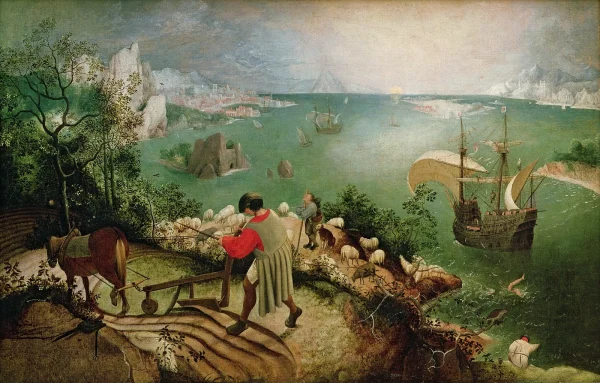
c. 1560 · Oil on canvas · Royal Museums of Fine Arts of Belgium, Brussels
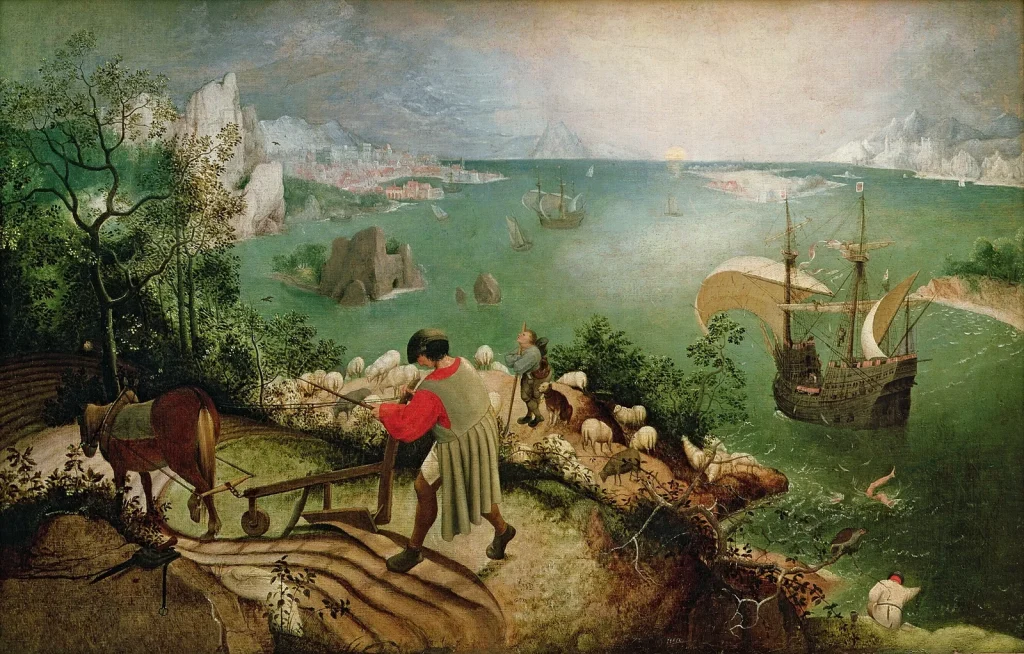
In December 1938 the poet W. H. Auden spent a few weeks in Brussels and went to the Royal Museums of Fine Arts. He stood in front of this painting and came away with a poem, "Musée des Beaux Arts", that begins with the line "About suffering they were never wrong, / The Old Masters". It is the most famous poem ever written about a painting, and it is why most people outside Belgium have heard of this one.
Auden's point was simple. In the old paintings, terrible things happen while everyone else gets on with the day: someone is having a meal, someone is at a window, the dogs carry on being dogs. And in Bruegel's Icarus, he noticed, everyone and everything turns away from the disaster without any hurry.
He was describing exactly what you will see. But the painting was doing it four hundred years before he arrived, and it has more in it than the poem lets on.
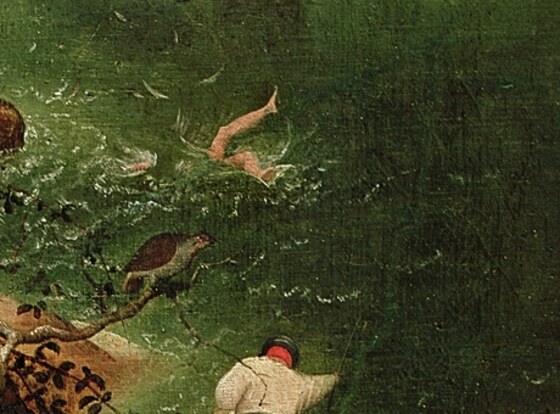
Most people look at this painting for a full minute before they find him. A ploughman works a hillside. A shepherd leans on his staff and looks at the sky. A ship sails out of a bay under a sun that is already low. Then, in the bottom right corner, beside the ship, a pair of pale legs stick out of the green water and a few feathers drift down.
That is Icarus. Look at how little Bruegel gives him: no face, no wings, no Daedalus circling overhead. The son of the man who built the Labyrinth is drowning in the corner of a landscape, and the landscape is not about him.
The story comes from Ovid. Daedalus made wings of feathers and wax so that he and his son could escape from Crete, and warned the boy not to fly too high. Icarus flew too high, the sun melted the wax, and he fell into the sea that still carries his name. Every painter before Bruegel who touched the subject painted the fall. Bruegel painted the world going on without it.
Bruegel read his Ovid closely. In the Metamorphoses, as father and son fly over the sea, three people on the ground look up:
Someone catching fish with a trembling rod, a shepherd leaning on his staff, a ploughman resting on his plough: each saw them and stood amazed, and took them for gods who could travel through the air.
Ovid, Metamorphoses, Book VIII
Bruegel kept all three, and took away the amazement.
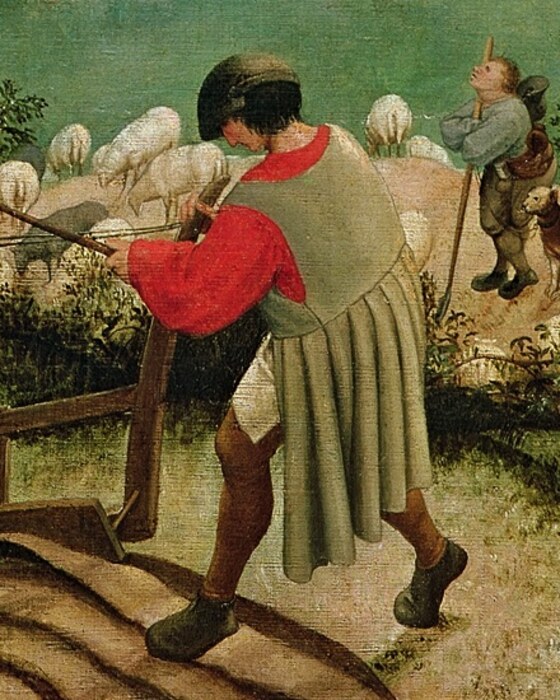
The ploughman is the biggest thing in the picture, bigger than the ship, far bigger than Icarus. His red shirt pulls the eye to him first. He is cutting neat terraces across the hillside, and the furrows lead the eye downhill, past the shepherd, past the ship, to the corner where the boy is dying. He never looks up.
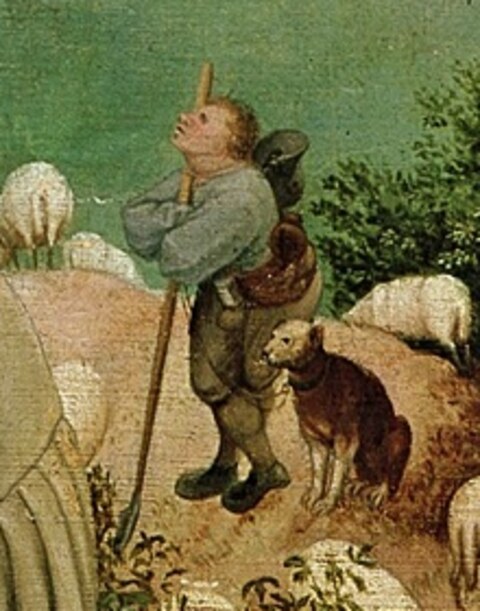
The shepherd does look up. But he is looking to the left, away from the splash, at an empty patch of sky. A second version of the composition, in the Van Buuren Museum across town, shows Daedalus flying exactly where he is looking. In the Royal Museums' version Daedalus has been left out, and the shepherd's gaze goes nowhere.
And the angler, closest of all to the drowning boy, watches his float.
Two details are easy to miss and change the picture once you know them.
On the branch above the angler sits a partridge. In Ovid it is Perdix, Daedalus's nephew and apprentice, who invented the saw and the compass and was so gifted that Daedalus, jealous, pushed him off the Acropolis. Athena turned the boy into a partridge as he fell. In the poem, Perdix watches Daedalus bury his son and is glad. Bruegel put the bird there for readers who would understand that the father's crime has come home.
The second detail is harder. In the bushes at the far left, under the trees, a few viewers make out the top of a bald head: a dead man lying in the undergrowth. Not everyone agrees it is there. If it is, it points to the Flemish proverb behind the whole picture: no plough stops for a man who is dying.
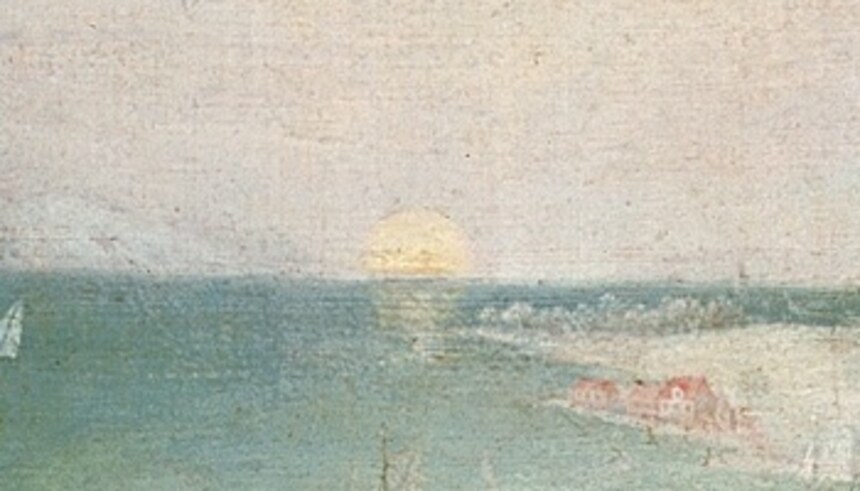
Icarus fell because he flew too near the sun at midday. In the painting the sun sits on the horizon, going down. Bruegel is not illustrating the moment of the fall. He is painting the whole day, and the fall is one thing that happened in it, hours ago or just now, it does not matter.
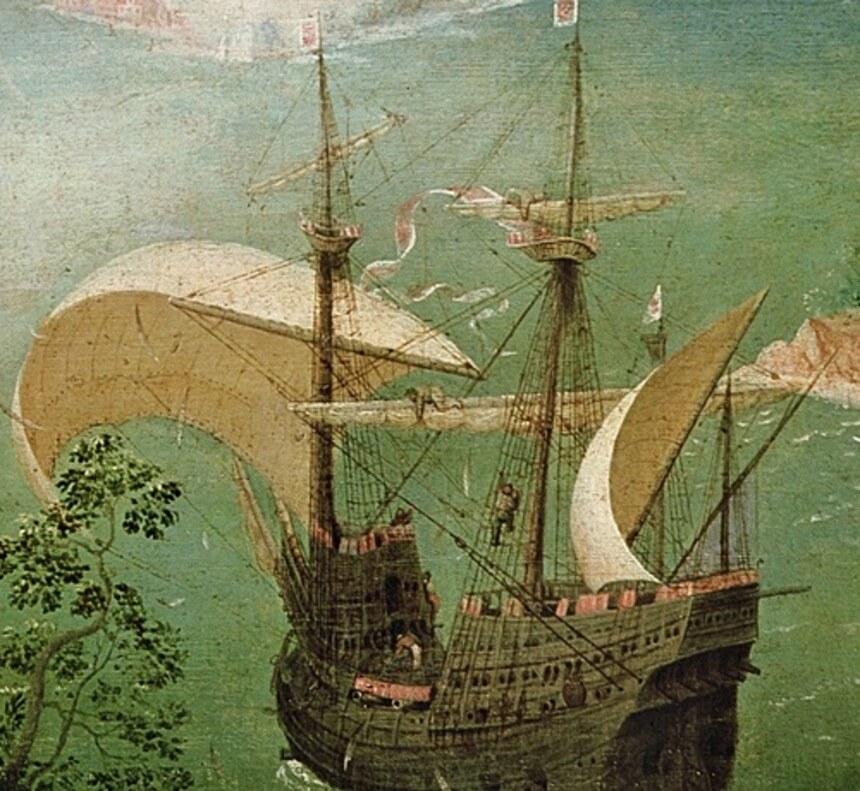
The ship is the second-largest object in the painting, drawn with the care of a man who had studied real ships in Antwerp harbour, and it faces away from Icarus, out toward the low sun and the pale city on the far shore. Everything with mass and purpose in this picture is moving away from the tragedy.
That far distance, green glass water, cliffs, towers, mountains dissolving into light, is not a real place. Bruegel had crossed the Alps and seen the Mediterranean on his way to Italy in the early 1550s. He combined what he remembered into a coast that exists nowhere.
Auden's reading, that suffering happens in a corner while life goes on, is the one everyone knows, and it is true. But a Flemish viewer in 1560 would have read it the other way round.
Icarus was warned. He flew too high, and he paid. The ploughman, the shepherd and the angler are doing their jobs, and the picture is on their side. This is a painting about ambition and its price, made in a culture that prized work and distrusted people who flew too high. The proverb about the plough is not a complaint about indifference. It is advice.
And there is a third meaning, which is about looking. The painting hides its own subject and makes you hunt for it. Once you have found the legs you cannot stop seeing them, and the calm landscape becomes something else. Bruegel shows you how easy it is to miss what matters by making you miss it.
William Carlos Williams wrote his own short poem about the picture in 1960, and it ends on the word "drowning", after which there is nothing. Between Auden and Williams the painting has become the standard image for a truth people would rather not hear: that the world does not stop.
To see how strange Bruegel's choice was, look at what other painters did with the same story.
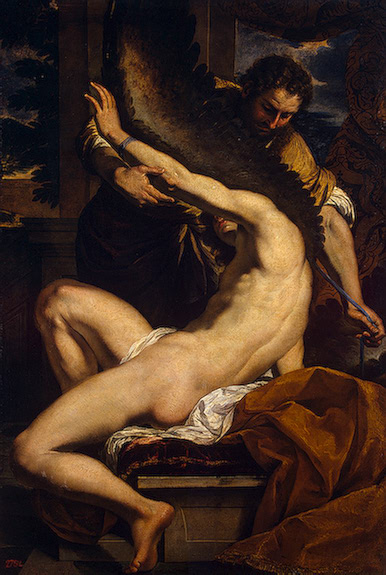
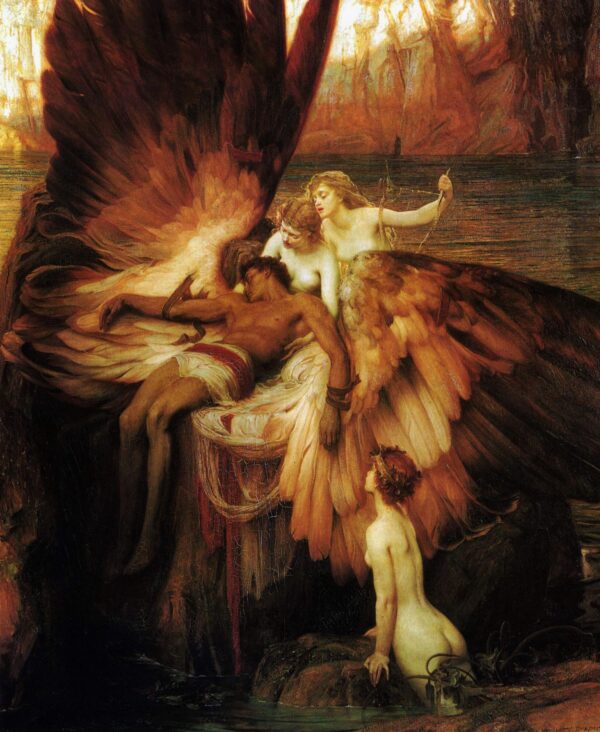
Charles Le Brun, in the seventeenth century, painted Daedalus and Icarus as the moment before: the father fastening the wings on the boy's back. Frederic Leighton, in 1869, painted the same scene on a sunlit tower, with Icarus already looking at the sky. And Herbert Draper's Lament for Icarus of 1898 gives the ending everyone expects: the beautiful dead boy laid out on a rock, his great wings spread, nymphs weeping over him.
Each of them makes Icarus the centre of the picture. Bruegel is the only one who asked what it would look like if nobody cared, and his is the version that lasted.
This is the awkward question and it deserves a straight answer: probably not this canvas.
The painting in Brussels is oil on canvas, which is unusual for Bruegel, who worked on wood panel. It is not signed or dated. Technical examination in 1996 found materials and handling that point to a date after Bruegel's death in 1569. The Royal Museums of Fine Arts of Belgium now describe it as a copy, probably made around 1600, after a lost original by Bruegel of about 1558.
The composition is Bruegel's. The invention, the proverb, the hidden legs, the ship and the sun are his. The hand that painted the canvas we can see was most likely someone else's, working from his original or from a good copy of it. That is why you will find it listed as "Bruegel", "after Bruegel" and "attributed to Bruegel" depending on the book, and why it is the only mythological subject connected with a painter who otherwise painted peasants, proverbs, seasons and the Bible.
None of this changes what the picture does. Auden did not know, and it did not matter.
The painting is in the Royal Museums of Fine Arts of Belgium in Brussels, in the Old Masters Museum, inventory number 4030. It is oil on canvas, 73.5 by 112 centimetres, bought by the museum in 1912. The Van Buuren version, with Daedalus in the sky, is a short tram ride away.
It is a small painting full of small things, and it rewards a reproduction at or above the original size, where the legs, the partridge and the head in the bushes can be found the way Bruegel meant them to be. Our hand-painted reproduction of Landscape with the Fall of Icarus is painted in oil on canvas from the Brussels composition. Hang it with the bottom right corner at eye level. That is where the story is.
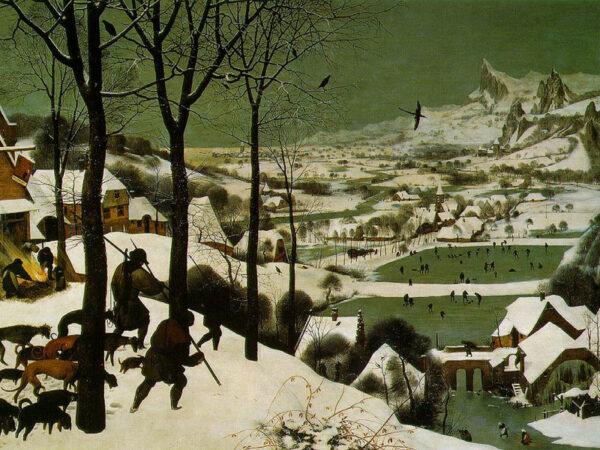
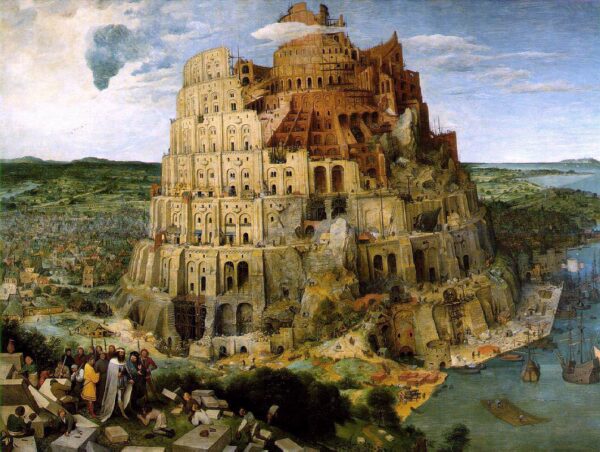
More Bruegel, and the painting itself, from our Pieter Bruegel the Elder collection:
Visible details, documented facts and interpretation are kept separate throughout this article. The attribution is reported as the museum currently states it.