Loading cart…
No products in the cart.

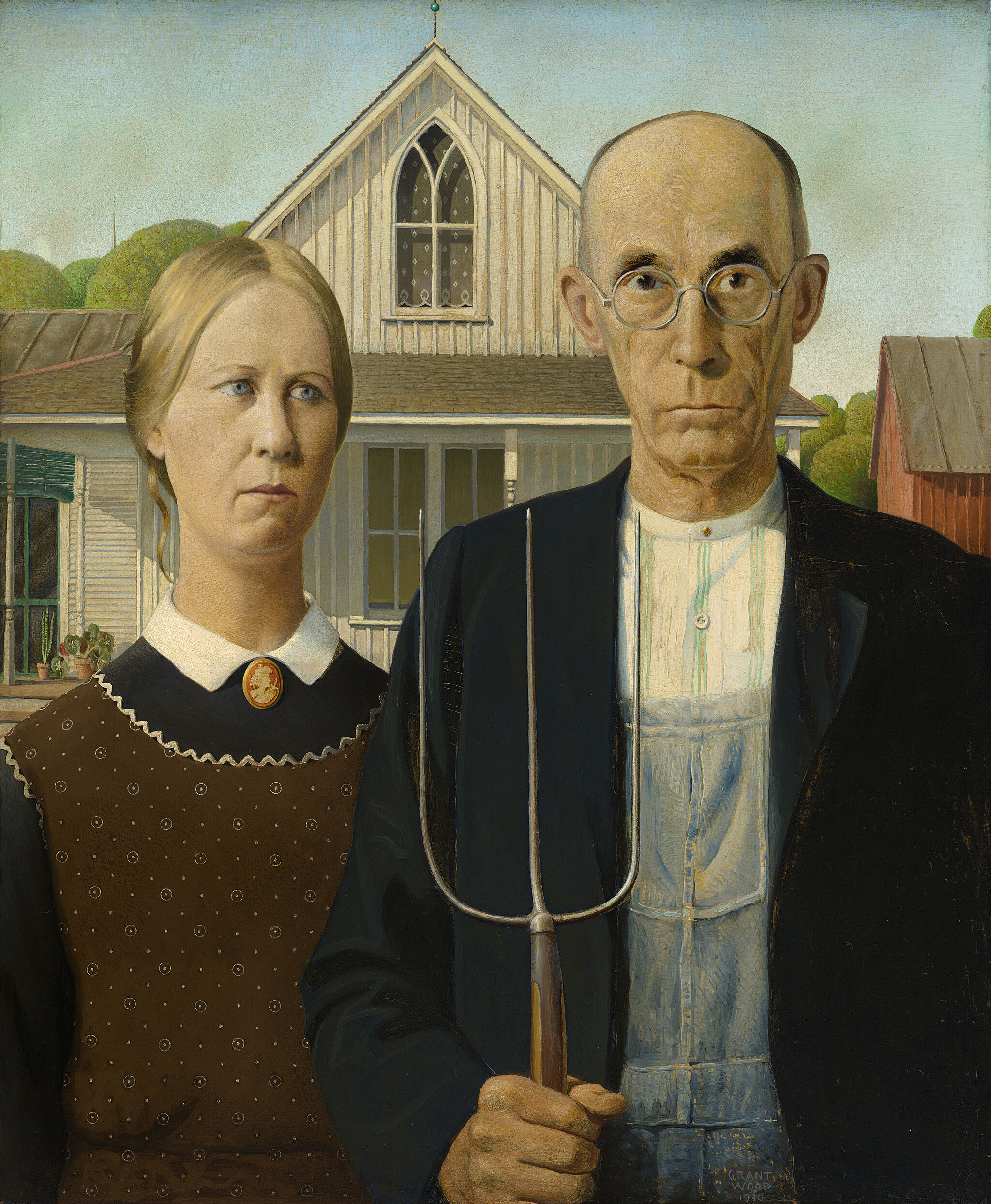
1930 · Oil on beaverboard · Art Institute of Chicago, Chicago, United States
Save articles to your collection
Log in or create a free account, and this article will be waiting in your Private Collection.
Log in or sign upGrant Wood painted American Gothic in 1930 after spotting a small Gothic Revival cottage with a distinctive pointed window in Eldon, Iowa. Struck by the visual contrast between the delicate Carpenter Gothic architecture and the rugged practicality of the rural Midwest, he decided to imagine the kind of people who might inhabit such a place. He posed his sister, Nan Wood Graham, and his dentist, Dr. Byron McKeeby, as his models, dressing them in period-appropriate clothing drawn from nineteenth-century American life. The pitchfork held by the male figure was a deliberate compositional choice, its vertical tines rhyming with the Gothic window above and reinforcing the upright, unyielding posture of both subjects. Wood submitted the finished painting to the Art Institute of Chicago for its annual exhibition that same year, where it won a bronze medal and a three-hundred-dollar prize. The Art Institute subsequently purchased the work for its permanent collection, where it has remained ever since. The reception of the painting was immediate and polarizing. Some Midwesterners took offense at what they perceived as a mockery of rural people, reading the tight-lipped figures as caricatures of provincial narrowness. Wood consistently maintained that his intent was affectionate rather than satirical, arguing that he admired the stoic endurance these figures represented. Regardless of that debate, the painting rapidly entered American popular consciousness. Within years of its creation it was being reproduced, parodied, and referenced in ways that no single artwork had been in the United States since Gilbert Stuart rendered the face of George Washington. Today it remains one of the most recognized paintings in the world, and its power to provoke reflection on American identity has not diminished in the decades since Wood set down his brush.
The composition of American Gothic is governed by a strict vertical axis that runs from the tip of the pitchfork through the shirt seam of the male figure and upward to the pointed Gothic window above the roofline. This central spine gives the image an almost heraldic stability, as if the two figures and the architecture behind them form a single unified emblem rather than a casual scene. The woman is positioned slightly to the right and behind the man, her gaze directed off to one side, while the man looks directly outward at the viewer with an expression that is simultaneously guarded and unflinching. The asymmetry of their gazes creates a subtle psychological tension within an otherwise severely balanced design. Wood applied paint to beaverboard with the painstaking care he had absorbed from studying Flemish masters in Europe. Every stitch in the rickrack trim of the woman dress, every tine of the pitchfork, and every clapboard of the farmhouse is rendered with a precision that borders on the obsessive. The surface is smooth and enamel-like, with no visible brushwork to interrupt the illusion of presence. Colors are restrained and predominantly cool, with the crisp white of the house, the dark tones of the figures clothing, and the muted greens of the plants at the edges of the frame creating an atmosphere of austere dignity. This technical discipline transforms what might have been a genre scene into something closer to an icon. To own this as a hand-painted oil reproduction is to bring one of the defining images of American visual culture into your own space, rendered with the care and materiality the original deserves.
American Gothic carries a layered cultural meaning that has evolved continuously since its creation. On its surface it depicts two people, commonly assumed to be husband and wife though Wood himself described them as father and daughter, standing before their home with an air of steadfast self-possession. At this level the painting reads as a tribute to the Puritan work ethic and the stoic resilience that American mythology associates with frontier settlement and agricultural life. The upright postures, the direct gaze, and the firm grip on the pitchfork all speak to values of duty, endurance, and unadorned practicality that Wood clearly found worthy of serious artistic attention. Beyond this surface reading, the painting has served as a mirror in which successive generations of Americans have seen their own preoccupations reflected. During the Great Depression, when it first rose to national prominence, it resonated as a document of tenacity in the face of hardship. In later decades it became a template for parody and social commentary, its instantly recognizable composition adapted to comment on politics, gender, regional identity, and cultural change. This adaptability is itself a mark of the depth of the original image. A work this widely quoted, this persistently relevant, and this deeply embedded in collective memory earns its place at the center of any serious engagement with American visual history. Acquiring a hand-painted oil reproduction of American Gothic means owning a work that continues to generate meaning and conversation wherever it is displayed.
Enjoyed this story?
Save articles to your collection
Log in or create a free account, and this article will be waiting in your Private Collection.
Log in or sign up