Loading cart…
No products in the cart.

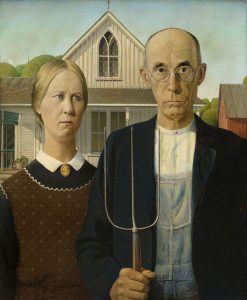
Grant Wood stands today as one of the most recognizable voices in the history of American art. His image of a pitchfork-holding farmer and a stern-faced woman, rendered in crisp and unsparing detail, has become a universal visual shorthand for…
Save articles to your collection
Log in or create a free account, and this article will be waiting in your Private Collection.
Log in or sign upGrant Wood stands today as one of the most recognizable voices in the history of American art. His image of a pitchfork-holding farmer and a stern-faced woman, rendered in crisp and unsparing detail, has become a universal visual shorthand for rural American identity. Reproduced in advertisements, satirized in films, and referenced in popular culture across every decade since its creation, American Gothic is among the handful of paintings that virtually any viewer in the world can identify on sight. Beyond that single iconic work, Wood shaped an entire movement, giving American Regionalism a visual grammar rooted in the rolling hills, hardworking people, and quiet rhythms of the Midwest. Museums and collectors prize his paintings for their technical discipline, their warmth of feeling, and their ability to transform the ordinary landscape of the American heartland into something both monumental and intimate. His legacy endures in art education curricula, in the collections of major American institutions, and in the imagination of anyone who has ever stood before a wide Iowa horizon and felt the weight of the land.
That legacy was built through a life of persistent self-invention and deep attachment to place. Wood was born in 1891 in Anamosa, Iowa, and spent much of his childhood absorbing the textures and rhythms of rural life after his father died and the family relocated to Cedar Rapids. He studied at the Art Institute of Chicago and made multiple trips to Europe, where the Flemish and Northern Renaissance masters profoundly reshaped his approach to painting. The meticulous surfaces, rounded forms, and jewel-like clarity he observed in the work of van Eyck and Memling became the foundation of his mature style. Returning to Iowa with a newly sharpened visual language, he committed himself to painting the world he knew best. Through the 1930s he produced a sustained body of work that celebrated and occasionally gently satirized Midwestern life, earning both national fame and the devoted support of his community. He taught at the University of Iowa and remained a central figure in American cultural life until his death from pancreatic cancer in 1942, just one day before his fifty-first birthday.
The technique of Grant Wood is immediately legible as something singular in American painting. Working primarily in oil, he developed a surface of extraordinary smoothness and precision, building up layers of paint to achieve a near-enamel finish reminiscent of the Northern European masters he admired during his travels in Germany and the Low Countries. His brushwork is largely invisible at normal viewing distances, subsumed into a seamless, almost porcelain-like skin of color. Contours are firm and deliberate, shapes are simplified into gently swelling volumes that suggest solidity and permanence, and every element within a composition is rendered with equal attentiveness. Hills become rounded ribbons of green, trees resolve into perfect spherical masses, and human faces acquire a quality somewhere between portraiture and archetype. This stylization is never careless. It reflects a conscious artistic decision to distill the visible world into its essential forms, much as a medieval illuminator might condense a landscape into a pattern of symbolic clarity.
Wood handled color with equal care and intention. His palettes tend toward the warm and saturated, favoring golden yellows, deep greens, and rich earth tones that evoke the agricultural abundance of the Midwest without tipping into sentimentality. Skies in his landscapes are often immaculate, painted in clear high-keyed blues that press down against the curved horizon with a kind of compressed energy. In his figure paintings, flesh tones are modeled with the deliberate, almost sculptural attention he gave to the land itself, treating human subjects as natural formations embedded in their environment. Light in his work is diffuse and even, rarely dramatic, which reinforces the sense of stillness and permanence that defines his vision. This combination of technical rigor, formal clarity, and quiet emotional depth gives the paintings of Grant Wood a presence that rewards sustained looking and makes them ideal subjects for hand-painted oil reproduction.
Each card links to its own article with full analysis and reproduction details.
 #1
#1
A print can reproduce colors. What it cannot reproduce is texture, depth, and the physical presence of oil paint on canvas. Grant Wood technique depends on these.
At ByMuseum, every reproduction is painted by hand using oil on canvas. There is no inkjet, no digital print. The brushwork is real. The result looks like a painting because it is one.
Enjoyed this story?
Save articles to your collection
Log in or create a free account, and this article will be waiting in your Private Collection.
Log in or sign up