Loading cart…
No products in the cart.

1866 · Watercolour (catalogued variously) · Private collection
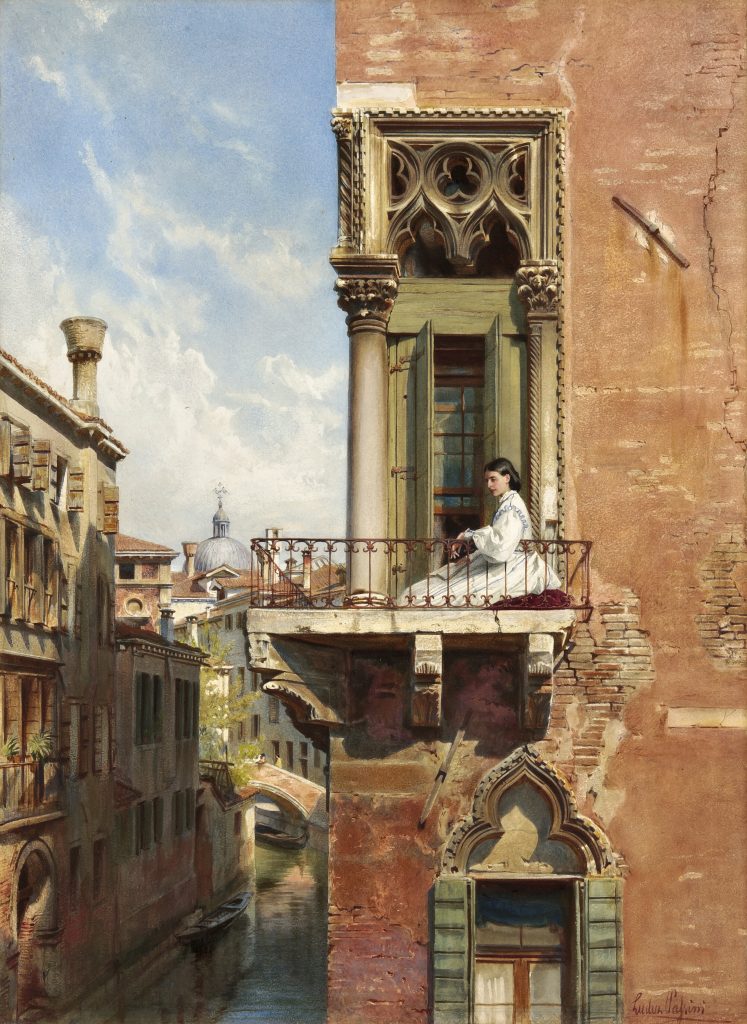
A young woman in a white dress sits on a red cushion on a stone balcony high above a Venetian canal, and looks down. That is all that happens. Below her the water is green and still, a small boat is tied up, a bridge crosses at the end of the canal, and the sun is on the houses opposite. She is not posing. She has come out to sit in the air, and the painter has caught her doing it.
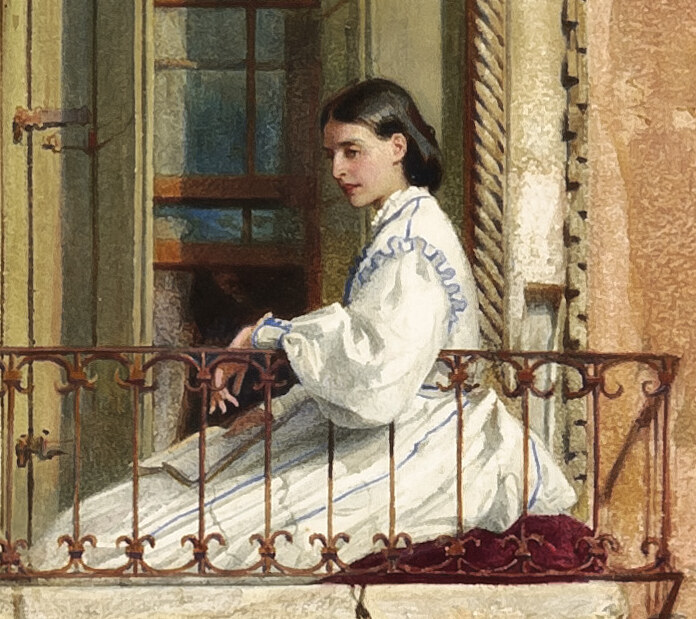
The painter was her husband. The balcony was their home. And the year, 1866, was the last year of her life. None of that is in the picture, which is why the picture is so moving once you know it.
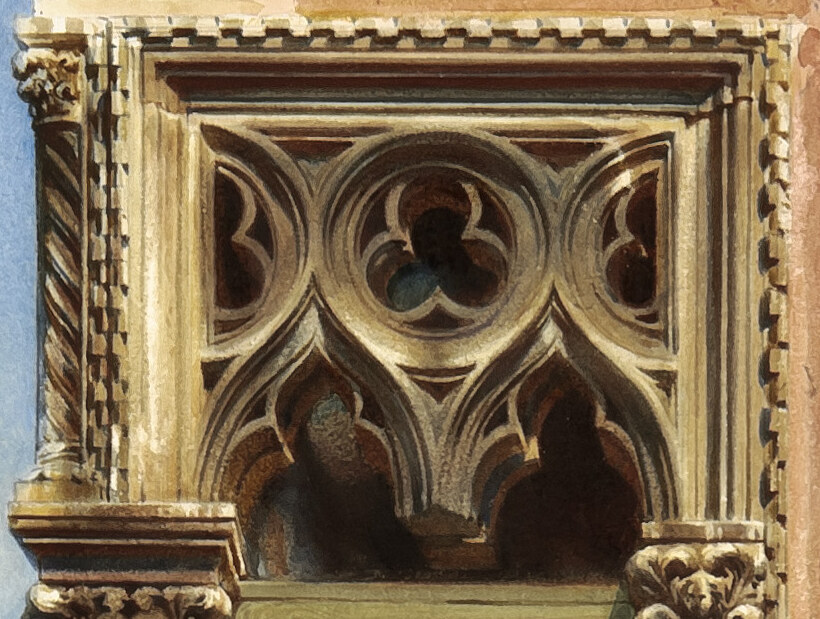
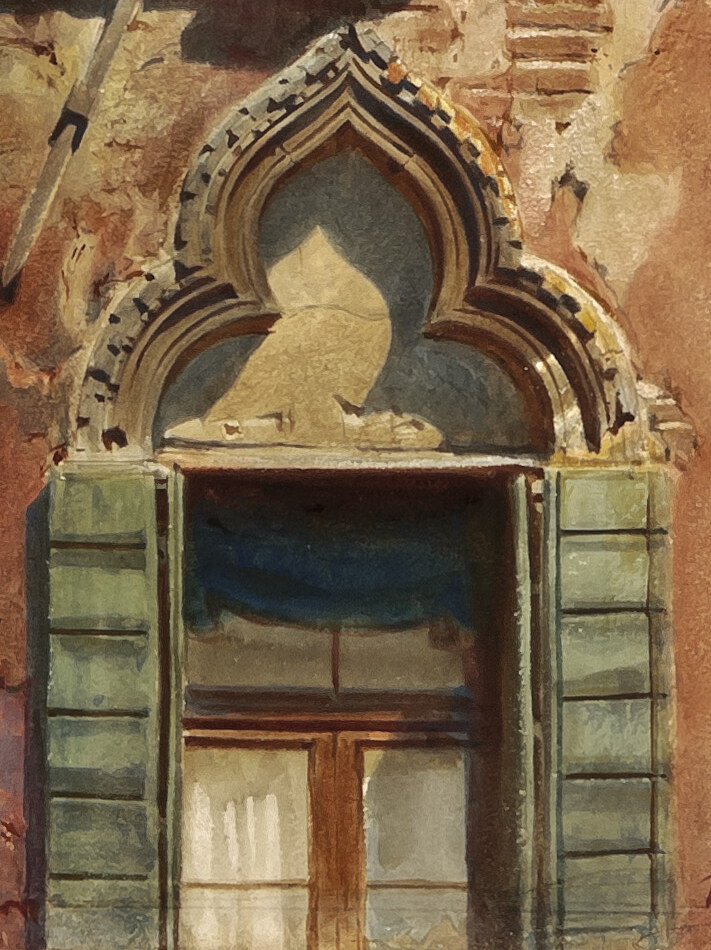
Look up from Anna and the building takes over. Above the balcony window the stone is carved into tracery, pointed arches and quatrefoils, the lace-like Gothic that Venice borrowed from the East and made its own in the fourteenth and fifteenth centuries. A twisted column holds up the corner, with a capital of carved leaves. This is the Palazzo Priuli, one of the old Gothic palaces of the Castello district near San Zaccaria, and the balcony is its most famous feature.
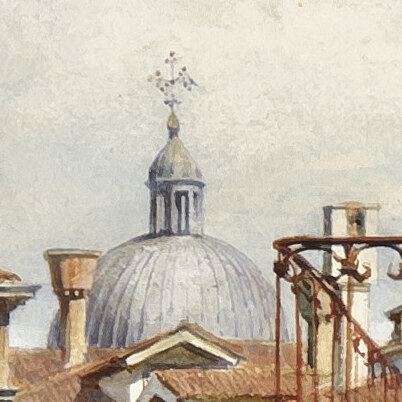
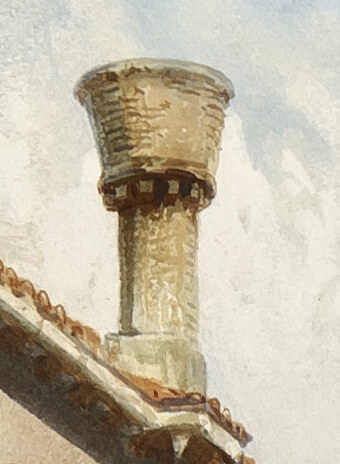
Passini paints the rest of the city the way someone who lives there sees it: a dome across the rooftops, the shutters open on the house opposite, and on its roof a chimney with the wide funnel top that is the signature of Venice, shaped to stop sparks falling on a city built of wood and wedged together.
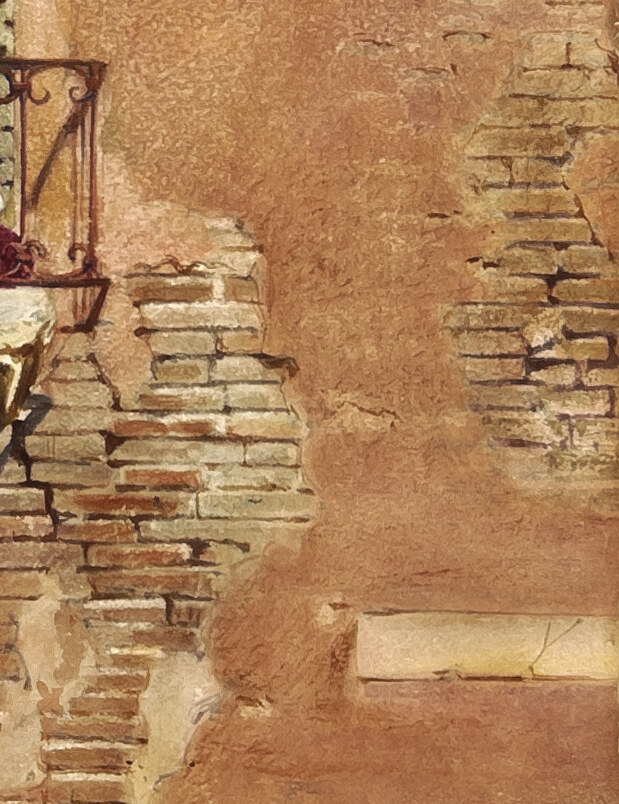
Then look at the wall. Beside the balcony the plaster has come away in patches and the brick shows through, cracked and mended and cracked again. Below, a second Gothic window with green shutters is set in the same worn wall. Passini does not tidy any of it. Venice in the 1860s was an Austrian garrison town in decline, full of empty palaces that could be rented for little, and painters who lived there painted it as it was.
That care is the other thing to notice. Every brick, every leaf of the capital, every rung of the iron railing is painted as carefully as Anna's face. Passini had trained with Carl Werner, the great watercolourist of architecture, and it shows: this is a portrait of a woman and of a building, and he gives them equal time.
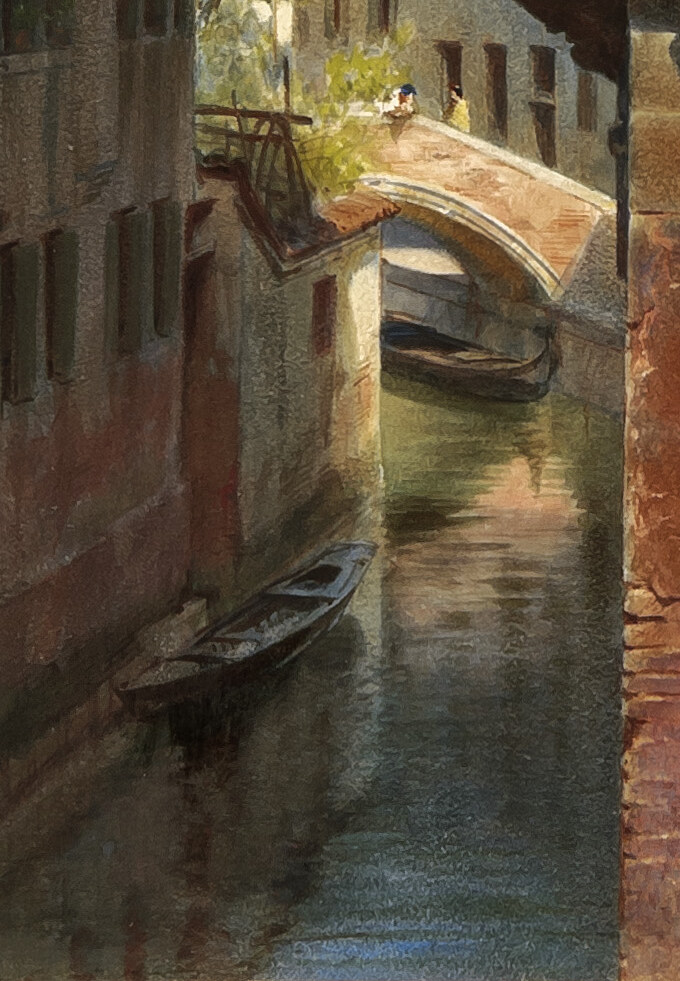
At the bottom of the picture, the canal, a boat, a bridge, and a tree in fresh green leaf. It is spring.
Ludwig Passini was born in Vienna in 1832, the son of the engraver Johann Nepomuk Passini, trained at the Vienna Academy, and spent most of his life in Italy, first in Rome and then in Venice, painting its people and its buildings with a precision that won him medals in Paris, Vienna, Munich and Berlin and a Legion of Honour in 1878. He was, above all, a watercolourist, and a very fine one.
On 9 November 1864 he married Anna Warschauer, a banker's daughter from Berlin. She was twenty-three, the daughter of Robert and Mary Warschauer, and a great-granddaughter of the banker Joseph Mendelssohn, which made her a great-great-granddaughter of the philosopher Moses Mendelssohn and a cousin of the composer's family. They had a daughter. About a year and a half after the wedding, in 1866, Anna died, at twenty-five.
So the picture is a young wife on her balcony in spring, painted by a husband who was about to lose her, and the only witnesses are the buildings. It is the most private kind of painting there is: not made for an exhibition or a patron but kept, one imagines, by the man who painted it. He lived in Venice for most of the rest of his life and died there in 1903.
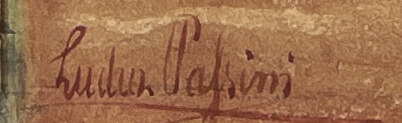
In a private collection. It passed through the Munich dealer Kunkel Fine Art, whose photograph is the one reproduced here, and it has never belonged to a museum, which is why it is so little known outside the circle of people who love Venetian painting. Passini worked mainly in watercolour on paper, and this sheet is catalogued as watercolour by some sources and as oil by others; the finish is so fine that the difference is hard to see.
It is a picture for a quiet room. Our hand-painted reproduction of Anna Passini on the Balcony of the Palazzo Priuli is painted in oil on canvas, in the tall format of the original, with every brick of the wall laid in by hand. Venice painted by the people who lived in it looks like this:
Visible details, documented facts and interpretation are kept separate. Anna's age at her marriage and death are calculated from her dates, 1841 to 1866.


