Loading cart…
No products in the cart.

Hieronymus Bosch was born Jheronimus van Aken around 1450 in the city of s-Hertogenbosch, in the Duchy of Brabant, a region that now forms part of the southern Netherlands. He came from a family of painters. His grandfather Jan van…
Save articles to your collection
Log in or create a free account, and this article will be waiting in your Private Collection.
Log in or sign upHieronymus Bosch was born Jheronimus van Aken around 1450 in the city of s-Hertogenbosch, in the Duchy of Brabant, a region that now forms part of the southern Netherlands. He came from a family of painters. His grandfather Jan van Aken and several of his uncles were all practicing artists in the same city, which means that Bosch grew up immersed in the visual language, materials, and workshop traditions of Netherlandish panel painting from a very young age. Very little is known about his formal training, but the prevailing scholarly view is that he learned the craft within his family workshop, absorbing techniques of tempera and oil on panel that had been refined across several generations. He married Aleyt Goyaerts van den Meervenne around 1480, a marriage that brought him a degree of financial stability and social standing, as she came from a prosperous family. This stability allowed him to work with considerable independence throughout his mature career. Bosch spent virtually his entire life in s-Hertogenbosch, a prosperous market city with a vibrant religious culture, and this local environment shaped his imagination in profound ways.
Bosch became a prominent member of the Illustrious Brotherhood of Our Lady, a prestigious religious confraternity based in s-Hertogenbosch, and this association brought him important commissions and connected him to the intellectual and spiritual life of his era. He is recorded as having produced altarpieces, designs for stained glass, and other devotional works throughout his career, though the surviving body of paintings attributed to him with confidence is relatively small. His mature works are populated with hybrid creatures, fantastical landscapes, moral allegories, and scenes drawn from scripture, popular proverbs, and medieval folklore. These images were not regarded as purely bizarre in his own time. They were deeply rooted in the visual and theological traditions of late medieval Christianity, and contemporary viewers would have recognized many of the symbols and references embedded within them. His reputation spread well beyond the Netherlands during his lifetime, and his works attracted powerful collectors, including Philip II of Spain, who acquired many of them for the royal collection. Bosch died in August 1516, leaving behind a body of work that has continued to fascinate, disturb, and inspire viewers across more than five centuries.
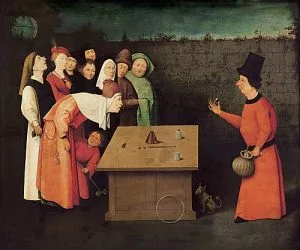
The visual style of Hieronymus Bosch is instantly recognizable and unlike anything produced by his contemporaries in the Netherlandish tradition. He worked primarily in oil on oak panel, a medium that was standard for the region, but he used it in a way that was entirely his own. His palette tends toward cool, luminous tonalities, with pale blues, muted greens, and warm ochres dominating his panoramic landscapes. Rather than focusing on the kind of intimate, precisely rendered domestic interiors favored by many Early Netherlandish painters, Bosch preferred vast, aerial compositions in which the viewer is positioned high above the scene, surveying an entire world laid out below. This bird-eye perspective allowed him to populate his panels with hundreds of tiny figures, each engaged in a distinct action, creating a visual density that rewards close examination. His line work is fluid and inventive, and his rendering of texture, whether the surface of skin, the shimmer of water, or the rough bark of a fantastical plant form, demonstrates a technical command that belies the seemingly chaotic nature of the imagery.
What makes the style of Bosch so distinctive is the seamless integration of meticulous naturalistic detail with utterly impossible subject matter. He paints his hybrid creatures, part human and part animal or object, with the same careful attention to light and shadow that he applies to conventional figures, giving them a disturbing plausibility. His triptych format, which he used for his most ambitious works, allowed him to construct elaborate narrative programs across multiple panels, moving from scenes of paradise through moral allegory to visions of damnation. The figures in his paintings are expressive and often grotesque, with faces that convey a wide range of emotion from ecstasy to agony. His skill in suggesting depth and atmosphere across vast panoramic spaces was advanced for his era, and the internal consistency of his invented worlds gives them a compelling, dreamlike logic that continues to captivate scholars and general audiences alike.
Each card links to its own article with full analysis and reproduction details.
 #3
#3
A print can reproduce colors. What it cannot reproduce is texture, depth, and the physical presence of oil paint on canvas. Hieronymus Bosch technique depends on these.
At ByMuseum, every reproduction is painted by hand using oil on canvas. There is no inkjet, no digital print. The brushwork is real. The result looks like a painting because it is one.
Enjoyed this story?
Save articles to your collection
Log in or create a free account, and this article will be waiting in your Private Collection.
Log in or sign up