Loading cart…
No products in the cart.

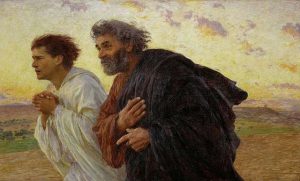
Two figures run through the pale light of early morning. Their faces carry the full weight of grief, confusion, and a trembling, desperate hope. One man clutches his robe as he leans forward into his stride; the other turns slightly,…
Save articles to your collection
Log in or create a free account, and this article will be waiting in your Private Collection.
Log in or sign upTwo figures run through the pale light of early morning. Their faces carry the full weight of grief, confusion, and a trembling, desperate hope. One man clutches his robe as he leans forward into his stride; the other turns slightly, his expression caught between sorrow and astonishment. The sky behind them is luminous with dawn, and the wind moves through their garments as though the world itself is breathless. This is the painting known commonly as Peter and John Running to the Tomb, completed by Eugène Burnand in 1898, and it is among the most emotionally immediate religious paintings produced in the nineteenth century. The work now hangs in the Musée d'Orsay in Paris, where it continues to draw visitors who are moved by its raw psychological honesty. It is a painting that asks the viewer not merely to observe a biblical event, but to feel it alongside the two men at its center.
Eugène Burnand was born on August 30, 1850, in Moudon, a small town in the Canton of Vaud in Switzerland. He showed exceptional skill in drawing from an early age and eventually studied under the Swiss painter Charles Gleyre in Paris, where he was also influenced by the traditions of French academic Realism. Burnand became known for a deeply personal approach to figurative painting, one that combined careful observation of the human form with a profound sensitivity to spiritual and emotional states. Unlike painters who rendered biblical subjects with theatrical grandeur, Burnand sought an intimate, almost documentary quality in his religious works. He was also a skilled illustrator and contributed extensively to publications of his era, including celebrated illustrated editions of biblical texts. His career spanned decades of prolific output, earning him recognition across Switzerland and France. He died on February 4, 1921, in Paris, leaving behind a body of work that bridges the gap between academic tradition and deeply felt human experience. His paintings remain touchstones for anyone interested in the intersection of faith, realism, and psychological depth in nineteenth-century European art.
The technique of Eugène Burnand is rooted in careful academic training, yet it is driven by something more personal than mere technical proficiency. He worked primarily in oil on canvas, building forms through layered glazes and precise brushwork that allowed him to capture the texture of fabric, the warmth of skin, and the subtle play of natural light across human faces. His palette leaned toward the muted and the luminous simultaneously, favoring soft ochres, warm greys, and the cool blue-whites of early morning or overcast skies. This restrained color range gave his compositions a timeless, almost photographic clarity that felt grounded in observable reality while remaining spiritually elevated. He was especially gifted at rendering the human face in moments of heightened emotion, capturing expressions that communicate interior states without resorting to melodrama. His figures feel like real people caught in real moments, which is precisely what separates his religious work from the theatrical conventions of earlier academic painting.
Visually, Burnand favored tight compositional focus on one or two figures, pushing them close to the picture plane so that the viewer feels drawn directly into the scene. He used landscape and sky not merely as backdrop but as atmospheric participants in the emotional narrative, allowing light conditions and weather to reinforce the psychological tone of each work. His illustrative background also shaped his approach to storytelling within a single image, ensuring that every element of a composition contributed to a unified emotional statement. This economy of means, combined with his deep observational accuracy, gave his paintings a quality that critics and theologians alike described as spiritually authentic. For collectors who value both technical excellence and emotional resonance, the work of Burnand offers a rare and rewarding encounter with nineteenth-century Realism at its most human.
Each card links to its own article with full analysis and reproduction details.
 #1
#1
A print can reproduce colors. What it cannot reproduce is texture, depth, and the physical presence of oil paint on canvas. Eugène Burnand technique depends on these.
At ByMuseum, every reproduction is painted by hand using oil on canvas. There is no inkjet, no digital print. The brushwork is real. The result looks like a painting because it is one.
Enjoyed this story?
Save articles to your collection
Log in or create a free account, and this article will be waiting in your Private Collection.
Log in or sign upA note from the studio
Our studio is working through an exceptional number of commissions, so we have paused new orders for a short time. We will start taking orders again on 1 October.
Every painting is made entirely by hand, and we would rather pause than rush one. Thank you for your patience and your trust.
Leave your details and we will reserve your place: we will write to you as soon as orders reopen.
Thank you
Your request is saved. We will write to you on 1 October, and a confirmation is on its way to your inbox.