Loading cart…
No products in the cart.

1896 · Oil on canvas · Musée cantonal des Beaux-Arts, Lausanne, Switzerland

Save articles to your collection
Log in or create a free account, and this article will be waiting in your Private Collection.
Log in or sign upBurnand painted The Prodigal Son in 1896, situating it within the broader arc of his religious and figurative work during the 1890s, a decade that proved to be among the most productive and thematically focused of his career. The parable of the prodigal son from the Gospel of Luke had been a subject of European painting for centuries, rendered by artists as diverse as Rembrandt van Rijn and Bartolomé Esteban Murillo, and Burnand was fully aware of the weight of that tradition when he approached the subject. Rather than positioning himself in dialogue with the baroque dramatics of those earlier works, Burnand sought to strip the scene back to something immediate and contemporary in feeling, grounding the ancient parable in the observable world of real human poverty, physical degradation, and the slow, uncertain walk toward reconciliation. The painting was created during a period when Burnand was deeply engaged with illustrated biblical projects, and the compositional clarity of those illustration-focused works is visible in the directness of this oil painting. The work entered the collection of the Musée cantonal des Beaux-Arts in Lausanne, where it has been a significant part of the permanent collection representing Swiss figurative painting of the late nineteenth century. It has been reproduced extensively in religious and art-historical publications, cementing its place as one of the key works in the study of Burnand's treatment of New Testament subjects. The painting demonstrates his ability to transform a familiar narrative into something that feels personally witnessed rather than merely illustrated.
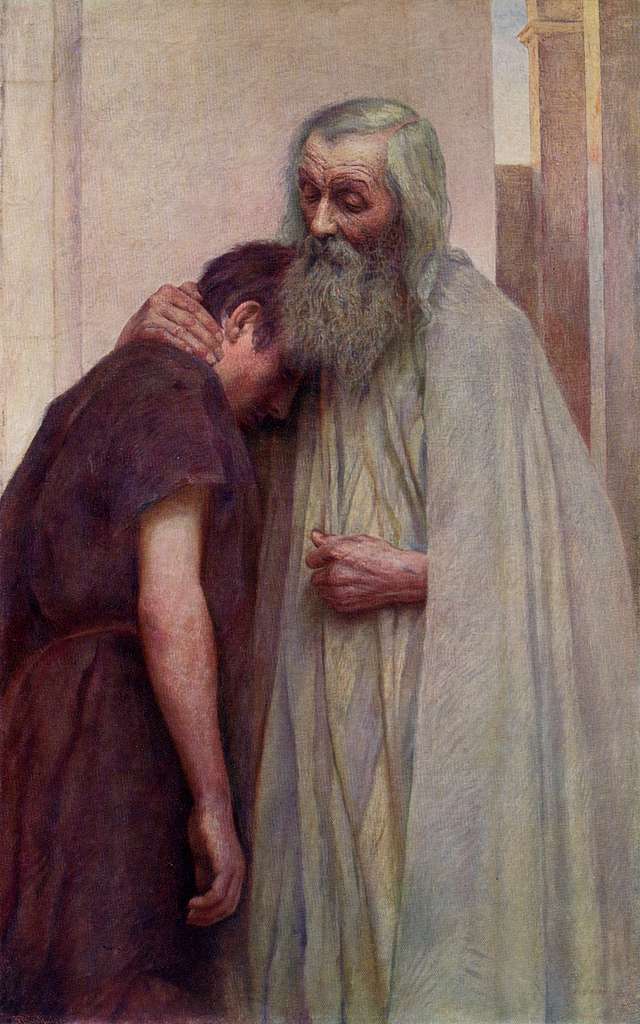
Burnand structures the composition around the solitary figure of the prodigal son, whose body carries the visible marks of his journey through excess and degradation. The figure is lean and worn, his clothing reduced to rags that hang loosely from a frame that has clearly known hunger. Burnand uses the posture of the figure with great care, conveying through the slight forward lean of the body and the downward cast of the head both physical exhaustion and the particular inward quality of someone rehearsing an anticipated confrontation with shame and longing. The palette is warm but subdued, built from earth tones and the dull yellows of dry ground and faded fabric, a color language that reinforces the sense of depletion and long distance traveled. In the background, Burnand opens the landscape with characteristic restraint, using the quality of the light and the openness of the horizon to suggest the vast distance the son has crossed and the tentative nature of his return. The handling of the face is especially accomplished, with Burnand modeling the features in a way that communicates a complex emotional state: not mere penitence, but the rawer, harder experience of someone who has arrived at self-knowledge through suffering and is now uncertain whether it is too late to matter. This psychological complexity is characteristic of Burnand at his finest. For those who wish to experience this work in their own home, ByMuseum offers the painting as a hand-painted oil reproduction of exceptional quality, allowing collectors to engage with Burnand's realist vision up close and daily.
The parable of the prodigal son is one of the most widely interpreted narratives in the Christian tradition, carrying meanings that extend far beyond its immediate religious context into the universal territory of forgiveness, return, and the nature of unconditional love. Burnand approaches the subject from the perspective of the son rather than the father, which is itself a significant interpretive choice. By centering the composition on the figure of the young man at the moment of his approach, Burnand places the viewer inside the emotional experience of the one who has transgressed and now returns, uncertain of his welcome. This is a more psychologically uncomfortable position than the perspective of the forgiving father, and it demands a different kind of engagement from the viewer. The painting asks not whether forgiveness will be offered but whether the one who needs it can bring himself to ask. In this way, Burnand transforms a familiar theological statement about divine grace into a portrait of human vulnerability and the cost of moral reckoning. In the broader cultural context of late nineteenth century European painting, this reframing of a sacred subject through the lens of psychological realism was part of a larger conversation about how art could remain spiritually meaningful in an increasingly secular age. Burnand's answer was to trust the emotional truth of the human figure as a carrier of spiritual content, allowing the observed reality of a worn and humbled body to speak more eloquently than any amount of heavenly iconography. The result is a painting that remains deeply affecting more than a century after its creation, and it is available as a hand-painted oil reproduction through ByMuseum for those who wish to own this enduring work.
Enjoyed this story?
Save articles to your collection
Log in or create a free account, and this article will be waiting in your Private Collection.
Log in or sign upA note from the studio
Our studio is working through an exceptional number of commissions, so we have paused new orders for a short time. We will start taking orders again on 1 October.
Every painting is made entirely by hand, and we would rather pause than rush one. Thank you for your patience and your trust.
Leave your details and we will reserve your place: we will write to you as soon as orders reopen.
Thank you
Your request is saved. We will write to you on 1 October, and a confirmation is on its way to your inbox.