Loading cart…
No products in the cart.

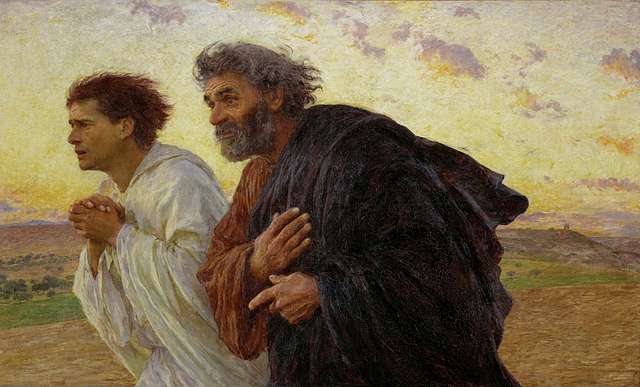
1898 · Oil on canvas · Musée d'Orsay, Paris, France
Save articles to your collection
Log in or create a free account, and this article will be waiting in your Private Collection.
Log in or sign upEugène Burnand completed this monumental work in 1898, after years of deep personal and theological reflection on the Resurrection narrative as recorded in the Gospel of John. The painting was commissioned as part of a broader series of biblical illustrations that Burnand was developing during this period, a project that consumed much of his creative energy in the final decades of the nineteenth century. He spent considerable time studying the physiognomy of real people before settling on the specific faces and body language depicted in the final composition. Burnand reportedly sought models whose physical presence could carry the weight of extreme emotional states, working through numerous preparatory sketches before arriving at the definitive arrangement of the two figures in motion. The work was exhibited at the Paris Salon in 1898, where it received immediate critical and public attention. Viewers and critics alike were struck by the unusual directness of its emotional register and the sense that Burnand had broken decisively from conventional academic approaches to sacred narrative painting. The painting entered the collection of the Musée du Luxembourg in Paris and was later transferred to the Musée d'Orsay, where it remains one of the most visited works in the collection. Its reputation has grown steadily over the decades, and it is now widely regarded as the defining achievement of Burnand's career and one of the most compelling religious paintings of the nineteenth century.
The composition places Peter and John in close proximity to the viewer, filling the canvas with their urgent, striding forms so that the emotional intensity of the scene is inescapable. Burnand uses the horizontal format of the canvas to emphasize the forward momentum of the two figures, whose bodies lean into their stride against a background of pale, luminous sky that signals the very early hours of the morning. The color palette is deliberately restrained, built from warm ochres, dusty blues, and the soft grey-gold of dawn light, which gives the scene a cool, breathless atmosphere entirely suited to its subject. The brushwork is precise and layered, particularly in the rendering of the figures' faces and the fabric of their robes, where Burnand modulates tone with exceptional sensitivity to capture both physical movement and inner turmoil. The faces of Peter and John are the true center of the composition, each communicating a distinct emotional state. Peter's expression is one of raw, almost anguished urgency, while John's face carries something closer to stunned astonishment shading toward belief. This psychological differentiation between the two men is one of the great achievements of the painting, demonstrating Burnand's extraordinary ability to read and render the inner life of his subjects. The wind-caught garments and the open, atmospheric landscape behind the figures reinforce the sense of breathless, world-altering movement. Collectors who wish to live with a work of this emotional and technical quality can own this as a hand-painted oil reproduction from ByMuseum, where every detail of Burnand's technique is carefully rendered by skilled artists.
The biblical event depicted here is described in the twentieth chapter of the Gospel of John, in which Mary Magdalene runs to tell Peter and the beloved disciple that the tomb of Jesus is empty. The two men then race to see for themselves, and it is John who arrives first, pausing at the entrance, while Peter enters immediately. Burnand chooses to depict the moment of the run itself, not the arrival or the discovery, which is a theologically and artistically bold decision. By focusing on the journey rather than the destination, he places the emphasis on faith in its most vulnerable, unresolved state: the moment before confirmation, when hope and grief exist simultaneously and neither has yet triumphed over the other. The painting thus becomes a meditation on the nature of belief itself, capturing the universal human experience of moving toward something longed for with desperate urgency but not yet fully understood. The two disciples represent two modes of responding to the impossible: the impetuous, whole-bodied commitment of Peter and the more contemplative, wondering openness of John. In the broader cultural context of the late nineteenth century, when religious certainty was increasingly challenged by scientific and philosophical skepticism, this painting offered viewers something rare: a representation of sacred narrative that honored doubt and longing without surrendering the possibility of meaning. Its lasting impact is felt not only in the history of religious art but in the broader story of how painters can use the visible world to speak about invisible realities. To own this as a hand-painted oil reproduction is to bring that conversation into your own space every day.
Enjoyed this story?
Save articles to your collection
Log in or create a free account, and this article will be waiting in your Private Collection.
Log in or sign upA note from the studio
Our studio is working through an exceptional number of commissions, so we have paused new orders for a short time. We will start taking orders again on 1 October.
Every painting is made entirely by hand, and we would rather pause than rush one. Thank you for your patience and your trust.
Leave your details and we will reserve your place: we will write to you as soon as orders reopen.
Thank you
Your request is saved. We will write to you on 1 October, and a confirmation is on its way to your inbox.