Loading cart…
No products in the cart.

1609 · Oil on canvas · Museo Regionale di Messina, Messina, Italy
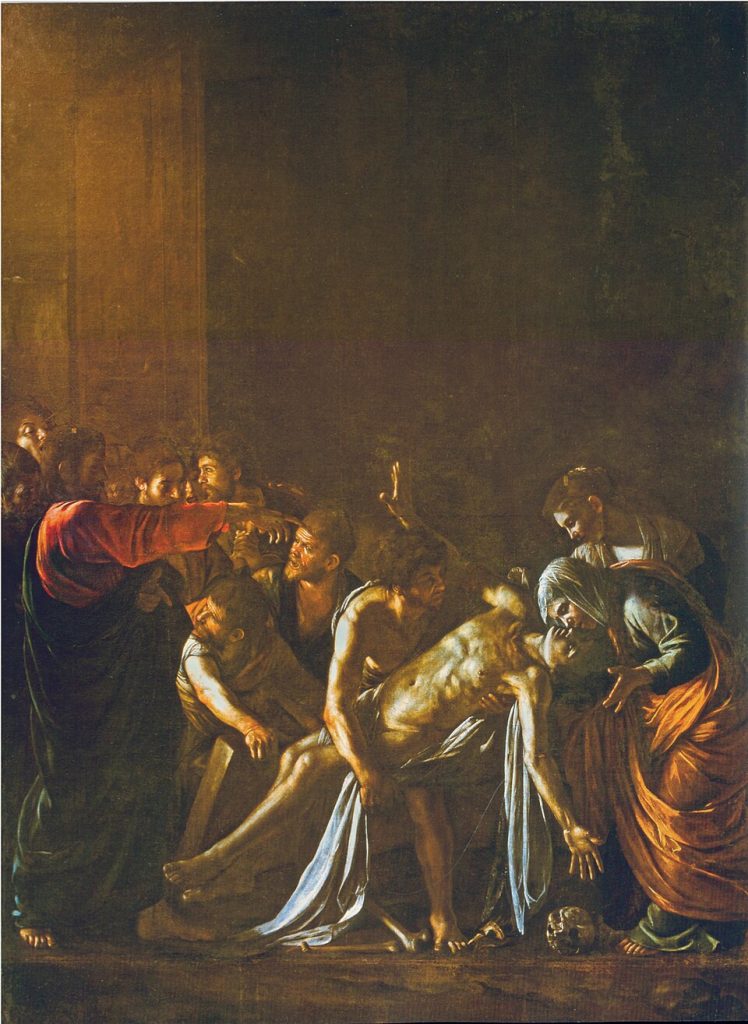
The Resurrection of Lazarus was commissioned in 1609 by the Genoese merchant Giovanni Battista de Lazzari for the church of the Padri Crociferi in Messina, Sicily. Caravaggio had arrived in Sicily after fleeing Malta, where he had been imprisoned following a violent altercation, and the Sicilian period represents one of the most turbulent and productive phases of his career. The commission was a significant one, both in financial terms and in the scale of the canvas, which at nearly four meters in height was among the largest works he ever produced. The painting remained in the church for which it was made until it was moved to the Museo Regionale di Messina, where it continues to be held. Contemporary accounts from Sicily describe Caravaggio working with unusual intensity during this period, reportedly using a freshly exhumed corpse as a model for the figure of Lazarus and working in conditions that disturbed some of those who witnessed the process. Whether or not these accounts are entirely accurate, they reflect the impression that the artist methods made on his contemporaries and the extent to which his insistence on direct observation from life was perceived as radical and unsettling. The painting bears the marks of rapid execution in certain passages, consistent with the compressed timescale of the Sicilian commissions, and this quality of urgency contributes to the emotional power of the finished work.
The scale of The Resurrection of Lazarus is integral to its expressive impact. The canvas is dominated by the enormous horizontal form of Lazarus, his body occupying the lower portion of the composition and his arms extended in a posture that strongly evokes the crucified Christ. This visual parallel between the resurrected Lazarus and the body of Jesus is not incidental. It reinforces the theological reading of the miracle as a prefiguration of the Resurrection and connects the individual act of raising Lazarus to the cosmic significance of the Passion narrative. The figures surrounding Lazarus press inward in a compressed crowd, their faces and gestures registering a range of responses from astonishment to disbelief. Christ stands to the upper right of the composition, his arm extended toward Lazarus in a commanding gesture that bridges the vertical and horizontal axes of the painting. The light source picks out the extended hand of Christ and the upturned face and reaching arm of Lazarus, creating a diagonal axis of illumination that structures the entire composition. The surrounding figures are largely in shadow, their features only partially resolved, which concentrates attention on the two figures whose interaction defines the meaning of the scene. This use of selective illumination to establish narrative priority is one of the most characteristic features of Caravaggio late style, deployed here with particular confidence given the demands of the large format.
The Resurrection of Lazarus carries profound theological significance as one of the most dramatic miracles attributed to Jesus in the Gospel of John. The raising of a man who had been dead for four days was understood in Christian tradition as the clearest demonstration of divine power over death prior to the Resurrection itself, and it was closely linked in theological commentary to the promise of eternal life available to believers. Caravaggio interpretation of the subject emphasizes the physical reality of death before giving way to the astonishing reversal that the miracle represents. The weight and pallor of the Lazarus figure communicate the full force of mortality, making the subsequent act of restoration all the more overwhelming. The grief of the mourners surrounding Lazarus, particularly the two women identified in the Gospel as Mary and Martha, is rendered with particular sensitivity. Their anguish is not theatrical but intimate, rooted in genuine human loss rather than conventional lamentation. This emotional authenticity reflects the Counter-Reformation insistence on the capacity of religious art to produce genuine devotional feeling in the viewer rather than merely illustrating doctrine. By grounding the miraculous in recognizable human experience, Caravaggio makes the theological claim of the miracle available to viewers who might otherwise find it remote. The painting thus functions as both a devotional object and a meditation on the nature of grief, hope, and the fragile boundary between life and death.