ByMuseum.com

USD
  • USD
  • EUR
Artist
Caravaggio
Paintings
12 deep-dives
Artist profile
All paintings
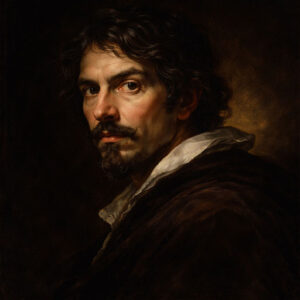
Caravaggio oil painting reproduction portrait in Baroque style
Baroque · Italian · 1571 to 1610

Caravaggio

BornSeptember 29, 1571, Milan, Duchy of Milan
MovementBaroque
Known forThe Calling of Saint Matthew, Judith Beheading Holofernes, The Supper at Emmaus
~80paintings
BaroqueItalian Painters
Artist guide · 12 most famous paintings

Caravaggio Paintings: His Most Famous Works as Hand-Painted Oil Reproductions

A single candle cuts through absolute darkness. On one side of the painting, a shaft of light falls across a group of men gathered around a table in what appears to be an ordinary tavern. One of them looks up,…

Who was Caravaggio?

A single candle cuts through absolute darkness. On one side of the painting, a shaft of light falls across a group of men gathered around a table in what appears to be an ordinary tavern. One of them looks up, startled, pointing at himself as if to ask: me? That moment, captured in The Calling of Saint Matthew, completed around 1600 for the Contarelli Chapel in Rome, distills everything that made Michelangelo Merisi da Caravaggio one of the most consequential painters of the seventeenth century. The figure of Christ stands at the right edge of the composition, his arm extended in a gesture borrowed directly from Michelangelo Buonarroti, yet the setting is shockingly immediate, almost journalistic in its refusal to idealize. This is not a heavenly vision. It is a moment happening right now, in the world you recognize, among people who look like the ones you pass in the street. Caravaggio was born in Milan in 1571 and trained under the painter Simone Peterzano before relocating to Rome sometime around 1592. His early years in the city were difficult, marked by poverty and a series of minor commissions, but his fortunes changed when Cardinal Francesco Maria Del Monte became his patron and provided him with both lodging and access to influential clientele. The paintings that followed established the technique of tenebrism, a radical use of deep shadow and concentrated light that would reshape European painting for generations. His personal life was as turbulent as his brushwork was daring. He killed a man in a brawl in 1606 and spent the remainder of his short life as a fugitive, moving through Naples, Malta, and Sicily while continuing to produce paintings of extraordinary emotional force. He died in 1610 at the age of thirty-eight, but the visual language he forged continued to echo through the work of Rembrandt, Rubens, Artemisia Gentileschi, and countless others who followed in his path.

What defines Caravaggio style

The defining characteristic of the work of Caravaggio is the dramatic manipulation of light and shadow known as chiaroscuro, which in his hands became an even more extreme form that later critics called tenebrism, from the Italian word for darkness. Rather than illuminating a scene with the diffuse, even light common in Renaissance painting, Caravaggio positioned his figures as though a single concentrated beam were falling on them from one specific source, leaving the surrounding space in near-total obscurity. This technique was not merely decorative. It served a profound psychological function, forcing the viewer to focus on the human body, on facial expressions, on the texture of skin and fabric, on the weight of a sword or the fragility of a wine glass. The figures in his compositions seem to push forward out of the picture plane, reaching toward the viewer with an intimacy that can feel almost uncomfortable. He painted directly onto the canvas with minimal underdrawing, relying on his acute observation of live models rather than idealized classical forms, and this directness gives his figures a physical credibility that was genuinely new in European painting. Caravaggio also made deliberate choices about who he depicted and how. Where earlier artists portrayed sacred figures with an aura of remote perfection, he dressed his saints in coarse linen, showed dirt under their fingernails, and set holy scenes in spaces that looked like Roman taverns or back-alley courtyards. This approach scandalized some patrons and thrilled others, but it was never accidental. It reflected a theological conviction, shaped by the post-Tridentine Catholic environment of Counter-Reformation Rome, that religious images should speak directly to ordinary people. The compositions tend to be stripped of ornamental background detail, concentrating all visual and emotional energy on the human figures and the drama unfolding between them. Color is used sparingly but with great purpose, with rich reds and deep ochres emerging from shadow to anchor the eye. The cumulative effect is painting that feels less like illustration and more like confrontation.

Hand-painted · Not printed
Own a Caravaggio. The real way.
Every reproduction is painted by hand in oil on canvas. The brushstrokes are real. That is the difference.
Browse Caravaggio paintings

Caravaggio most famous paintings

Each card links to its own article with full analysis and reproduction details.

The Incredulity of Saint Thomas
#0
The Incredulity of Saint Thomas
c. 1601–1602 · Sanssouci Picture Gallery, Potsdam
Caravaggio's electrifying Baroque masterpiece captures the moment doubting Thomas presses his finger into Christ's wound, rendered with unsparing realism and dramatic chiaroscuro.
Analysis and reproduction
The Cardsharps by Caravaggio #1
The Cardsharps
c. 1595 · Kimbell Art Museum, Fort Worth
The Cardsharps shows a well-dressed boy absorbed in his cards while an older accomplice reads his hand over his shoulder and signals to a young cheat who is drawing a hidden card from his belt, beside a dagger. Painted by Caravaggio around 1595, it was bought by Cardinal del Monte and launched the painter's career.
Analysis and reproduction
The Calling of Saint Matthew by Caravaggio, hand-painted oil reproduction #1
The Calling of Saint Matthew
1599-1600 · Contarelli Chapel, San Luigi dei Francesi, Rome, Italy
Caravaggio depicts the precise moment Christ summons the tax collector Matthew from a counting table in a scene of dramatic light and shadow.
Analysis and reproduction
The Supper at Emmaus
#2
The Supper at Emmaus
1601 · National Gallery, London, United Kingdom
Caravaggio captures the precise moment two disciples recognize the risen Christ during a meal at Emmaus, rendered with striking naturalism and dramatic light.
Analysis and reproduction
Judith Beheading Holofernes
#3
Judith Beheading Holofernes
1598-1599 · Galleria Nazionale d Arte Antica, Rome, Italy
Caravaggio depicts the biblical heroine Judith in the act of decapitating the Assyrian general Holofernes, presenting the violent subject with unflinching naturalism and psychological complexity.
Analysis and reproduction
David with the Head of Goliath by Caravaggio - hand-painted oil reproduction #4
David with the Head of Goliath
1610 · Galleria Borghese, Rome, Italy
In this late and deeply personal work, Caravaggio portrays a young David holding the severed head of Goliath, using his own features for the defeated giant.
Analysis and reproduction
Saint Jerome Writing by Caravaggio - hand-painted oil reproduction #5
Saint Jerome Writing
1605 · Galleria Borghese, Rome, Italy
Caravaggio presents Saint Jerome as a deeply focused scholar and penitent, using spare composition and intense light to unite the intellectual and spiritual dimensions of the saint devoted life.
Analysis and reproduction
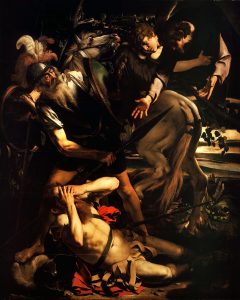
The Conversion of Saint Paul by Caravaggio - hand-painted oil reproduction #6
The Conversion of Saint Paul
1600-1601 · Cerasi Chapel, Santa Maria del Popolo, Rome, Italy
Caravaggio captures the instant of Saul conversion on the road to Damascus by focusing on the fallen figure and the looming presence of a horse, rather than celestial spectacle.
Analysis and reproduction
The Resurrection of Lazarus by Caravaggio - hand-painted oil reproduction #7
The Resurrection of Lazarus
1609 · Museo Regionale di Messina, Messina, Italy
Painted in Sicily near the end of his life, Caravaggio monumental Resurrection of Lazarus presents the miracle with somber grandeur, weaving grief and wonder into a scene of extraordinary physical and spiritual tension.
Analysis and reproduction
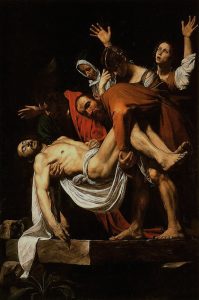
The Entombment of Christ by Caravaggio - hand-painted oil reproduction #8
The Entombment of Christ
1603-1604 · Pinacoteca Vaticana, Vatican City
Caravaggio presents the lowering of the dead Christ into the tomb as a physically demanding act, emphasizing the weight of the body and the grief of the mourners.
Analysis and reproduction
The Lute Player
#9
The Lute Player
1596 · Hermitage Museum, Saint Petersburg, Russia
Caravaggio presents a young musician absorbed in playing the lute, surrounding the figure with carefully arranged musical scores and still-life objects that transform a genre scene into a meditation on the senses and beauty.
Analysis and reproduction
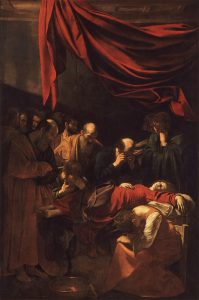
The Death of the Virgin by Caravaggio - hand-painted oil reproduction #10
The Death of the Virgin
1601-1606 · Musee du Louvre, Paris, France
Caravaggio portrays the death of the Virgin Mary with an unsparing naturalism that reportedly led to the rejection of the work by its original patrons before it gained wide acclaim.
Analysis and reproduction

Why hand-painted, not printed

A print can reproduce colors. What it cannot reproduce is texture, depth, and the physical presence of oil paint on canvas. Caravaggio technique depends on these.

At ByMuseum, every reproduction is painted by hand using oil on canvas. There is no inkjet, no digital print. The brushwork is real. The result looks like a painting because it is one.

Read: how our hand-painted reproductions are made

ByMuseum Editorial
Art history desk · ByMuseum

Written and fact-checked by the ByMuseum editorial team: art historians and painters who research each work from museum records and catalogues raisonnés, then explain how it is recreated by hand in oil on canvas.