Loading cart…
No products in the cart.

1605 · Oil on canvas · Galleria Borghese, Rome, Italy
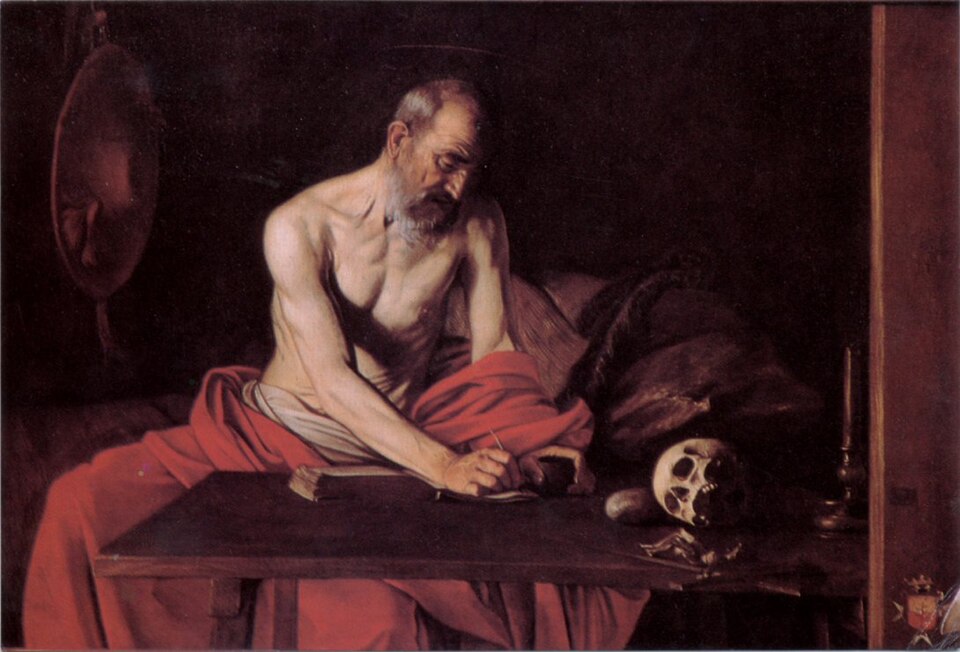
Saint Jerome Writing was painted around 1605 and is now held in the Galleria Borghese in Rome, one of the richest collections of Caravaggio work anywhere in the world. The painting was acquired by Cardinal Scipione Borghese, a powerful figure in the Roman Church and an avid collector who played an important role in shaping the reception of Baroque painting in early seventeenth-century Rome. The Borghese collection was assembled with a particular interest in works that combined technical excellence with immediate emotional impact, and Caravaggio contribution to the collection reflects the high regard in which his work was held by the Roman ecclesiastical establishment despite the controversies that periodically surrounded him. The subject of Saint Jerome had been treated by earlier Italian painters including Leonardo da Vinci and Giovanni Bellini, and Caravaggio would have been familiar with those precedents. His version, however, departs significantly from the more complex compositional arrangements favored by his predecessors. Rather than situating Jerome within a landscape or a detailed monastic interior, Caravaggio reduces the setting to near abstraction, focusing all attention on the figure of the saint and the objects immediately surrounding him. This stripping away of contextual detail in favor of concentrated human presence is characteristic of Caravaggio mature approach to religious subjects and reflects the influence of the broader Counter-Reformation emphasis on direct, unmediated devotional engagement.
The composition of Saint Jerome Writing is notable for its radical economy. The aged saint, depicted as a lean and muscular older man rather than a frail ascetic, bends intently over an open book, his writing hand extended toward the page. A skull rests on the table at the far right, partially illuminated by the same light source that picks out the white fabric draped over the table edge and the upper body of Jerome. The background is almost entirely dark, reducing the spatial environment to near zero and creating the impression that the figure and his objects exist in a kind of concentrated void. Caravaggio handling of the aged body is particularly notable in this work. The shoulder and arm of Jerome are rendered with precise anatomical observation, the musculature visible beneath the old skin in a way that combines physical vulnerability with intellectual and spiritual vigor. The tonsured head is bowed in concentration, and the saint does not acknowledge the viewer, creating a sense of having witnessed a private moment of scholarly devotion rather than a formal devotional pose. The red cardinal hat and robe draped to the lower left of the composition identify Jerome as a Doctor of the Church, providing the necessary iconographic context while the dominant visual register remains focused on the immediate physical act of writing.
Saint Jerome holds special significance in the history of the Catholic Church as the translator of the Bible into Latin, producing the Vulgate that remained the authoritative scriptural text of Western Christianity for more than a millennium. His depiction in the act of writing therefore carries layered meaning: it simultaneously represents the historical act of translation, the broader ideal of scriptural scholarship as a form of devotion, and the individual soul engaged in the slow, demanding labor of bringing divine truth into human language. Caravaggio emphasis on the physical effort and concentration involved in writing gives the act a weight and dignity that elevates it to a spiritual practice. The skull on the table is a memento mori, a reminder of mortality that had long been associated with Jerome in visual tradition. Its placement beside the scholarly instruments, the book and the pen, creates a meditation on the relationship between intellectual labor and the awareness of death. For Jerome, the proximity of death was not a cause of despair but a spur to continued devotion and work. This combination of scholarly purpose and penitential awareness reflects the Counter-Reformation ideal of the learned churchman who combines rigorous intellectual engagement with genuine personal humility. Caravaggio renders this ideal not through idealized beauty or heavenly radiance but through the quiet dignity of concentrated effort, making the sacred accessible through the recognizable language of human work.