Loading cart…
No products in the cart.

1600-1601 · Oil on cypress wood panel (later canvas) · Cerasi Chapel, Santa Maria del Popolo, Rome, Italy
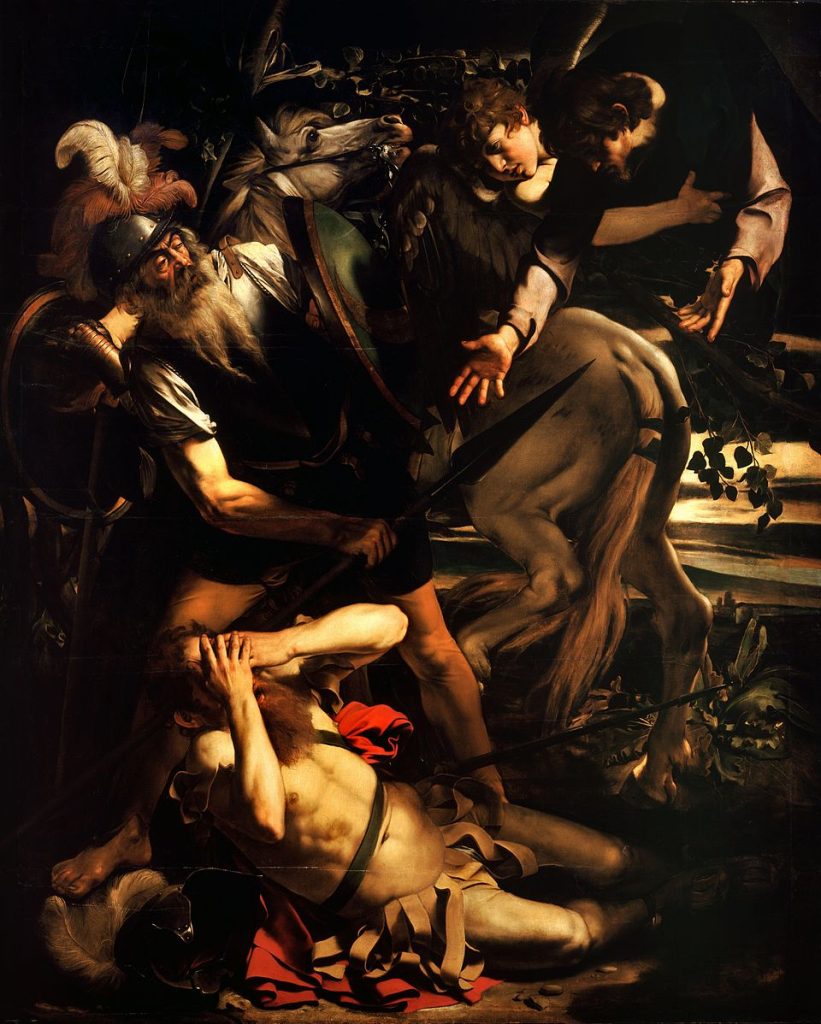
The Conversion of Saint Paul was commissioned by Tiberio Cerasi for his funerary chapel in the church of Santa Maria del Popolo in Rome. Cerasi signed a contract with Caravaggio in September 1600, and the chapel also received a painting of The Crucifixion of Saint Peter from the same artist, making it one of the rare locations where two major works by Caravaggio face each other across a single space. An earlier version of the composition exists in the Odescalchi Balbi collection and was apparently rejected by the patron, leading Caravaggio to produce the present work. The accepted version presents a radically different visual strategy from the rejected one, abandoning the crowd of figures and dramatic heavenly light in favor of an intimate, almost disorienting close-up. The painting has been in the Cerasi Chapel continuously since its installation, and despite some damage and restoration over the centuries, it retains the overwhelming spatial immediacy that made it so remarkable to viewers in the early seventeenth century.
The most immediately striking formal decision in this painting is the positioning of the horse as the largest single element in the composition. The animal dominates the upper portion of the canvas, its massive body pressing toward the picture plane, attended by an elderly groom who leads it with calm practicality. Saul lies on the ground below, his arms flung outward and his eyes closed, bathed in a warm, sourceless light that falls across his body. There is no thunderclap, no angelic host, no visible Christ. The divine intervention is registered entirely through the pose and expression of the fallen man and through the quality of the light that illuminates him. This restraint was profoundly unconventional and challenged the expectations of viewers accustomed to elaborate depictions of the scene. Caravaggio uses the low viewpoint and the compressed pictorial space to place the viewer in the position of a witness standing just at the edge of the event, unable to see its celestial cause but fully aware of its physical effect.
The theological significance of the Conversion of Saint Paul was central to Counter-Reformation thought. Paul was the apostle whose dramatic transformation from persecutor to champion of the faith served as the most powerful scriptural example of divine grace acting upon an unwilling subject. By stripping away all supernatural visual apparatus, Caravaggio places the entire weight of the conversion on the internal experience of the figure on the ground. The viewer is invited to understand transformation not as a theatrical event witnessed from a distance but as an overwhelming personal encounter that leaves a man helpless on the earth. The indifference of the horse and groom reinforces this interpretation. The miraculous does not announce itself with cosmic drama but descends quietly upon a single individual while the rest of the world continues its ordinary business. For the faithful in the Cerasi Chapel, this image offered a deeply human and accessible model of spiritual transformation, one rooted not in spectacle but in surrender.