Loading cart…
No products in the cart.

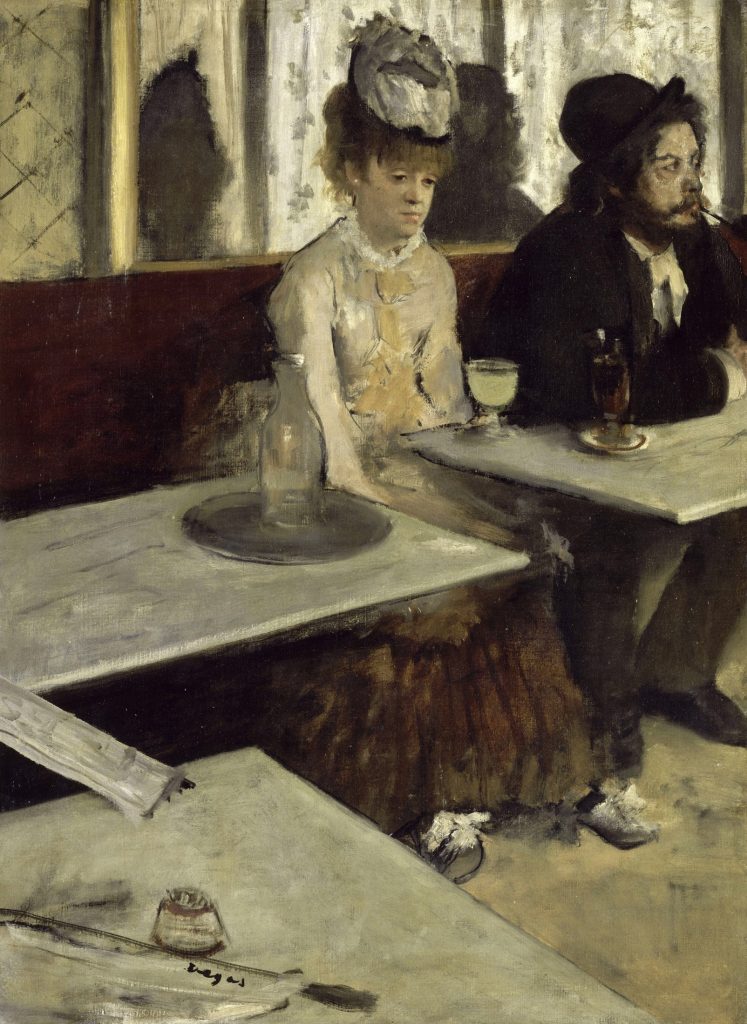
1875–1876 · Oil on canvas · Musée d’Orsay, Paris
Save articles to your collection
Log in or create a free account, and this article will be waiting in your Private Collection.
Log in or sign up Explore the artistEdgar Degas →
The woman’s eyes fall towards the table. Beside her, a bearded man turns away, his pipe projecting towards the edge of the canvas. A pale drink stands untouched in front of her. They occupy the same bench, yet the space between their attention feels larger than the room.
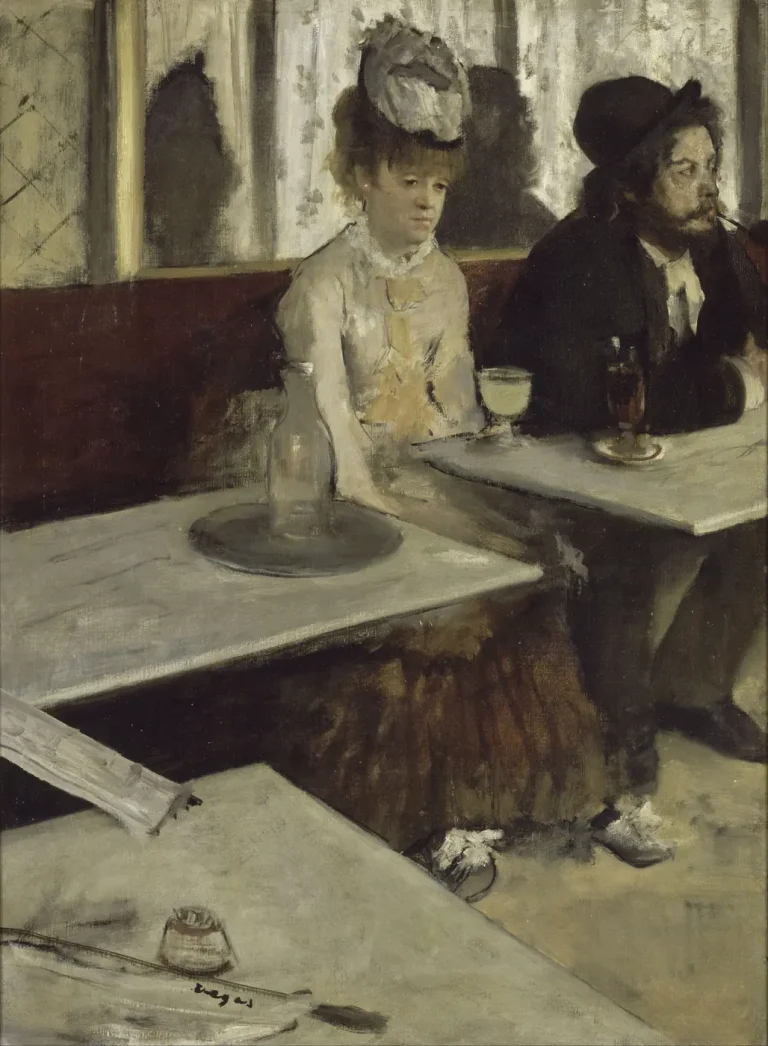
Edgar Degas painted L’Absinthe, also called Dans un café or In a Café, in 1875–1876. The picture now belongs to the Musée d’Orsay in Paris. It is an oil painting on canvas measuring 92 × 68.5 centimetres.
Its most consequential fact is easily missed: this apparently unguarded moment was staged. Degas used people he knew as models. The picture should not be treated as photographic evidence that he caught two strangers helplessly drinking away their lives.
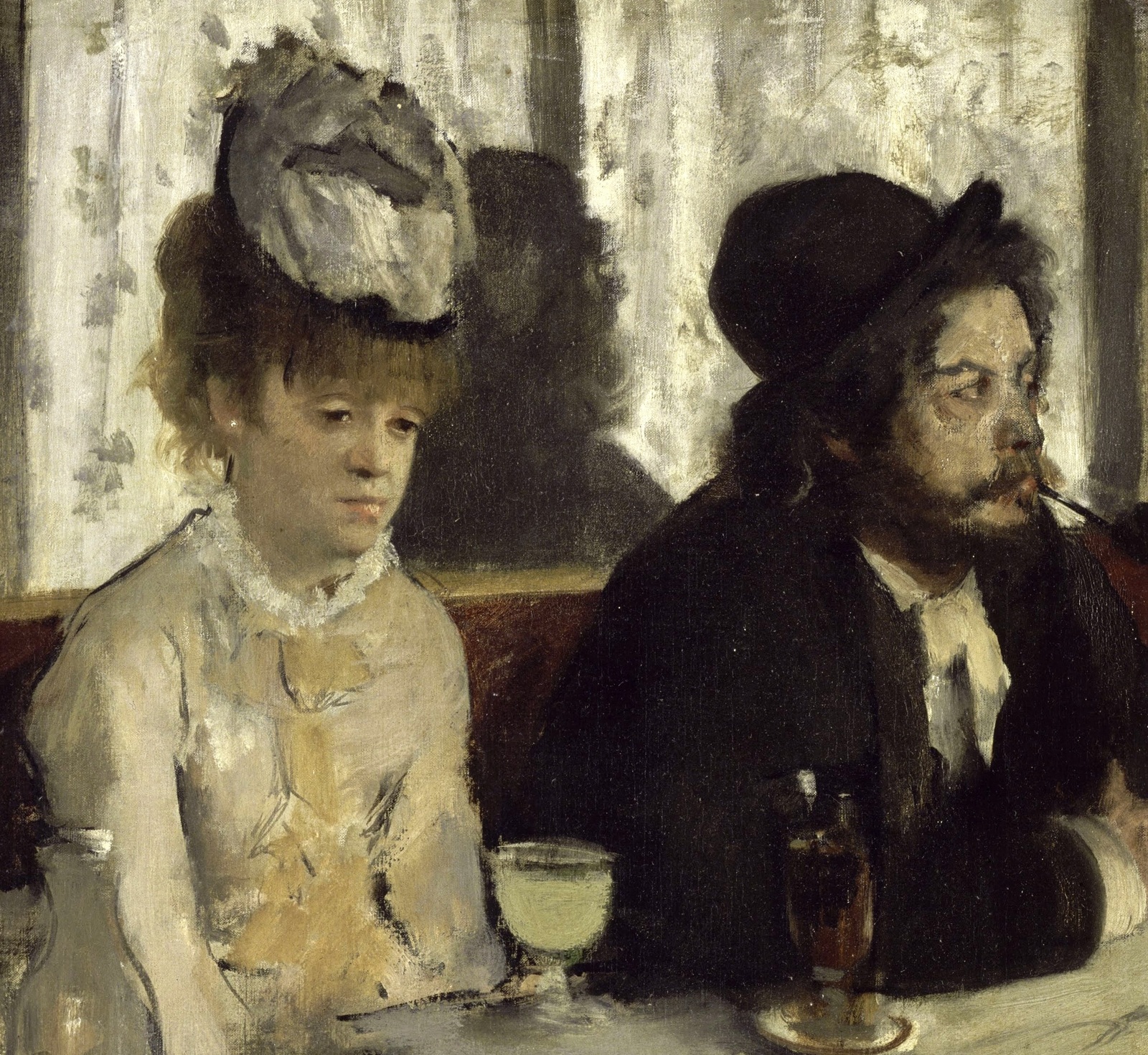
The woman is the actress and model Ellen Andrée. The man is the artist and engraver Marcellin Desboutin. According to the museum, Degas arranged the scene in his studio, drawing on the café La Nouvelle Athènes in Paris.
The distinction between a sitter and a role matters. Viewers read the atmosphere so strongly that the picture harmed the models’ reputations. Degas had to make clear that they were not alcoholics.
Their painted expressions remain open to interpretation. We can describe the lowered gaze, slumped shoulders and turn of the man’s head. Those observations do not authorise a diagnosis of either sitter’s real life.
The picture’s realism depends on this tension. It looks like an accidental encounter, but its effect emerges from chosen postures, a deliberately awkward viewpoint and a carefully constructed interior.
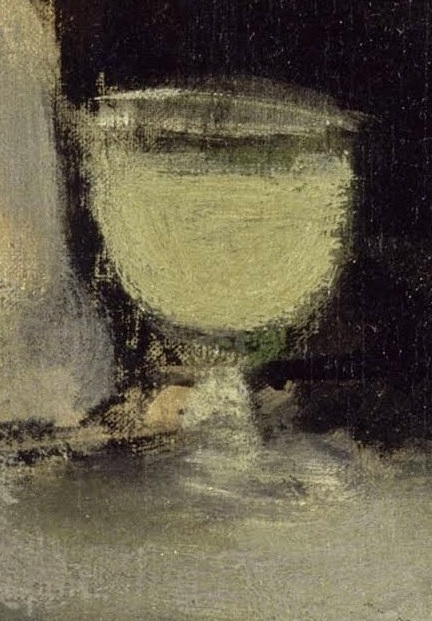
The pale greenish drink in front of the woman is identified as absinthe. Its colour is quiet, far from the brilliant green that later commercial imagery made familiar. The small glass sits prominently against the light tabletop.
The alternative title directs us towards that object and encourages a story of consumption. The more neutral In a Café leaves room for a wider encounter with waiting, fatigue and social distance.
The glass is not shown in the act of being raised. Its stillness is part of the effect. The woman sits behind it with her hands lowered, while the table keeps the drink between her and the viewer.
The Musée d’Orsay discusses an interpretation concerned with alcohol’s dangers. That is one way of reading the scene, rather than a reason to reduce every visible detail to a symptom or to ignore the models’ identities.
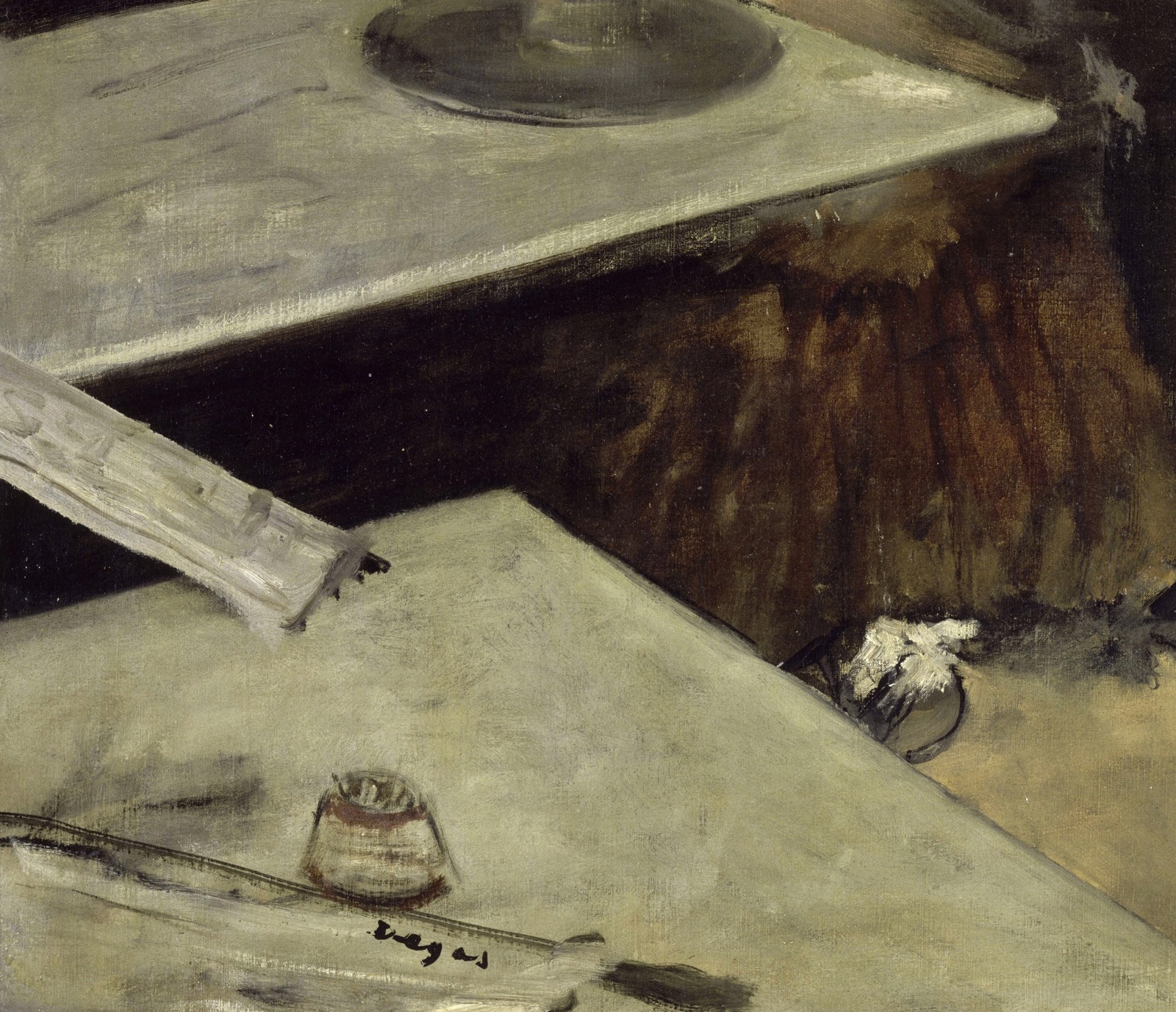
A light tabletop cuts across the bottom of the painting. Another enters from the left. A third supports the drinks before the seated figures. Their diagonals make a route through the picture, but they also place obstacles between us and the people.
The empty foreground is not unused space. It establishes the viewer’s uncertain position, as though we have arrived at a neighbouring table without being invited into a conversation.
The tables do not provide the reassuring geometry of a formal interior. Their abrupt edges lead our attention sideways, then back towards the woman. The composition keeps us looking from an angle.
Objects left on the near surfaces reinforce the sense of a place already occupied. We are not seeing a café arranged for our arrival. We appear to have entered somebody else’s interval, although the apparent informality is itself designed.
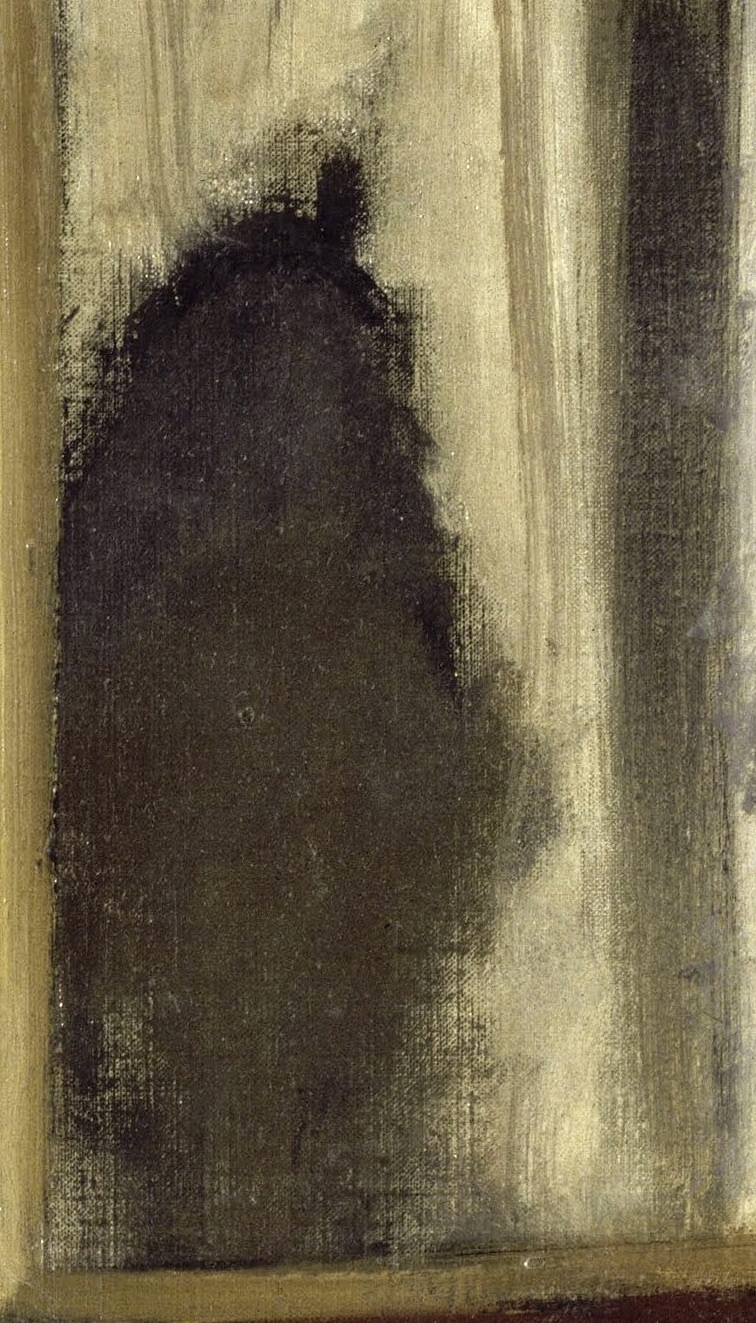
Behind the bench, the mirror reflects dark silhouettes. It extends the room without providing another clearly described social encounter. The figures remain accompanied chiefly by their own shapes.
The contrast with the pale blouse and table is strong. Dark areas gather above and beside the woman while her face occupies a small, exposed patch of light.
Rather than opening a deep view into the café, the reflection can feel like a second surface pressing behind the sitters. That is an effect of the painted arrangement, not proof that Degas intended one single psychological explanation.
The man does not fit comfortably within the frame. His pipe and parts of his body meet its right edge. The principal figures sit away from the centre, and the foreground appears disproportionately large.
Such choices can resemble a hurried photograph, but the museum also connects the off-centre framing with Japanese prints. Neither comparison means the painting was made mechanically or without revision.
The work belongs to the world of Impressionism while concentrating on an interior rather than an outdoor effect of sunlight. Degas makes the modern café a subject worthy of sustained attention. What matters is not simply where people meet, but how a public place can hold people who seem emotionally separate.
Compare it with the broader range of encounters in our guide to famous Impressionist paintings. This scene’s subdued palette and blocked approach produce a very different experience from an open-air gathering.
The Degas painting discussed here is also called L’Absinthe or In a Café. Other artists painted absinthe drinkers, so a title alone can be ambiguous.
The Musée d’Orsay records that Degas publicly rejected that assumption. They were people he knew posing for a constructed scene.
The museum identifies it as a studio painting based on the setting of La Nouvelle Athènes.
It is in the Musée d’Orsay collection, Paris, inventory number RF 1984.
Faithful public-domain reproduction of L’Absinthe, via Wikimedia Commons. Detail images are crops of the same historical painting; no reconstruction or upscaling.
Enjoyed this story?
Save articles to your collection
Log in or create a free account, and this article will be waiting in your Private Collection.
Log in or sign up
Man Writing a Letter
Gabriel Metsu, c. 1664
The gallery list
Every painting is already 50% off. Join the list and we will send you an extra $15 code, plus first access to new collections.
No spam. Unsubscribe anytime. · Privacy Policy
Welcome
Your $15 code is on its way. Explore the gallery while you wait.