Loading cart…
No products in the cart.

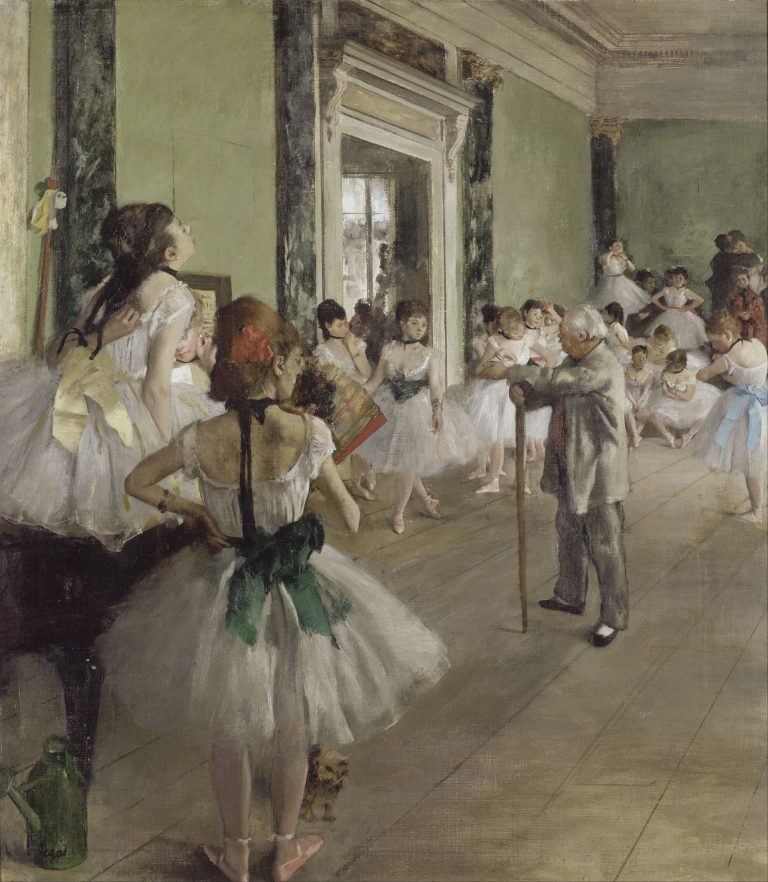
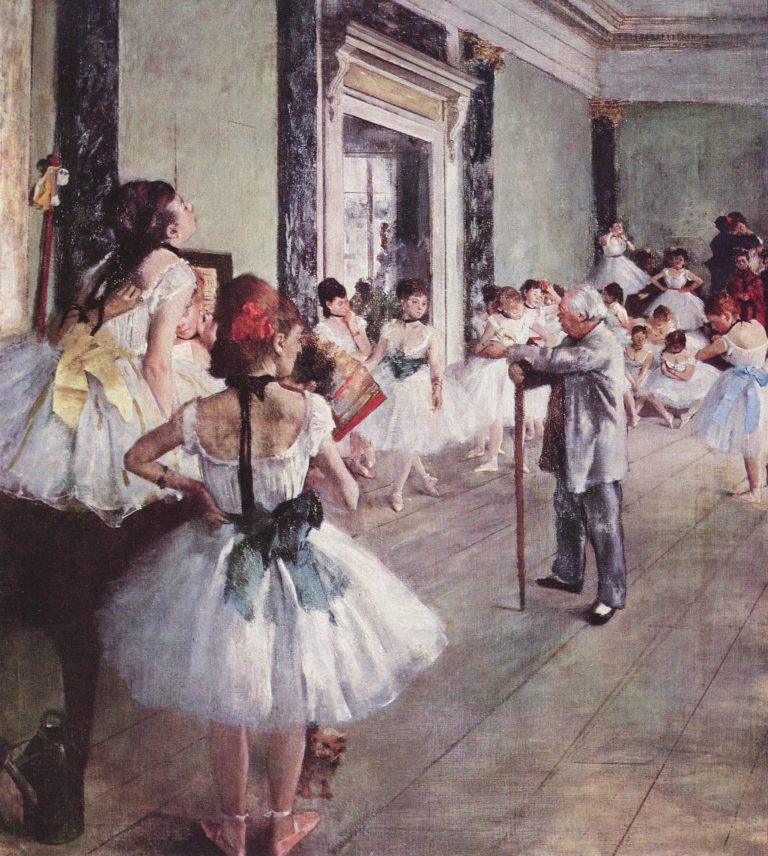
1873–1876 · Oil on canvas · Musée d’Orsay, Paris
Save articles to your collection
Log in or create a free account, and this article will be waiting in your Private Collection.
Log in or sign up Explore the artistEdgar Degas →
A dancer stands with her back towards us, one arm bent behind her waist. Another lifts her chin beside the piano. Across the room, bodies gather, stretch, sit and adjust their clothes. The old master with the long staff appears more firmly planted than anyone else.
Edgar Degas’s The Dance Class, or La Classe de danse, makes training rather than a finished performance its subject. The Musée d’Orsay dates this canvas to 1873–1876. Measuring 85.5 × 75 centimetres, it is distinct from the related dance-class picture at the Metropolitan Museum of Art in New York.
The white costumes can make the scene seem airy at first. Look longer and the room fills with the weight of standing, waiting and recovering from effort. The dancers have bodies that itch, tire and require adjustment.
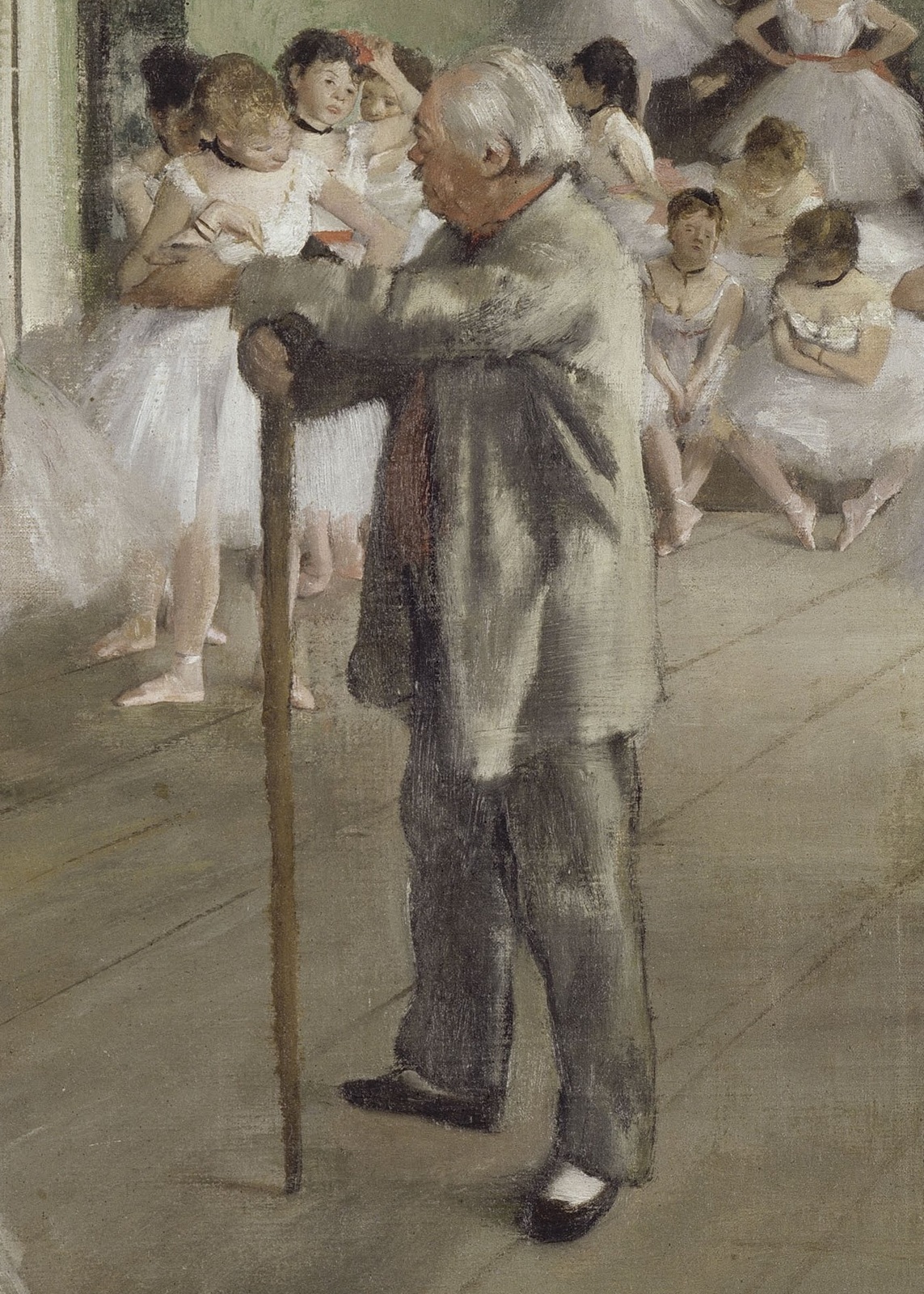
The teacher is the ballet master Jules Perrot. He leans on a long staff with his hands gathered at its top. His grey suit is a dense vertical form among the spreading white skirts.
The staff connects him visibly with the floor. It can mark time, but in the painting it also acts as a line around which the room seems to organise itself. His feet are settled while many of the dancers’ poses appear temporary.
The figure is a painted portrait within a constructed class scene. It should not be treated as a photograph proving that every surrounding person attended one lesson on a particular date.
The Musée d’Orsay’s research stresses Degas’s freedom to assemble and alter these interiors. The convincing room belongs to his artistic arrangement as well as to the world of the Paris Opera.
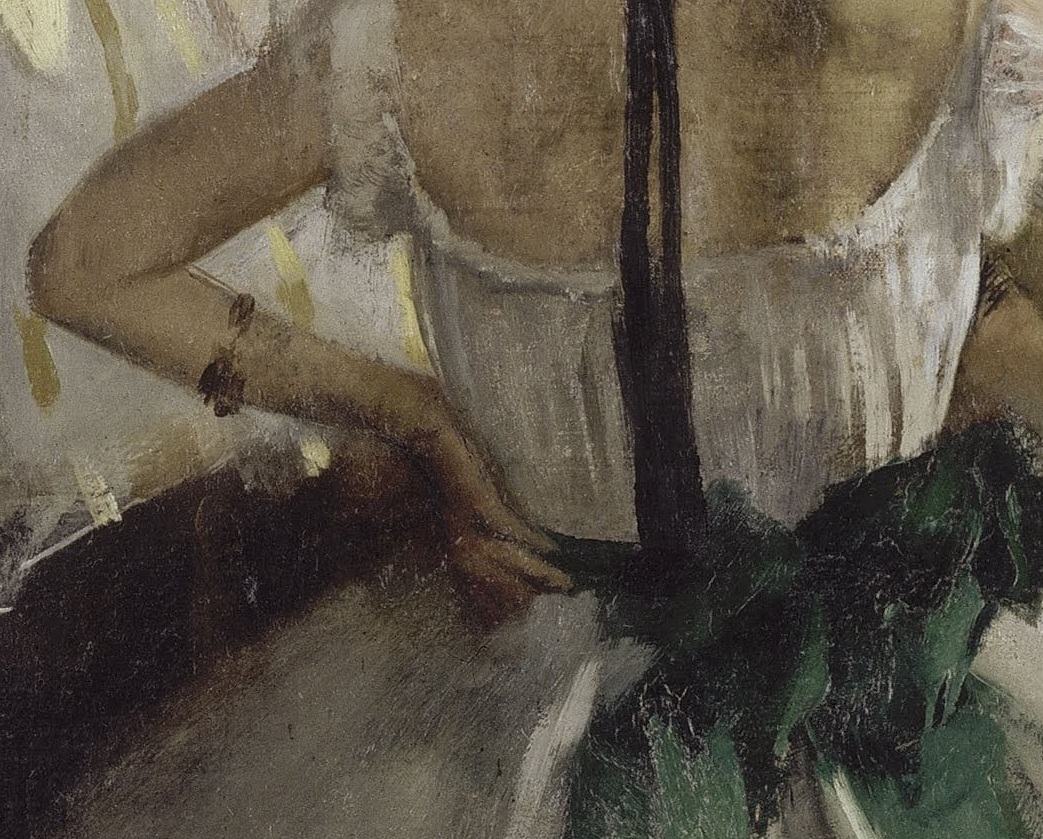
The nearest dancer’s hand reaches behind her back. Her elbow projects outward, pulling the pose away from an elegant stage silhouette. The gesture makes her feel occupied with her own physical comfort rather than with an audience.
We see the back of her head and the long dark ribbon descending towards her waist. The arrangement keeps her face unavailable while making her activity perfectly legible.
That choice matters. Degas does not need a facial expression to communicate the difference between disciplined public display and the body at rest. A bent arm is enough to loosen the room’s apparent formality.
The larger bow at her waist and the spreading skirt make a broad foreground shape. She blocks part of our route into the class even as her gesture invites close attention.
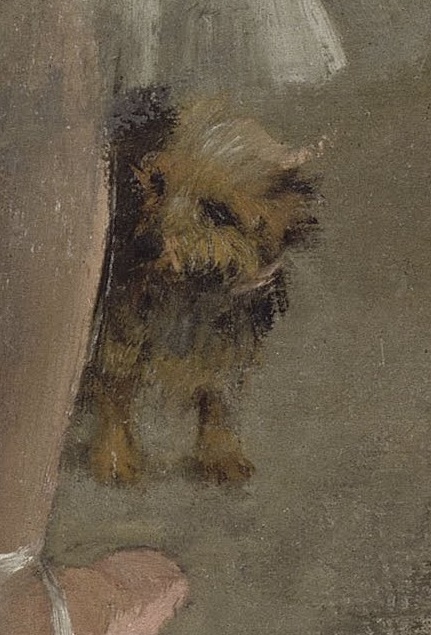
Near the dancer’s feet, a small dog stands on the floor. It is easy to miss because the ribbons, white skirts and teacher’s staff compete for attention above it.
The animal introduces another kind of presence into a room devoted to organised movement. It is close to the working feet, at a height where the class becomes a landscape of shoes, ankles and fabric.
It also helps the foreground feel inhabited beyond the formal demands of an exercise. The scene contains the incidental details of a social place, not just a demonstration of ballet positions.
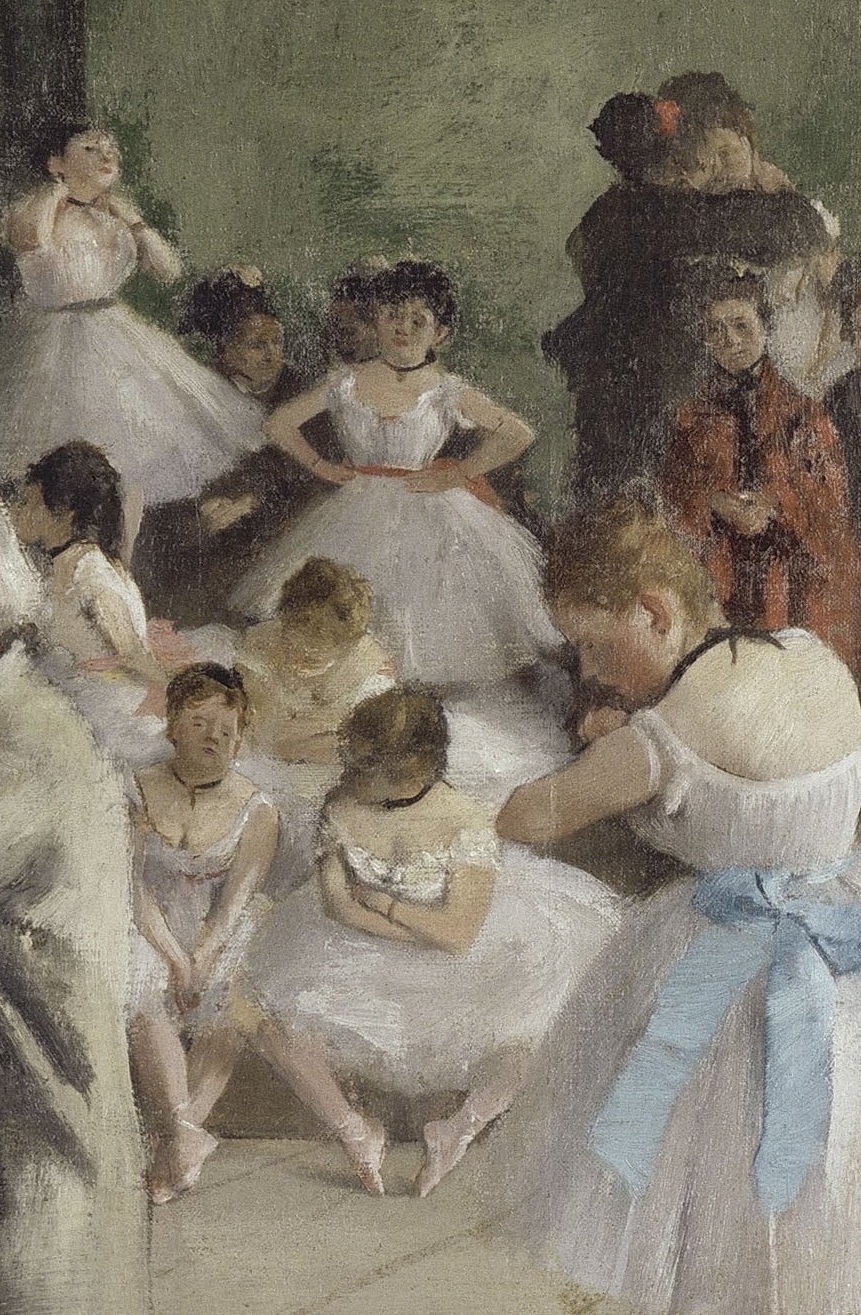
At the back and right of the room, the dancers do not repeat one approved posture. Some sit, some stand, and some attend to their own clothes or bodies. The pattern of lowered heads and bent arms is more varied than a row of performers waiting for applause.
The museum interprets this as the end of a demanding class, when concentration begins to loosen. That reading is supported by the gestures rather than by an obvious narrative announcement.
The figures remain subject to the room’s discipline, but they are not fully absorbed in it at every moment. We see the intervals that make sustained training possible.
This variety prevents the white skirts from becoming a single decorative mass. Each small change of direction gives a body its own relation to the teacher, neighbours and floor.
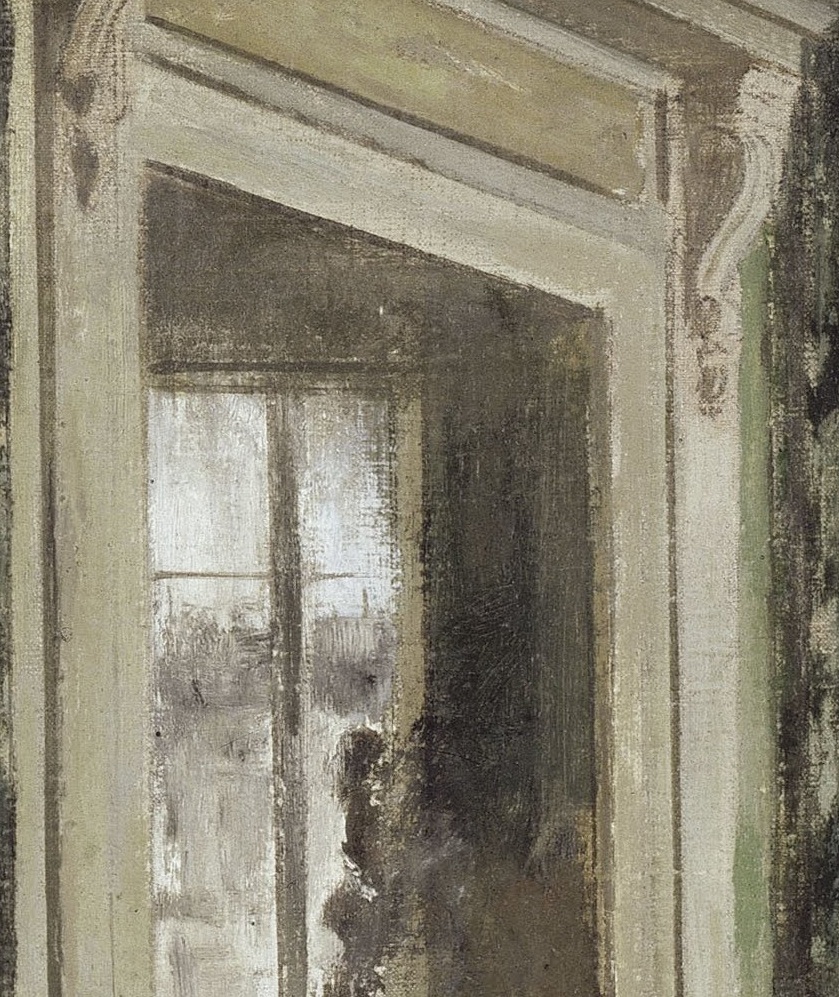
The tall opening brings a vertical band of light into the composition. Its surrounding architecture is much more rigid than the dancers’ changing postures.
Figures and reflections within that passage are less sharply described than the foreground dancer. Distance makes the classroom feel connected to a larger building without giving us a complete plan of it.
The room evokes the older Opera on the rue Le Peletier, rather than simply documenting the later Palais Garnier. Degas’s Opera scenes often combine remembered, observed and invented arrangements. The illusion of access should not be mistaken for architectural certainty.
The boards run diagonally away from us, carrying the eye towards the far end of the room. Their long lines establish distance while the dancers repeatedly interrupt them.
For the figures, the floor is a working surface. For the painting, it is the means of distributing bodies at different depths. A shoe, a staff and the dog acquire their positions through the same network of lines.
The large open area beside the teacher gives the room a centre that is not occupied by a star performer. We feel the possibility of a dancer entering that space, even while the image holds everyone still.
There is no need to add a separate close-up of every floorboard to recognise this effect. It becomes most intelligible when the main composition is seen as a whole.
The class is attractive, but its appeal is not dependent on pretending that ballet is effortless. Degas pays attention to the moments a stage performance usually hides: an adjustment, an idle wait, an uneven distribution of attention.
His L’Absinthe also uses an interior and an oblique viewpoint to make a relationship between people feel specific. The café’s distance is emotional; here, distance is organised through instruction, practice and the space of the room.
Both works remind us that an image can seem casually encountered while being carefully assembled. The Dance Class gives the viewer the pleasure of entering a private working world, then shows how much arrangement is involved in making that entry convincing.
The central ballet master is Jules Perrot, identified in the Musée d’Orsay catalogue.
The museum dates the Paris canvas to 1873–1876. It is often given the shorthand date 1874.
It belongs to the Musée d’Orsay, Paris, inventory RF 1976.
Yes. He repeatedly explored the subject, and the related Metropolitan Museum painting is a separate composition.
No. The scene concerns the training room and the intervals around practice.
Faithful public-domain reproduction of The Dance Class, via Wikimedia Commons. Detail images are crops of the same historical painting; no reconstruction or upscaling.
Enjoyed this story?
Save articles to your collection
Log in or create a free account, and this article will be waiting in your Private Collection.
Log in or sign up
Man Writing a Letter
Gabriel Metsu, c. 1664
The gallery list
Every painting is already 50% off. Join the list and we will send you an extra $15 code, plus first access to new collections.
No spam. Unsubscribe anytime. · Privacy Policy
Welcome
Your $15 code is on its way. Explore the gallery while you wait.