Loading cart…
No products in the cart.

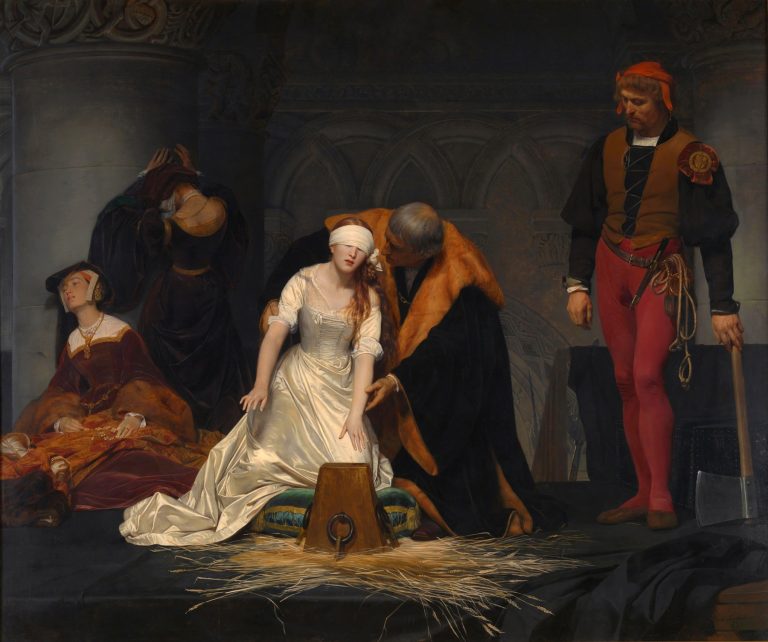
1833 · Oil on canvas · National Gallery, London, NG1909
Save articles to your collection
Log in or create a free account, and this article will be waiting in your Private Collection.
Log in or sign up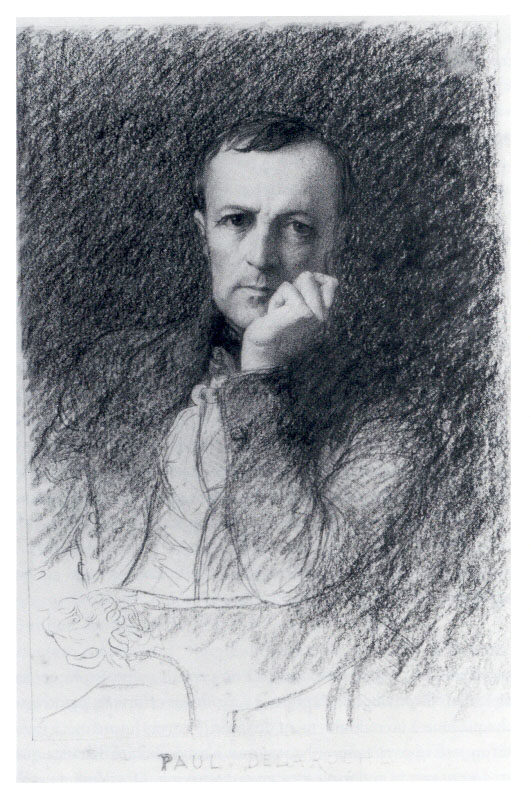 Explore the artistPaul Delaroche →
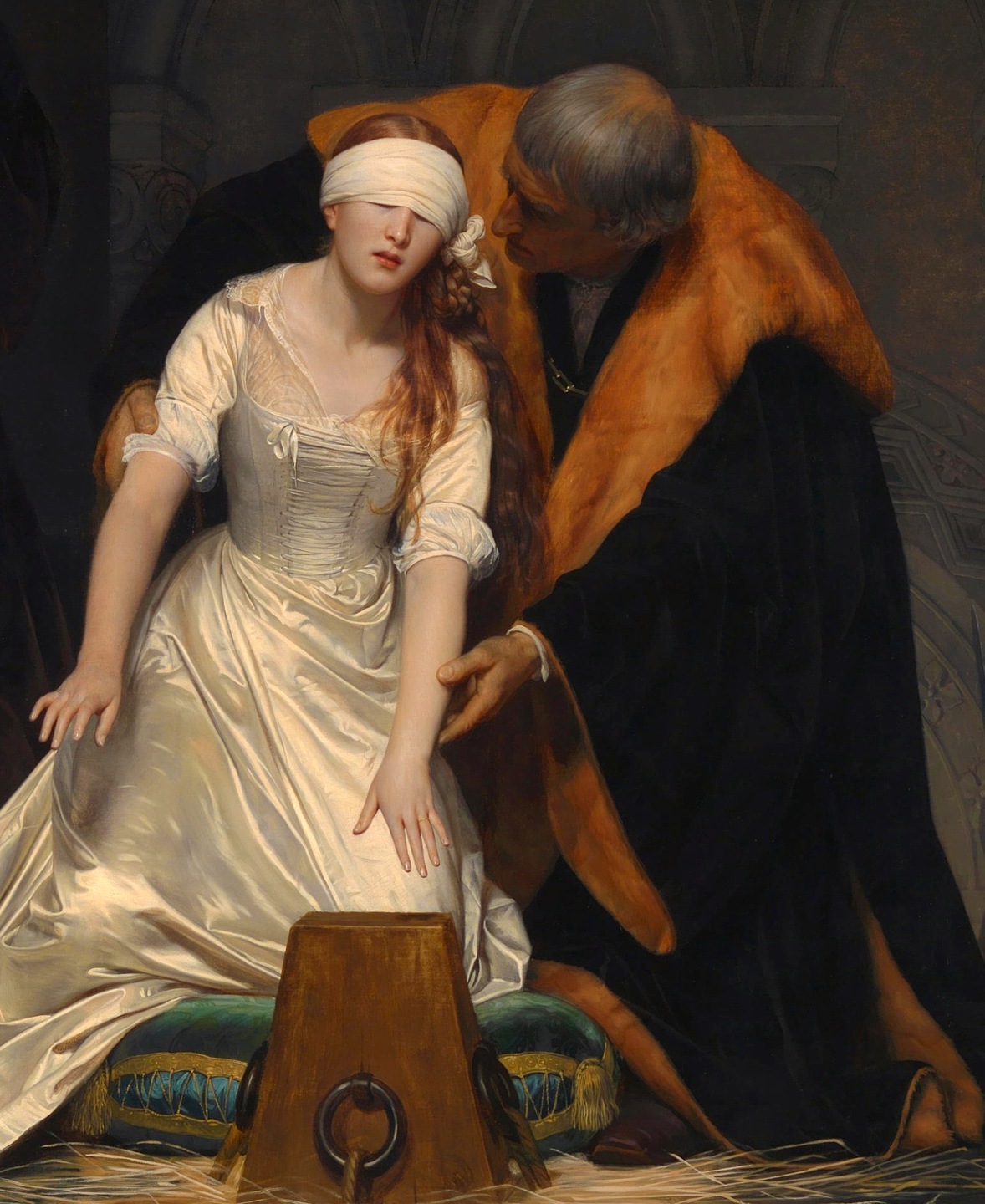
Lady Jane Grey reaches forward with both hands, searching for something everyone around her can already see. The wooden block is just below her fingers. A man bends close to help her. At the right, an executioner waits with his axe resting on the ground.
Paul Delaroche painted The Execution of Lady Jane Grey in 1833, almost three centuries after the young queen's death. The original is in the National Gallery, London. It shows the moments before her execution, but its dark interior and brilliant white dress belong to a carefully constructed historical drama. Understanding that distinction makes the picture more revealing.
Jane's brief rule began during the succession crisis following Edward VI's death in 1553. A Protestant, she was placed on the throne ahead of Edward's half-sister Mary. Her reign lasted only nine days. When Mary's supporters prevailed, Jane became a prisoner in the Tower of London.
Conviction for treason did not immediately lead to execution. Historic Royal Palaces explains that Mary initially hesitated to put Jane to death. The political danger changed after Wyatt's Rebellion in 1554, in which Jane's father was involved. Jane and her husband, Guildford Dudley, were executed on 12 February 1554. Jane was still a teenager.
Delaroche leaves that struggle for the crown outside the picture. There is no throne, council chamber or battlefield. He brings us to the point where political decisions have become a physical reality for one person. Read the historical account from Historic Royal Palaces.
Start with the small gap between Jane's hands and the wood. Her fingers spread rather than grip. The nearer hand hangs above the edge of the block; the other reaches into empty space beside her skirt. Those distances are easy for a sighted viewer to measure. For Jane, they are unknown.
The blindfold turns looking into an unequal experience. We know where the block stands and where the axe waits. She has to rely on touch and on the man beside her. The National Gallery identifies him as Sir John Brydges, Lieutenant of the Tower.
He bends over Jane instead of confronting her across the platform. One hand supports her arm, while his face comes close to hers. Read as a gesture, it offers practical help at an unbearable moment. The painting does not tell us what he is thinking, and his nearness should not be mistaken for a documented private conversation.
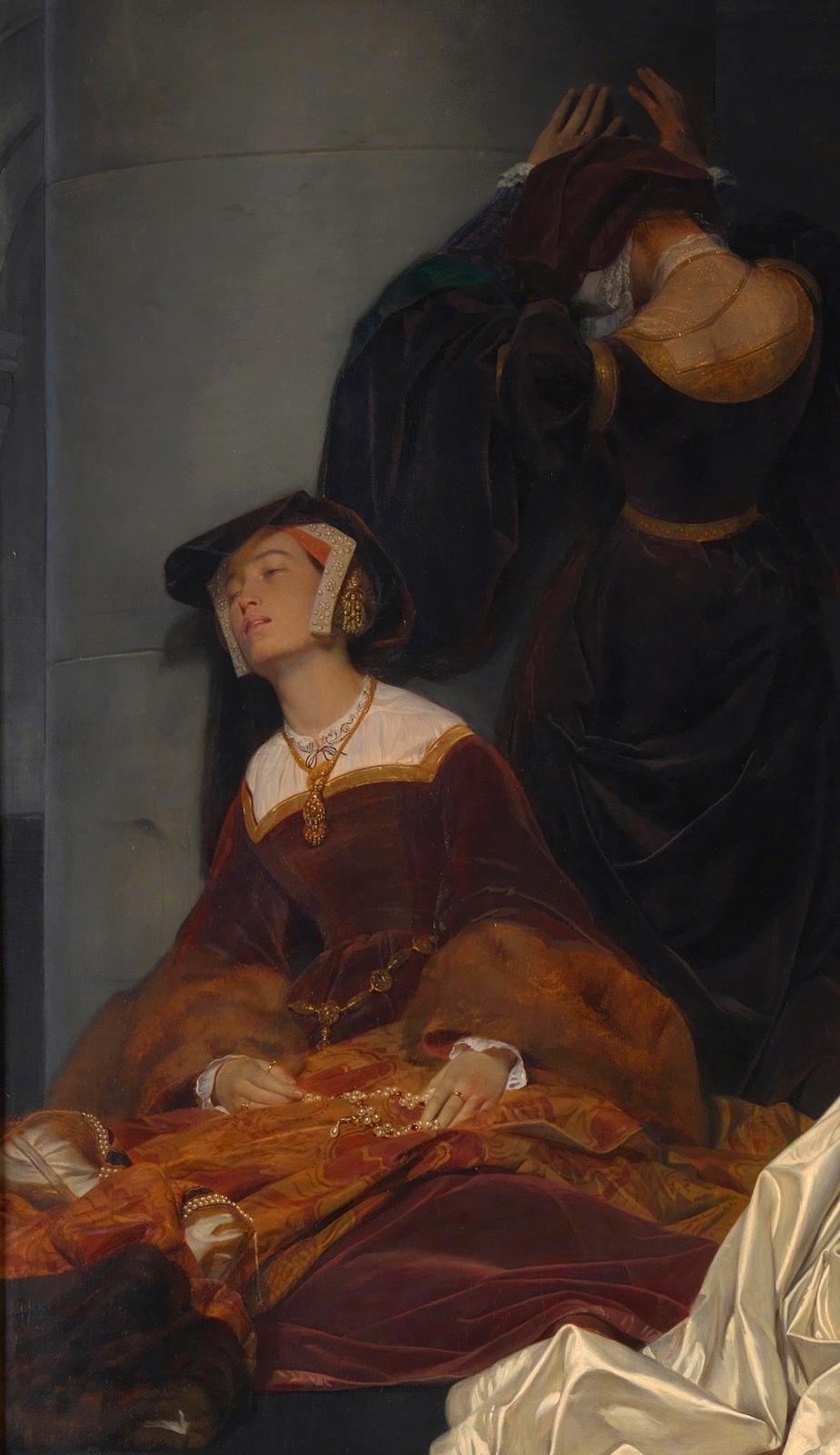
At the left, the attendants give the scene two different shapes of grief. One sits low against the column with her head tilted back and her gaze turned upwards. Rich fabric spreads across her lap. Behind her, the other turns towards the stone, raising both hands and hiding her face.
Their bodies move away from the action. Jane's body moves towards it. This opposition keeps the left side of the painting from becoming a separate episode: each attendant's withdrawal directs our attention back to what she cannot bear to witness.
The standing woman's raised hands also answer Jane's lowered ones. One pair reaches towards a wall; the other searches for the block. Delaroche gives their hands different tasks, while their covered or averted eyes link the three women across the composition.
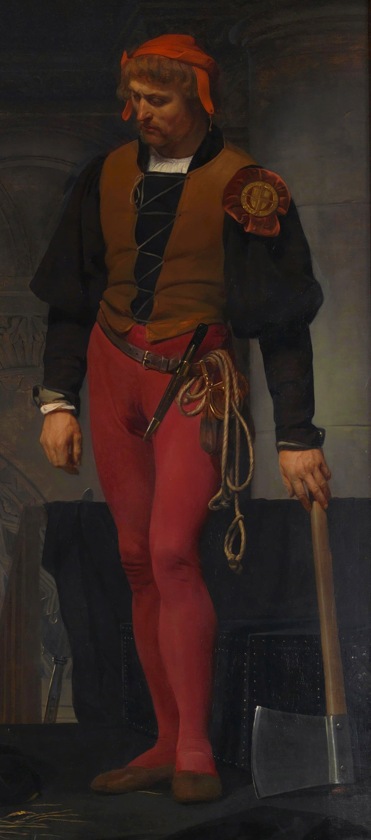
The executioner is upright and almost still. His red clothing makes him easy to locate against the dark wall, but his axe is lowered. Delaroche has chosen the pause before the killing rather than the raised weapon or the fatal blow.
Look at the space separating him from Jane. Nothing obstructs his route to the block. The pause feels temporary because the arrangement already contains everything needed for the next action.
His face is visible, without a mask. It would be tempting to call his expression pity, boredom or reluctance, but the picture cannot establish any of those feelings. What we can see is his downward gaze and his waiting posture. That restraint leaves the viewer to confront his role without an exaggerated gesture telling us how to respond.
Jane's dress occupies far more space than her body. Its folds spread across the platform, carrying light towards the foreground. Against the red, brown and black clothes around her, the white cloth makes her the first figure the eye finds.
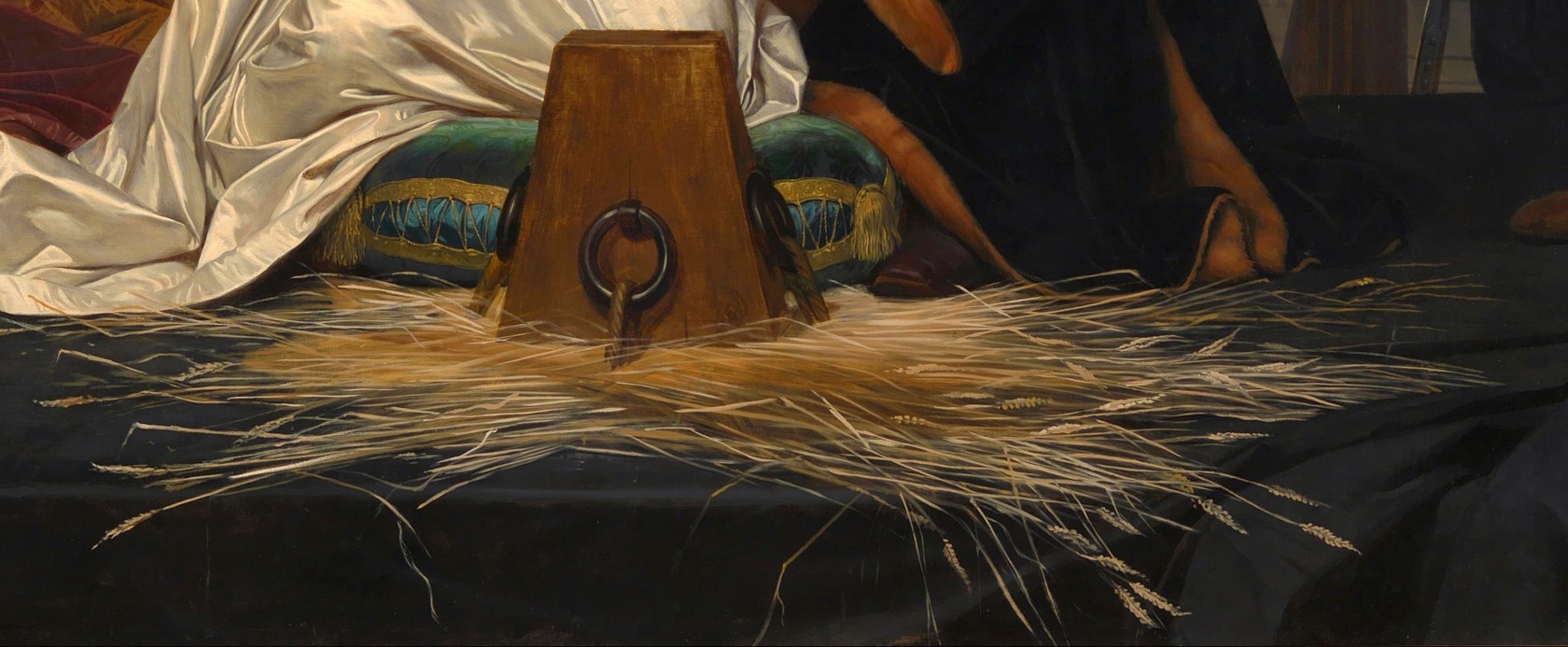
The satin can appear soft and almost weightless. Beside it, the block looks solid: a warm brown object with a ring fixed to its front. This meeting of fabric and wood brings the scene down to materials we can imagine touching.
Straw lies around the block, extending towards the lower edge of the canvas. The National Gallery explains its practical purpose: to absorb blood. There is no need for a painted wound. Once we understand why the straw is there, an apparently ordinary detail supplies the consequence that the picture otherwise withholds.
Jane was executed outdoors on Tower Green. Delaroche places her beneath heavy arches in a shadowy interior. The change removes the open air and confines the figures to a space that feels closed around them.
The painting is also much later than the event. Its remarkable clarity can make it feel like a witnessed scene, but Delaroche was born in 1797, long after Jane's death. It is a nineteenth-century interpretation of Tudor history, not a portrait made from life.
Accounts of Jane's final moments tell of her difficulty finding the block after she was blindfolded. The National Gallery traces Delaroche's subject to the Protestant martyr tradition and a text cited in the 1834 Salon catalogue. Such accounts shaped Jane's later reputation. The picture gives that tradition a persuasive visual form; it cannot independently verify every detail of the execution. See the National Gallery's account of the painting.
Delaroche built his reputation through scenes of historical crisis. The National Gallery's artist biography records the enthusiastic reception of Lady Jane Grey at the Paris Salon in 1834. It also describes his wider practice of large, finely detailed historical paintings.
For French audiences after the Revolution, stories of imprisoned royalty and execution had recent parallels at home. The Gallery's research for its 2010 exhibition places Jane alongside Delaroche's interest in Charles I and the princes in the Tower.
That background helps explain the theatrical setting. Delaroche gives us a small cast, a shallow platform and sharply directed light. The scene is arranged so that a viewer can understand its emotional stakes before recognising any of the names. Read about Delaroche's historical subjects and relationship with theatre.
The original belongs to the National Gallery in London. Its history includes damage in the Thames flood of 1928 and rediscovery in 1973. The Gallery's exhibition history records its first display there in 1975, two years after that rediscovery. Those dates explain how a nineteenth-century success acquired a renewed public life in the twentieth century.
For another painting that concentrates on the interval before death, read our guide to Jacques-Louis David's The Death of Socrates. ByMuseum also offers a hand-painted reproduction of The Execution of Lady Jane Grey.
The French artist Paul Delaroche painted it in 1833. It was exhibited at the Paris Salon the following year.
It depicts a historical execution through a later interpretation. The indoor setting differs from Tower Green, and the central action draws on accounts shaped by Jane's commemoration as a Protestant martyr.
The National Gallery describes the garment as a satin petticoat. Her outer clothing has been removed. Calling it a nightgown can obscure the execution preparations represented in the scene.
It presents Jane as a vulnerable young woman facing execution. Her searching hands, the attendants' averted faces and the waiting axe allow us to read the moment through uncertainty, grief and anticipation. Those are interpretations of Delaroche's composition, rather than evidence of the historical figures' private thoughts.
Paul Delaroche, The Execution of Lady Jane Grey (1833), National Gallery, London, NG1909. Faithful public-domain reproduction via Wikimedia Commons. Detail images are crops of the supplied source, with no painted forms added or upscaling.
Enjoyed this story?
Save articles to your collection
Log in or create a free account, and this article will be waiting in your Private Collection.
Log in or sign up
Man Writing a Letter
Gabriel Metsu, c. 1664
The gallery list
Every painting is already 50% off. Join the list and we will send you an extra $15 code, plus first access to new collections.
No spam. Unsubscribe anytime. · Privacy Policy
Welcome
Your $15 code is on its way. Explore the gallery while you wait.