Loading cart…
No products in the cart.

1787 · Oil on canvas · Metropolitan Museum of Art, New York
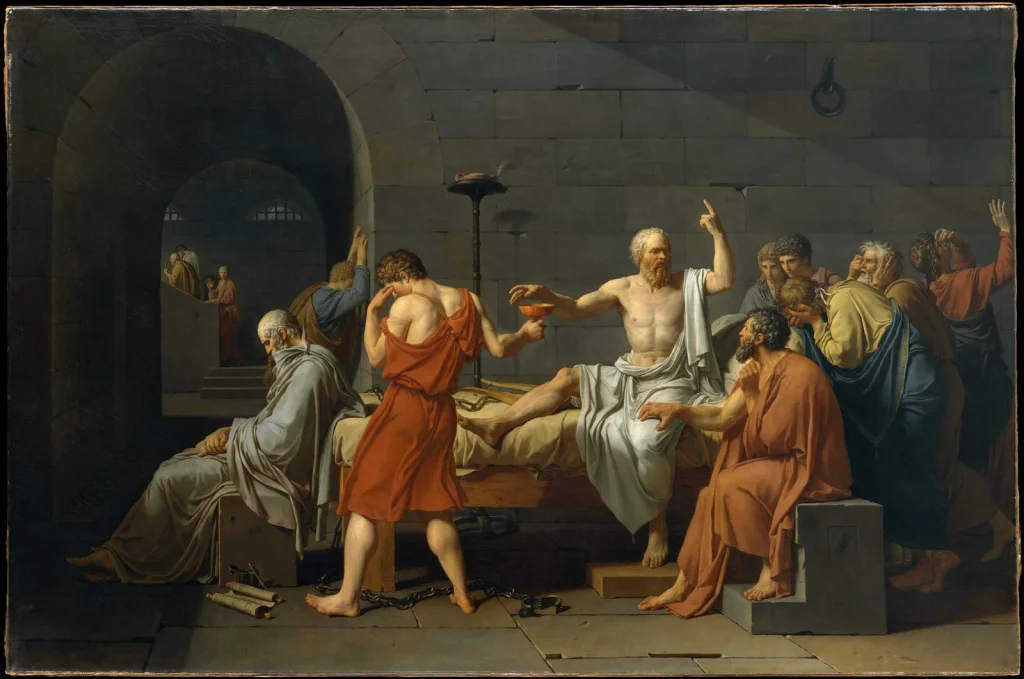
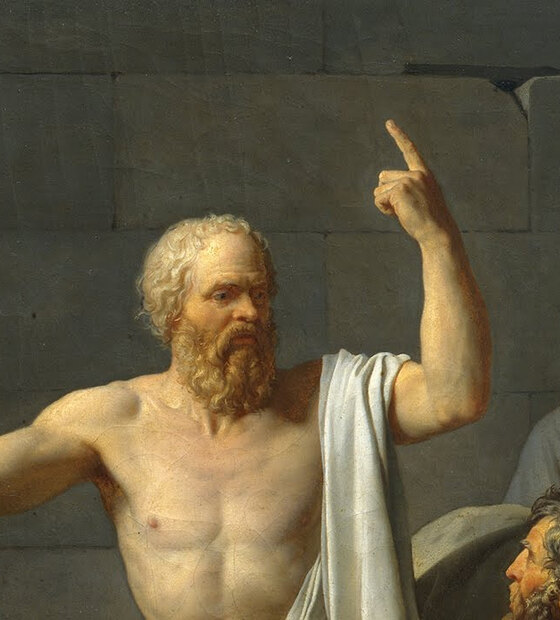
Two hands tell the story. Socrates' right hand is raised with one finger pointing upward: he is mid-sentence, arguing that the soul survives the body. His left hand is reaching sideways for the cup of hemlock, and he is not looking at it. He will drink it when he gets to the end of the thought.
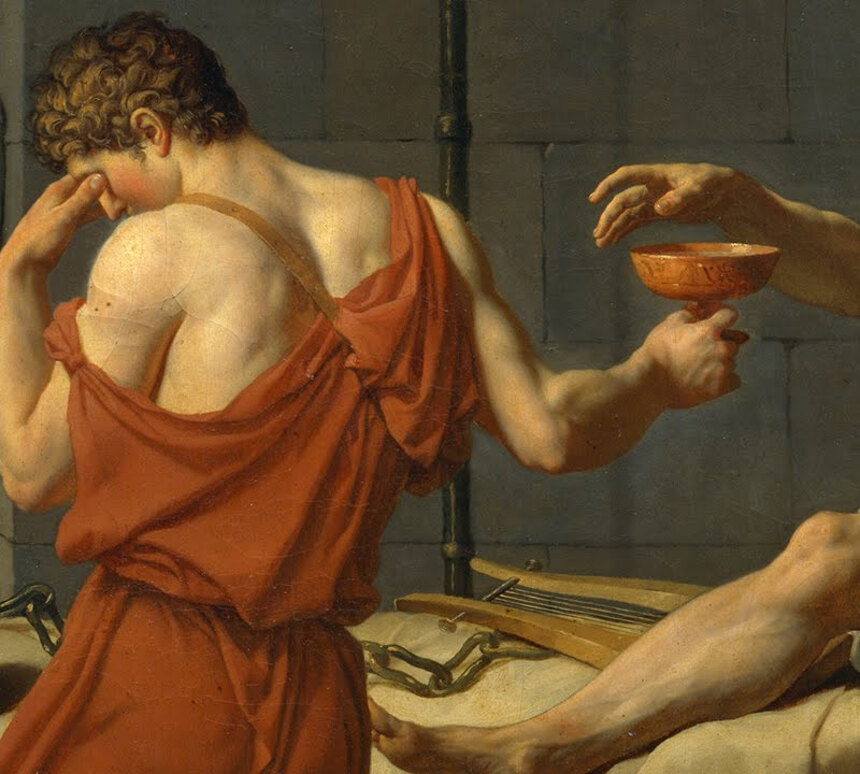
The man holding the cup is the jailer whose job it is to hand it over, and he has turned his face into his own arm because he cannot watch. The condemned man is calm and the executioner is in tears. David has put the whole moral of the picture into that reversal.
Socrates was seventy when the Athenians tried him for corrupting the young and not believing in the city's gods. He could have proposed exile as his sentence and probably got it. Instead he proposed that the city should feed him at public expense as a benefactor, and was condemned to death by a larger majority than had found him guilty.
His friends arranged an escape. He refused it: he had lived under the laws of Athens all his life and would not break them now. On the last day, with his friends around him in the prison, he talked about the soul until sunset, then drank the hemlock, walked until his legs grew heavy, lay down, and died. Plato, who was not there, wrote it all down in the Phaedo, and that is the text David painted.
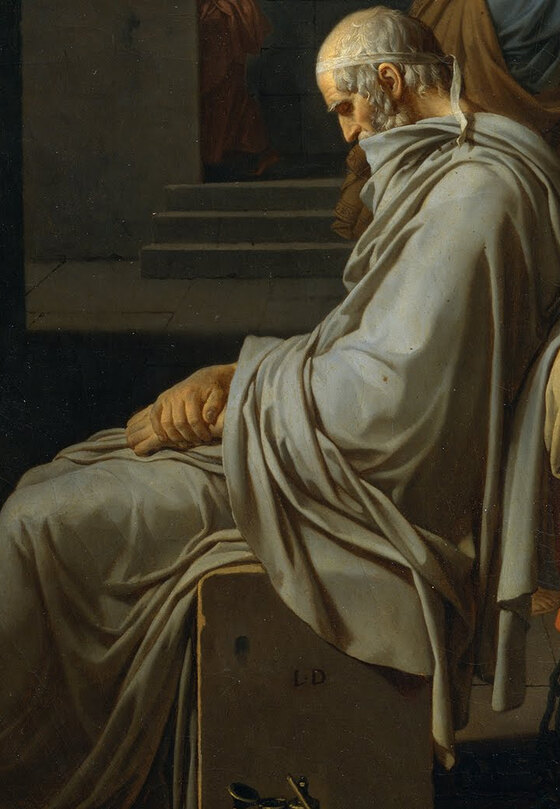
Look at the old man in grey sitting at the foot of the bed with his back to everything, eyes closed, hands folded, a scroll and a pen on the floor beside him. That is Plato. He was twenty-eight when Socrates died and, by his own account in the Phaedo, he was ill and stayed away. David has painted him as an old man anyway, and given him the scroll, because it is Plato's telling of the scene that we are looking at. He is not in the prison. He is remembering it, and the picture is his memory.
David signed the painting twice, and both signatures are on the philosophers: his initials on Plato's seat, and his full name on the stone block under Crito. It is the closest he came to saying whose side he was on.
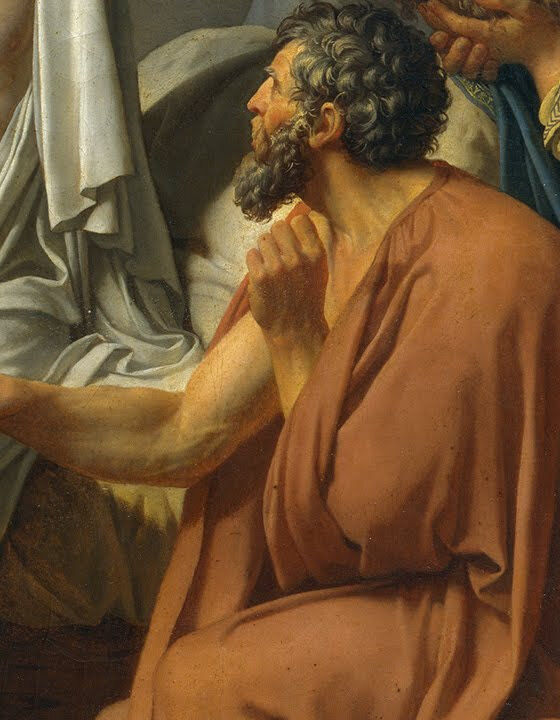
The man in red sitting on the bed with his hand clamped on Socrates' thigh is Crito, the friend who had bribed the guards and had a boat waiting. He is not listening to the argument. He is holding on. Around him the other disciples do what people do at a deathbed: one covers his face, one raises his arms, one leans on the wall, and at the back, going up the stairs, Xanthippe, the wife, is being led out because she was making too much noise.
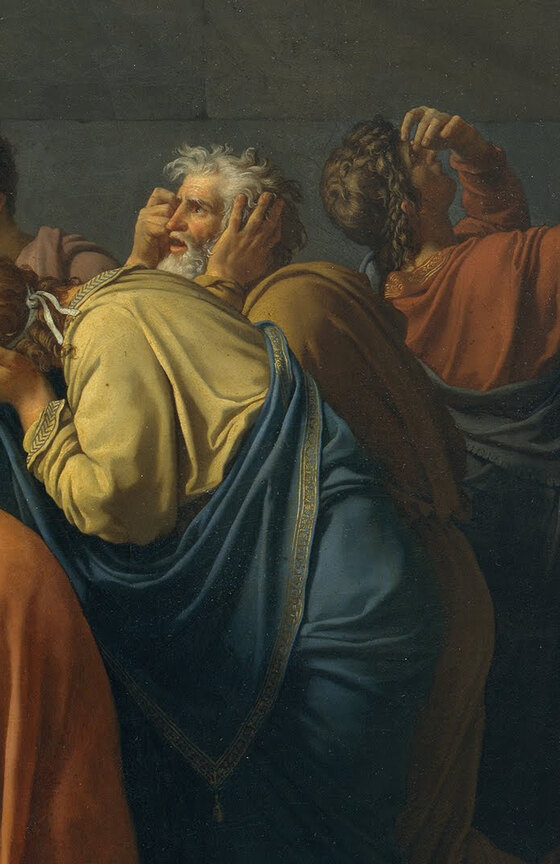
David gives every friend a different grief and gives Socrates none. The old man is the only person in the room who is not moving, and that stillness is the argument: the body is going to die and the man does not mind.
David painted it in 1787 for a rich young reformer, Charles-Michel Trudaine de la Sablière, and showed it at the Salon that year, three years after the Oath of the Horatii had made him the most talked-about painter in Europe. The English painter Sir Joshua Reynolds saw it in Paris and said, according to the report that reached David, that it was the greatest effort of art since the Sistine Chapel and the Stanze of Raphael.
It was also, in 1787, a political picture. A man who chose death rather than break the law, a philosopher who put reason above the gods of the city, a scene in which the state kills its best citizen and the citizen forgives it: two years before the Revolution, in a France that was already arguing about all of this, nobody needed it explained. Trudaine, who commissioned it, was guillotined in 1794. David, who painted it, voted for the king's death and painted Marat six years later.
It means that a good man can be killed but not defeated. Socrates in the painting is not a victim; he is a teacher finishing a class, and death is the last thing on the syllabus. David composed it like a relief on a Roman sarcophagus, a row of figures against a flat wall, with the light falling on the one white body in the middle, so that the eye cannot leave him.
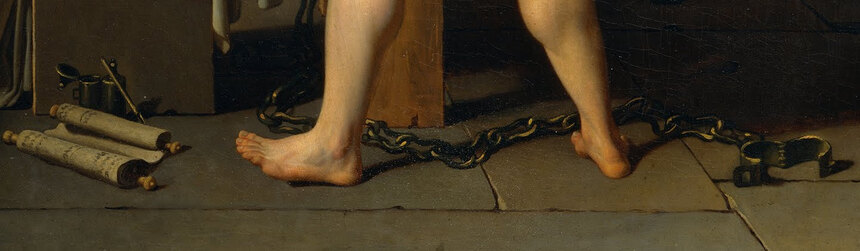
The picture has meant this to two centuries of people facing something they cannot escape. It has hung in classrooms and law courts, been quoted in films and parodied in cartoons, and become the standard image of dying well. Look at the shackle on the floor. They took it off him so that he could die free. He was already free.
In the Metropolitan Museum of Art in New York, which bought it in 1931 with the Catharine Lorillard Wolfe Fund. It is oil on canvas, 130 by 196 centimetres, and it hangs in the European paintings galleries where it is one of the most photographed pictures in the building. A smaller studio version is at Princeton.
It is a painting for a study, a library, a lawyer's office or anywhere an argument is respected. Our hand-painted reproduction of The Death of Socrates is painted in oil on canvas from the Met original, and its cool greys and the one white figure take a dark or black frame. Hang it at eye level; the finger should point at the ceiling, not at you.
More David in our Jacques-Louis David collection, and the wider Neoclassicism archive.
Visible details, documented facts and interpretation are kept separate throughout this article. The Reynolds remark is given as David's biographers reported it.