Loading cart…
No products in the cart.

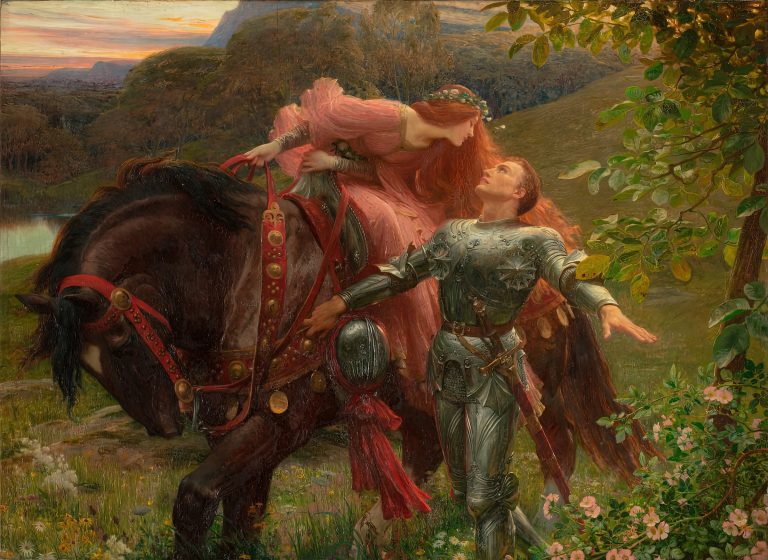
c. 1901 (exhibited 1902) · Oil on canvas · Bristol Museum & Art Gallery, Bristol, England
Save articles to your collection
Log in or create a free account, and this article will be waiting in your Private Collection.
Log in or sign upA young knight in silver armour walks beside a huge dark horse. On the horse sits a woman in a pink dress, with long red hair and a garland of flowers on her head. She leans right down out of the saddle until her face almost touches his. He looks up at her and throws both arms wide open, as if he is giving himself up.
Around them is an English meadow at the end of the day: wild roses, long grass, trees heavy with leaves, a lake in the distance and a sunset over the hills. It looks like a love scene. It is actually the first half of a ghost story.
The title comes from a ballad by John Keats, written in April 1819, when he was twenty-three. The words are French and mean "the beautiful lady without mercy". Keats borrowed them from a poem of 1424 by the French court poet Alain Chartier.
The ballad opens with a stranger finding a knight wandering alone on a bare hillside in late autumn:
O what can ail thee, knight-at-arms,
John Keats, La Belle Dame sans Merci, 1819
Alone and palely loitering?
The sedge has wither'd from the lake,
And no birds sing.
The knight explains. He met a lady in the meadows, "a faery's child", with long hair and wild eyes. He made her a garland, lifted her onto his horse and walked beside her all day while she sang to him. She took him to her cave, sang him to sleep, and in his dream pale kings, princes and warriors warned him that the beautiful lady without mercy had him in her power. He woke up alone on the cold hillside, and he has been waiting there ever since.
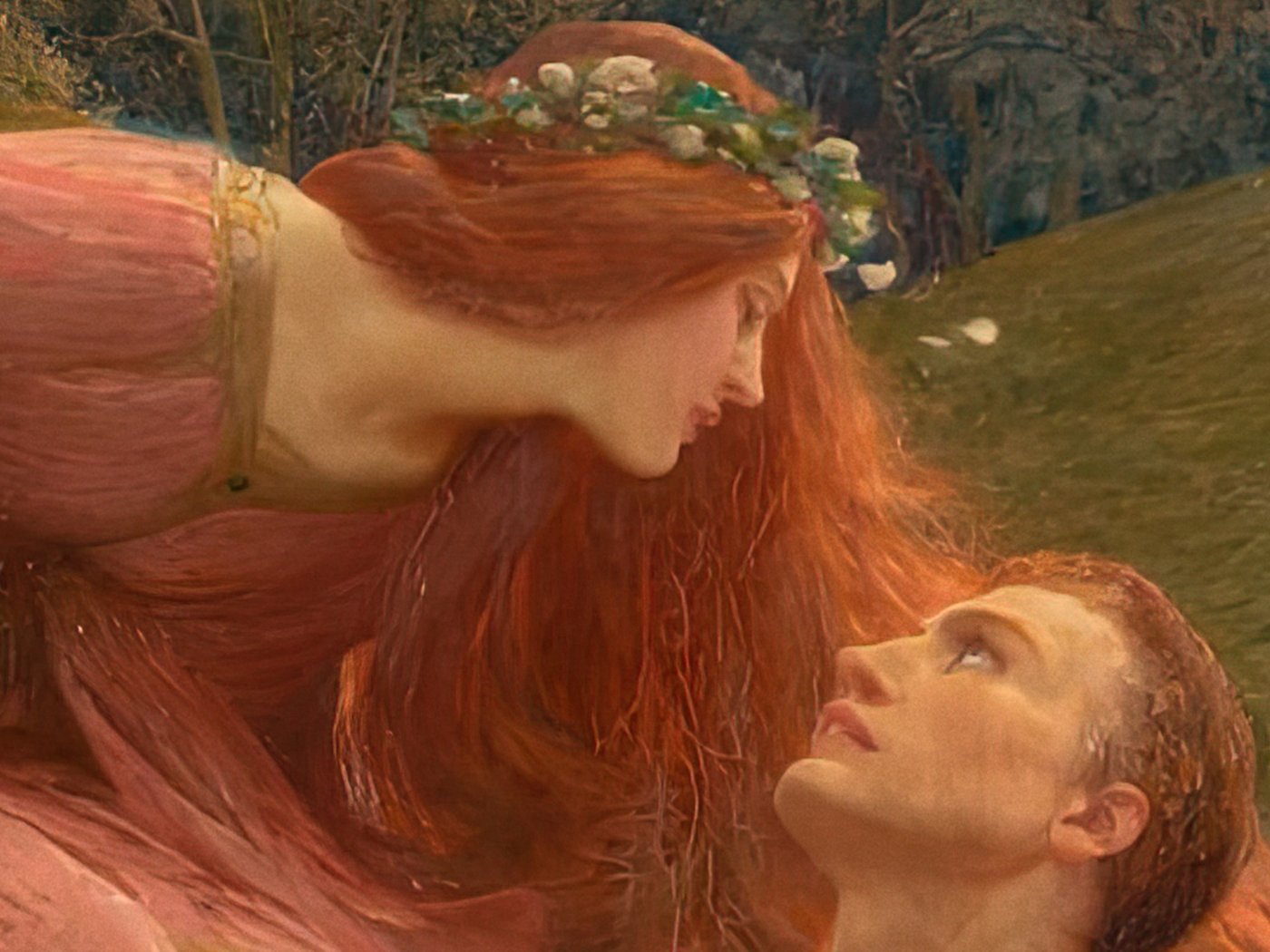
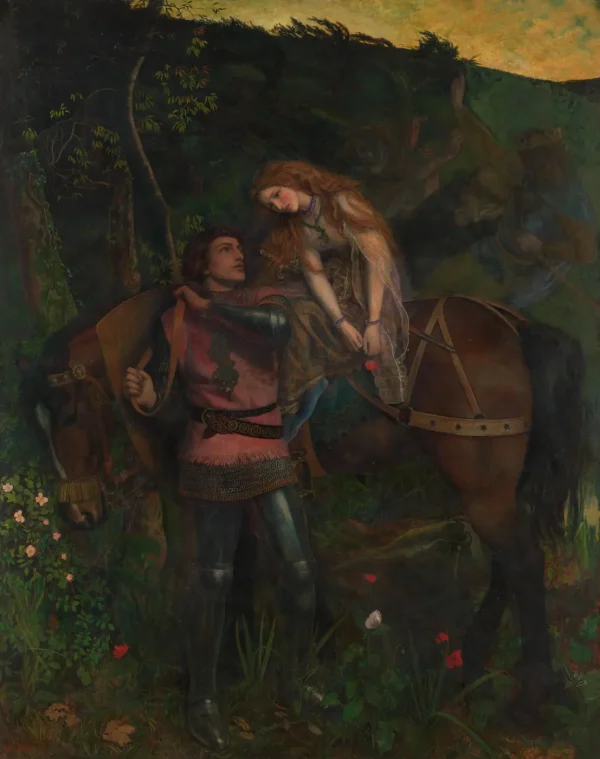
Dicksee chose the happiest moment in the poem, the day the knight spends walking beside her horse. He follows the words closely:
I set her on my pacing steed,
John Keats, La Belle Dame sans Merci, 1819
And nothing else saw all day long,
For sidelong would she bend, and sing
A faery's song.
Everything in that verse is in the picture. She is on his horse. She bends sideways toward him. He looks at nothing but her. The garland on her head is the one the knight says he made for her in the stanza before. Even the lake in the background comes from the poem's first lines.
What you can see, and what is interpretation: the pose, the horse, the garland and the lake are all visible and all match the text. Whether she is about to kiss him or only singing to him is not clear from the painting. Her lips are close to his face, but the poem only says that she sang.
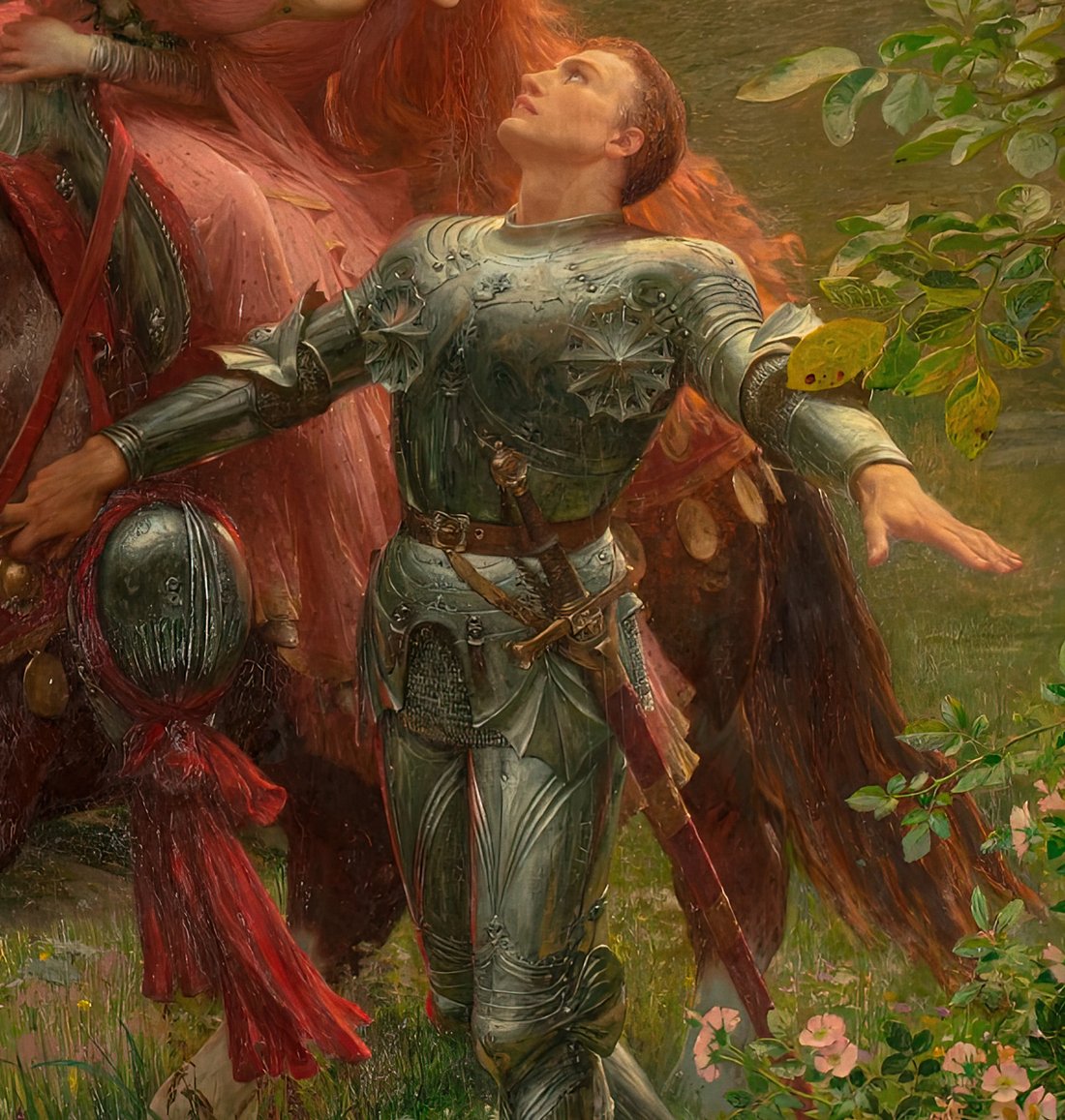
A knight is supposed to be in control: of his horse, his weapons and himself. This one has let go of everything. One hand only brushes the horse's side. The other arm swings out into empty air. His head tips back so far that he can only see her face. His sword hangs uselessly at his hip.
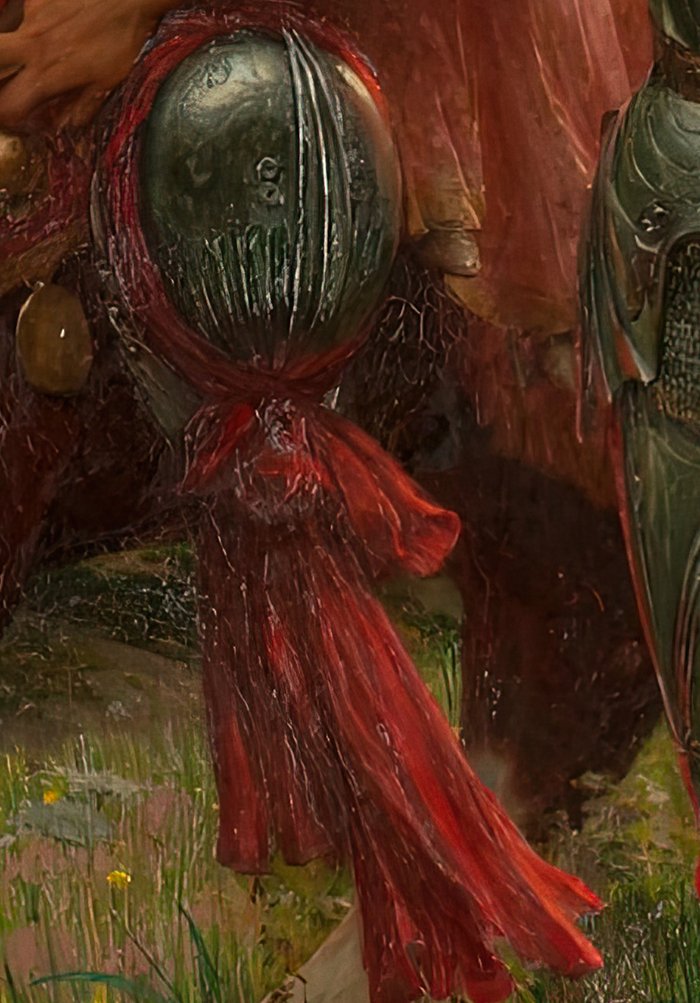
His helmet hangs from the saddle on a long red cord, so his head is bare. It is a small detail, but a telling one: the man in armour has taken off the one piece that would protect his face.
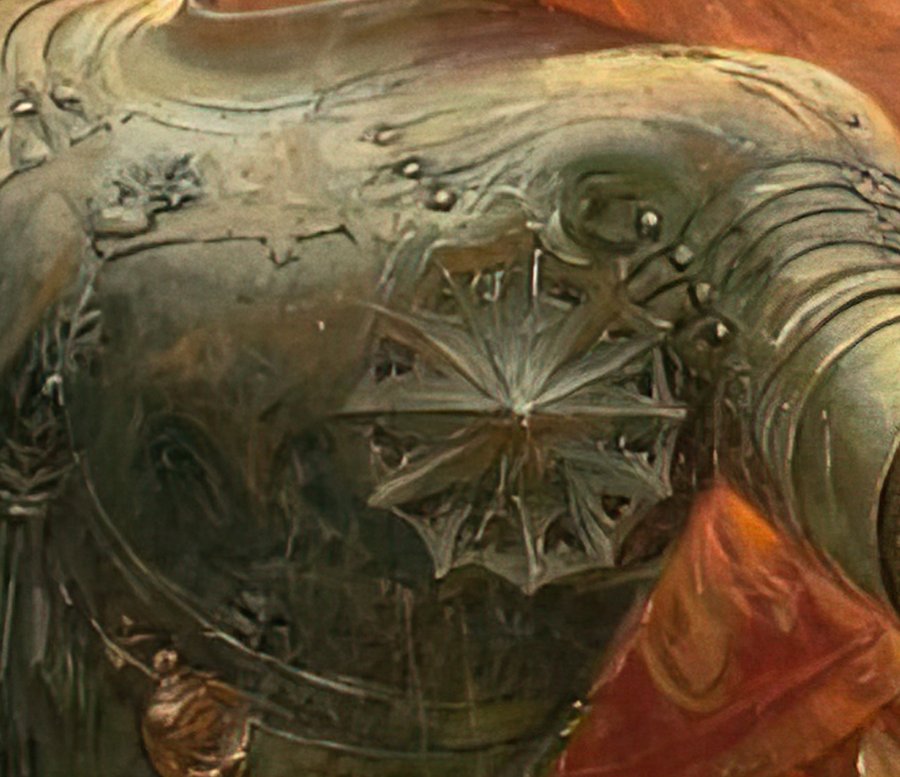
Look closely at the armour and you can see how much work Dicksee put into it. The steel picks up the green of the meadow and the pink of her dress. The breastplate carries a star-shaped ornament. The armour is shiny, new and perfect, and none of it helps him.
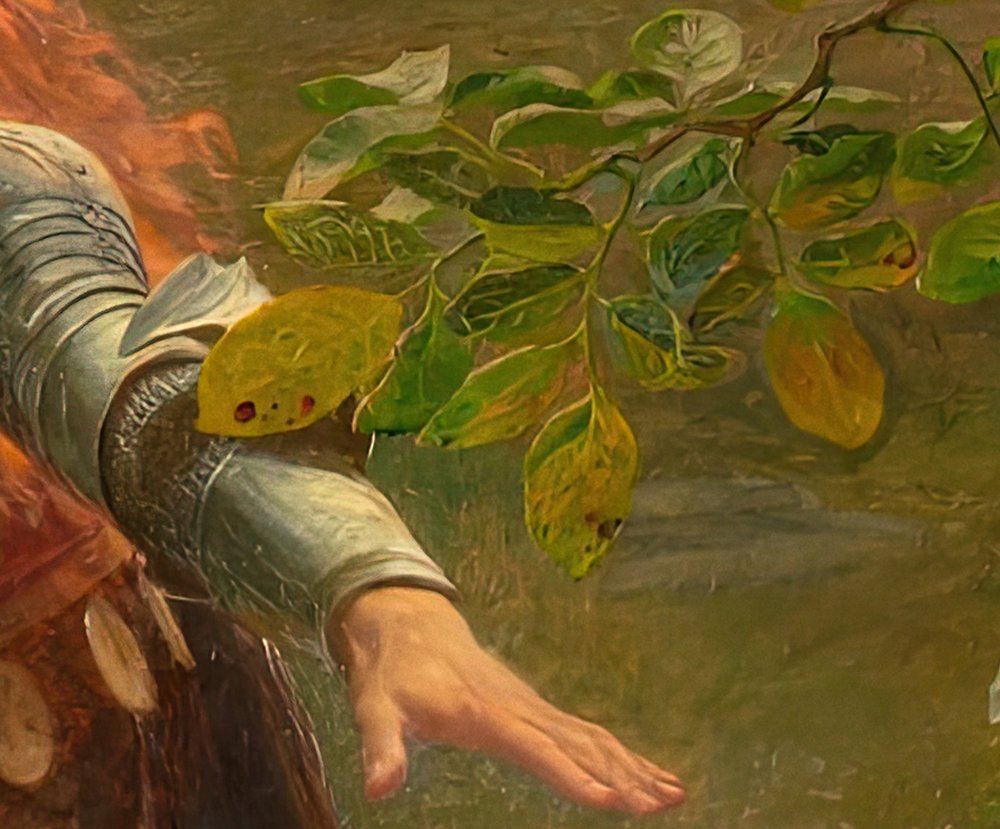
Dicksee does not paint the sad ending, the cold hillside and the ghostly kings. The whole scene is warm and green. But he leaves a few small hints.
The clearest is right beside the knight's outstretched arm. A branch reaches toward him, and some of its leaves have turned yellow and are spotted with brown. Bristol Museums, which owns the painting, points to these damaged leaves as the one sign in the picture that things will end badly. In the poem, the knight is found in a season when the plants have withered.
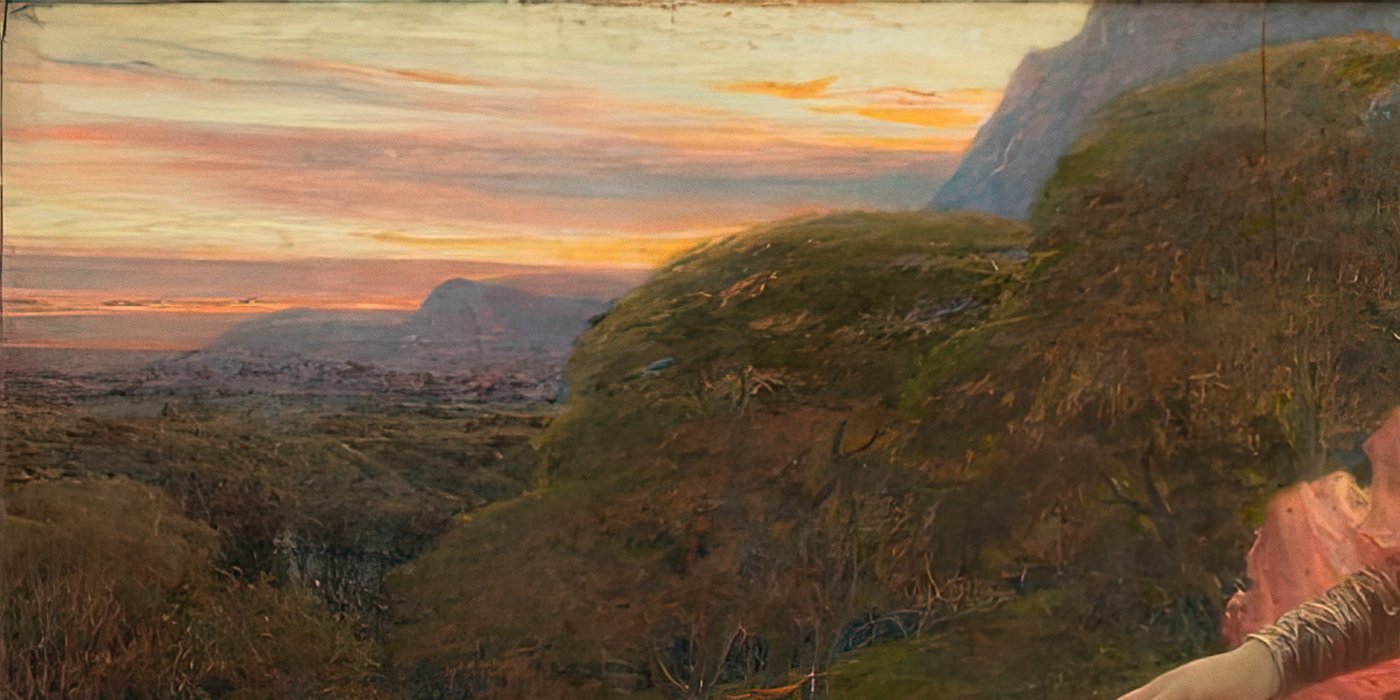
The second hint is the time of day. In the top left corner the sun is setting behind the hills, in bands of pink and gold. The knight's perfect day is nearly finished. In the poem, what comes next is her cave, a deep sleep and the cold hillside.
What you can see, and what is interpretation: the yellowed leaves and the sunset are both in the painting. Reading them as warnings is an interpretation, although it is a common one, and it fits the poem well.
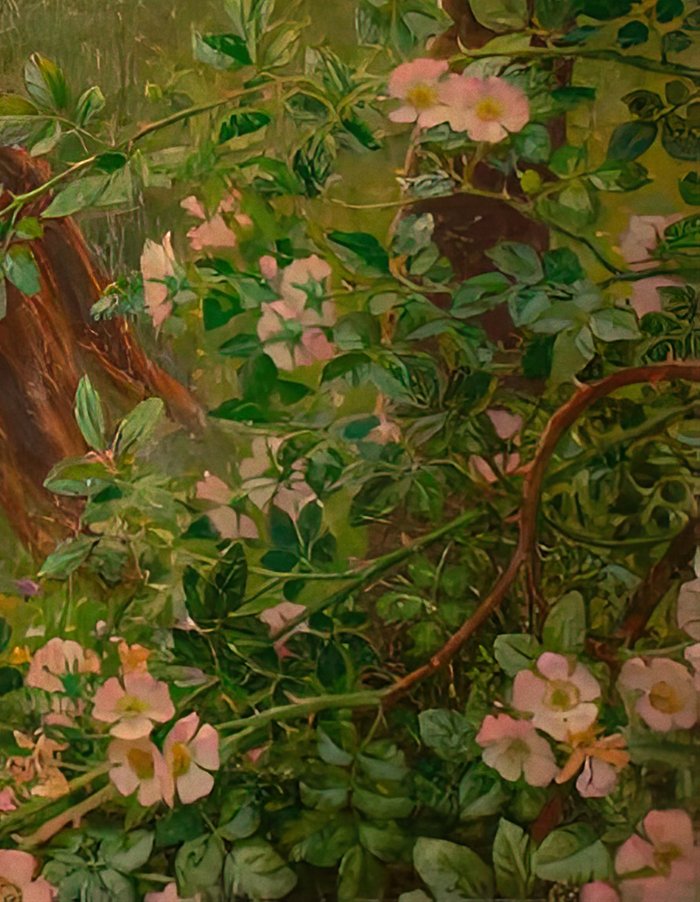
Because the danger in the story is beauty itself. Dicksee makes everything attractive: the pink wild roses in the corner, the tiny flowers in the grass, the glowing hair, the silky pink dress. The viewer is meant to be charmed in the same way the knight is.
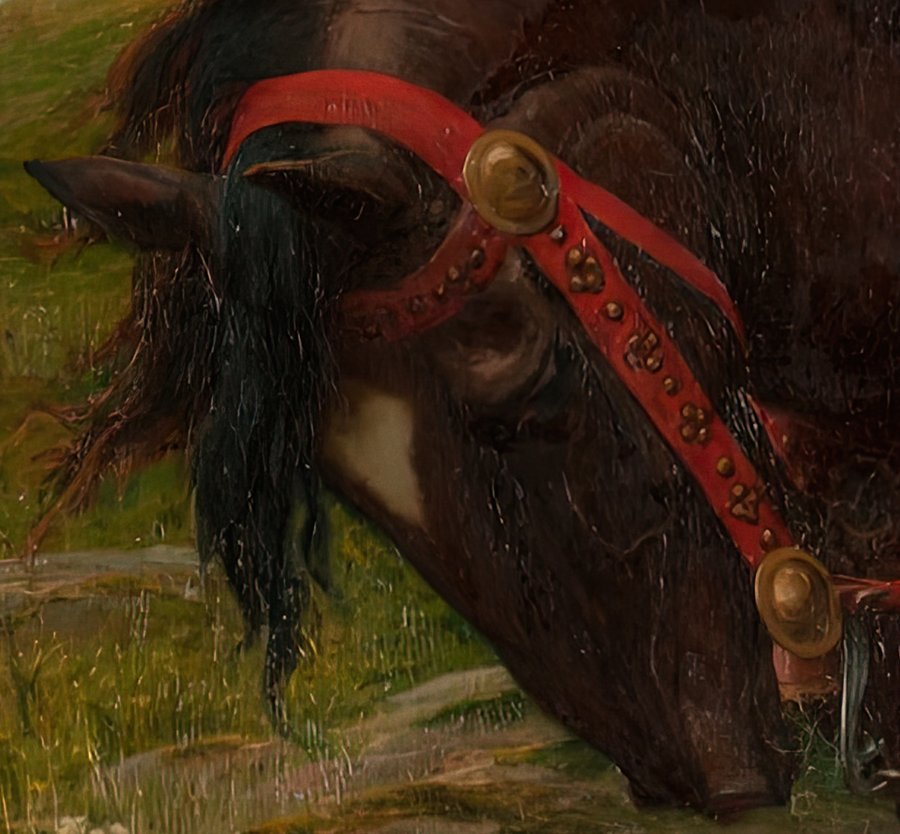
The horse is the one figure not looking at her. It bends its head down toward the grass, heavy and calm, in a red harness decorated with gold. It is the knight's own horse, but now it carries her, and it walks where she wants.
Earlier paintings of the poem, such as Arthur Hughes's version from the 1860s, are much smaller and quieter. Dicksee's is large, about 1.4 by 1.9 metres, bright and full of movement. Bristol Museums describes his use of strong colour and dramatic space as a new approach to an old subject.
On the surface it is a fairy tale about a man bewitched by a supernatural woman. Underneath, it is about desire: how wanting someone can take over everything else, and how empty life feels when that person disappears.
Late Victorian and Edwardian painters loved this kind of story. Knights, chivalry and dangerous beautiful women appear again and again in their pictures. The theme is often called the "femme fatale", French for a fatal woman. Bristol Museums links the painting to changing ideas about men and women around 1900, when women were demanding more independence and many men felt uneasy about it. In that reading, the knight who gives up all his control is a picture of a very modern worry.
Dicksee himself does not judge her. She is not shown as a witch or a monster. She is lovely, and so is the day. The painting shows the moment before anything goes wrong, and leaves the rest of the story to anyone who knows the poem.
Frank Dicksee was born in London in 1853 into a family of painters. His father taught him, and he trained at the Royal Academy Schools. He became famous young for large, romantic pictures of lovers, knights and dramatic moments from literature, including Romeo and Juliet, Chivalry and The Two Crowns, which was bought for the national collection in 1900.
He stayed loyal to this kind of storytelling painting long after modern art had moved on. In 1924 he became President of the Royal Academy, and the following year he was knighted, which is why he is often called Sir Frank Dicksee. He died in 1928. La Belle Dame sans Merci, painted around 1901, comes from the height of his career.
The painting belongs to Bristol Museum & Art Gallery in Bristol, England, and has been one of the highlights of its collection since 1913. It is oil on canvas and large, 137.1 by 187.9 centimetres. Dicksee painted it around 1901 and showed it at the Royal Academy in 1902.
We paint La Belle Dame sans Merci by hand in oil on canvas, at the original size or the size that suits your wall, with the glowing red hair, the polished armour and the wild roses built up in layers. See the hand-painted reproduction.
Enjoyed this story?
Save articles to your collection
Log in or create a free account, and this article will be waiting in your Private Collection.
Log in or sign upWhat can be seen in the painting, what is documented, and what is interpretation are kept separate throughout this article.