Loading cart…
No products in the cart.

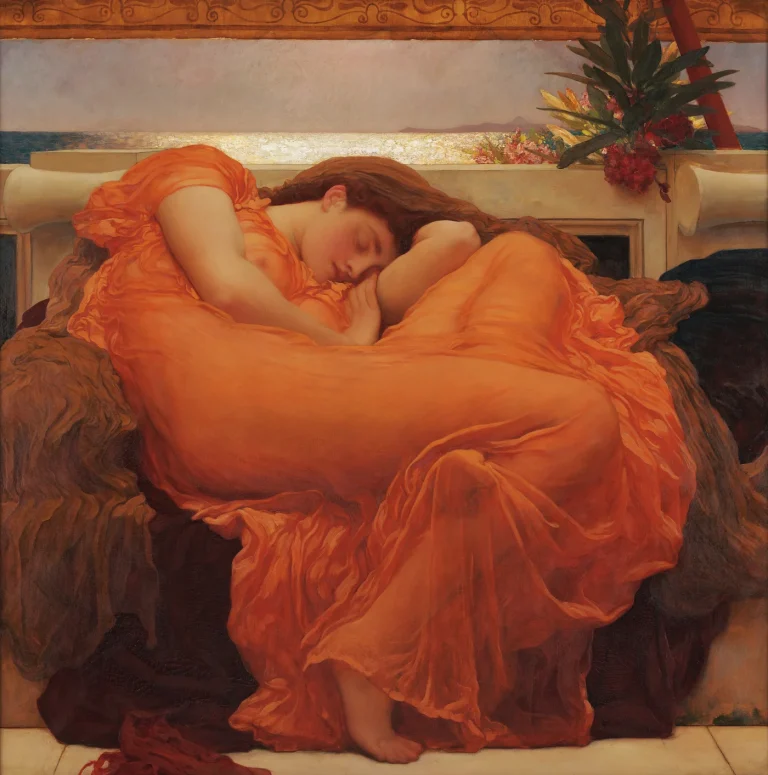
1895 · Oil on canvas · Museo de Arte de Ponce, Puerto Rico
Save articles to your collection
Log in or create a free account, and this article will be waiting in your Private Collection.
Log in or sign upIn 1962 a young music student in London saw this painting in a shop window in the King's Road, priced at fifty pounds, and asked his grandmother for the money. She refused. She would not, she said, have Victorian junk in her flat. The student was Andrew Lloyd Webber, who has been telling the story ever since, and the painting was Flaming June.
It had been found a few years earlier boxed in above a chimney in a house in Battersea, sold on with the frame worth more than the canvas, and passed through the trade unloved. In 1963 a Puerto Rican industrialist, Luis Ferré, bought it for the museum he was building in Ponce, for a sum that would not buy a car today. It has never left. The most reproduced painting of the Victorian age hangs on an island in the Caribbean, because for thirty years nobody in England wanted it.
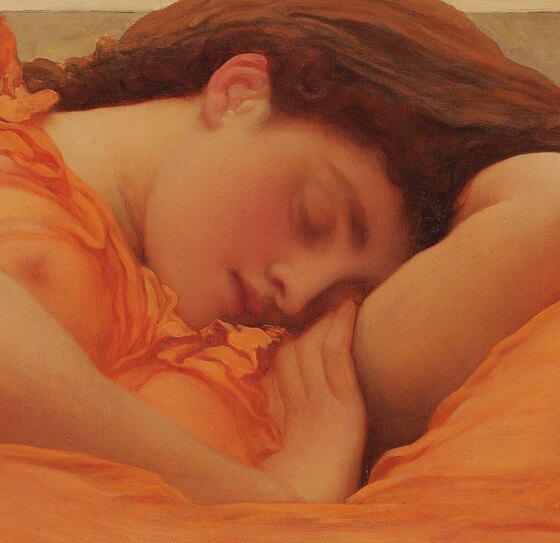
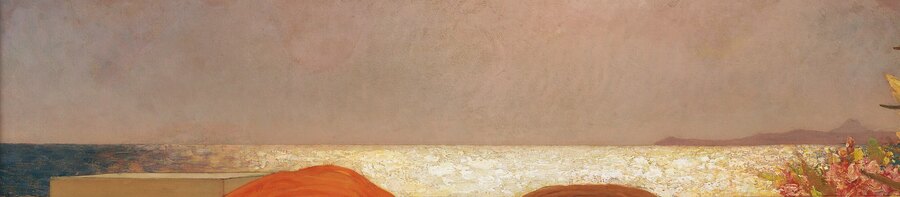
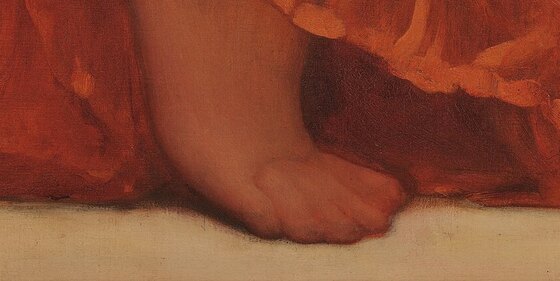
A young woman sleeps on a marble bench in the heat, curled into herself, her head on her arm, her hair down. She wears a dress of thin orange silk that the light comes through, and the dress has fallen and gathered so that her whole body is drawn by it: the curve of the back, the knee raised, the foot tucked under. Behind her a low parapet, and beyond it the sea at sunset, flat and gold.
The canvas is square, which is rare, and the figure fills it in a spiral, so that the eye goes round and round her and never gets out. Leighton was president of the Royal Academy and the most accomplished draughtsman in England, and this is the pose he had been working toward all his life: the sleeping figure of Michelangelo's Night, turned into a girl on a hot afternoon.
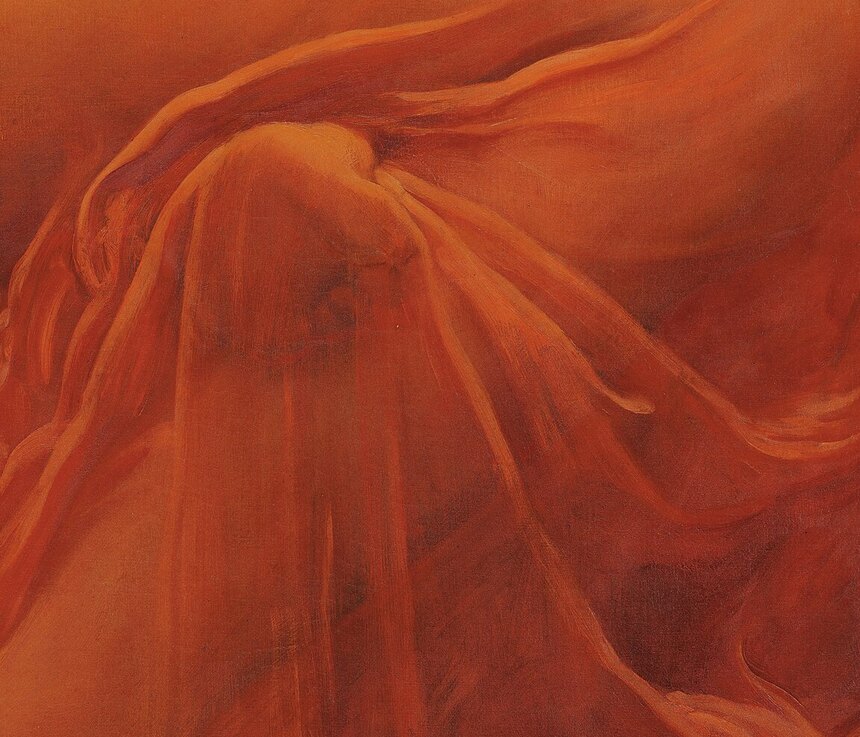
The colour is the painting. Leighton mixed the orange from cadmium and vermilion and painted it in glazes over a lighter ground, so that it glows as if lit from inside, and he chose a fabric transparent enough to show the body and opaque enough to hide it. The Victorians called this kind of thing classical, because the dress could be Greek. Everybody understood that it was also a way of painting a nude in a family magazine.
The model was probably Dorothy Dene, an actress from a poor South London family whom Leighton had painted for a decade, educated, and, according to gossip he never confirmed, loved. She was the original for Shaw's Eliza Doolittle. If it is her, she was thirty-six and had posed for him as goddesses, nymphs and priestesses. This is the last time.
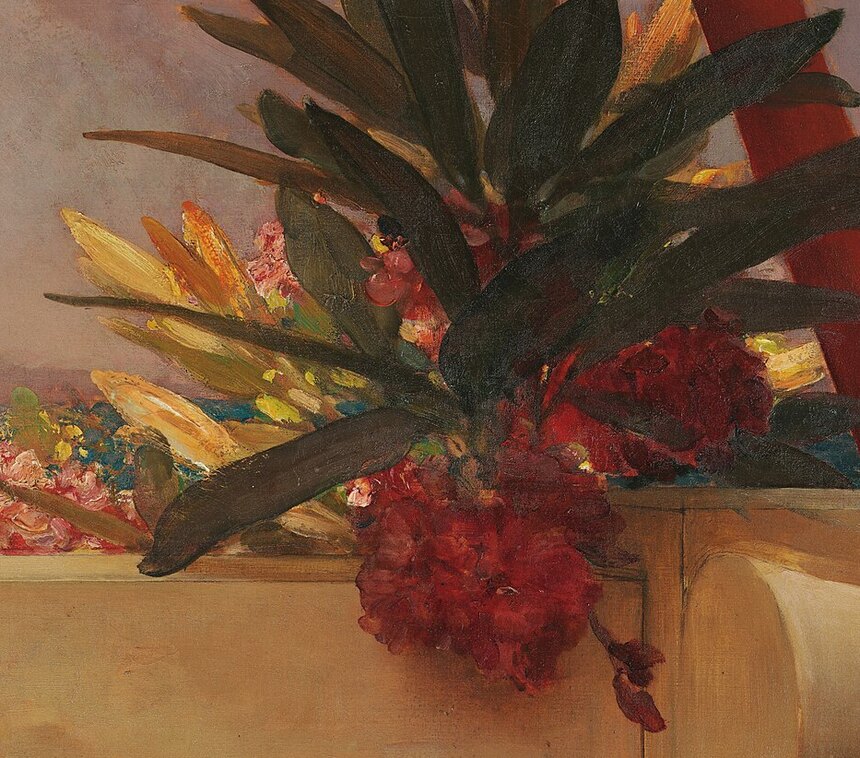
In the top right corner, over the parapet, a branch of oleander leans into the picture. It is a Mediterranean shrub with pink flowers, and every part of it is poisonous. Leighton knew his botany, and his audience knew the language of flowers. Oleander in a painting of a sleeping woman means that the sleep may be deeper than it looks.
That is as far as the painting goes toward a story, and it is far enough. Sleep and death were the Victorians' favourite pair, and the picture lets you choose. Most people choose sleep. The oleander is there for the ones who look longer.
Leighton painted it in the winter of 1894 to 1895 and showed it at the Royal Academy in the summer of 1895, with four other pictures, in what turned out to be his last exhibition. He was sixty-four and ill with heart disease. In January 1896 Queen Victoria made him a peer, Baron Leighton of Stretton, the first painter ever raised to the House of Lords. He died the next day. The title died with him: he had no children, and the barony lasted twenty-four hours.
The painting was bought by a magazine, The Graphic, which printed it as a Christmas colour supplement, and then the twentieth century arrived and Victorian painting became embarrassing. By the 1930s nobody could give it away, which is how it came to be behind a chimney in Battersea.
Leighton would have said it means nothing, and meant it as a compliment. He belonged to the movement that believed a painting could be about colour, line and beauty and owe no debt to a story. Flaming June is a woman asleep in a colour. The title is a joke about the weather. That is all he gives you.
What the painting has come to mean is the Victorian age at its most confident and its most vulnerable: a perfect surface, a whiff of death, and a fall from grace so complete that it could be bought for fifty pounds. Its rediscovery since the 1960s is the story of Victorian painting's rediscovery in general, and it has become the poster for it, the picture that made people admit they liked this kind of thing after all.
It has travelled twice in recent years, to the Frick in New York in 2015 and to Leighton's own house in Kensington in 2016, and each time the queues were long. Then it went home to Ponce.
In the Museo de Arte de Ponce in Puerto Rico, the museum Luis Ferré founded, where it is the painting the island is known for. It is oil on canvas, 120 by 120 centimetres, a perfect square, and the sleeping woman is a little under life size.
It is, for obvious reasons, a bedroom painting, and it is also a good one for a sitting room that gets afternoon light, since the orange warms everything around it. Our hand-painted reproduction of Flaming June is painted in oil on canvas from the Ponce original, with the silk built up in glazes so that it glows the way Leighton's does. A gilt frame is right; the Victorians would have used nothing else.
More Leighton in our Frederic Leighton collection.
Enjoyed this story?
Save articles to your collection
Log in or create a free account, and this article will be waiting in your Private Collection.
Log in or sign upVisible details, documented facts and interpretation are kept separate throughout this article. The identification of the model and the reading of the oleander are reported as the accepted proposals they are.