Loading cart…
No products in the cart.

1508–1510 · Oil on canvas · Gemäldegalerie Alte Meister, Dresden
Save articles to your collection
Log in or create a free account, and this article will be waiting in your Private Collection.
Log in or sign up Explore the artistGiorgione →
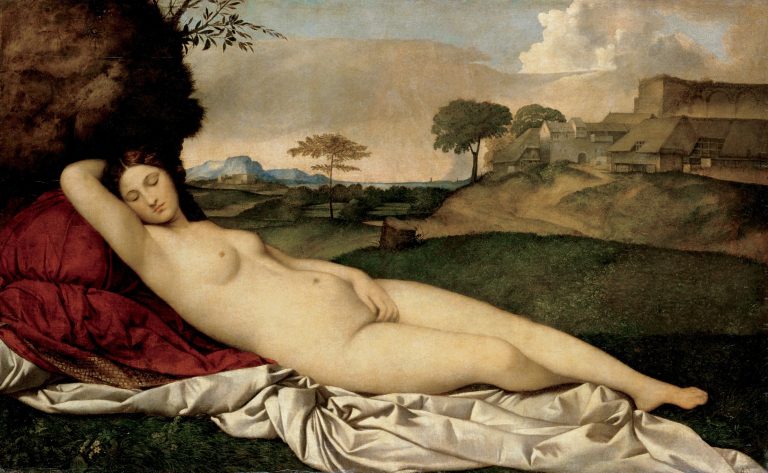
Venus lies across almost the full width of the canvas, one arm folded behind her head. Her eyes are closed. Behind her, a road climbs towards buildings, trees interrupt the horizon, and clouds gather above the distant hills. Nothing in that larger world appears to disturb her.
Sleeping Venus, also called the Dresden Venus, is associated with Giorgione and the completion of the picture by Titian. Dresden’s museum dates it to 1508–1510 and records Titian as an additional artist. The oil painting measures 108.5 × 175 centimetres and belongs to the Gemäldegalerie Alte Meister.
Its quietness is not an absence of design. The long reclining figure, the low hills and the folds of fabric have been arranged to answer one another. The body seems at rest because the world around it carries and continues its movement.
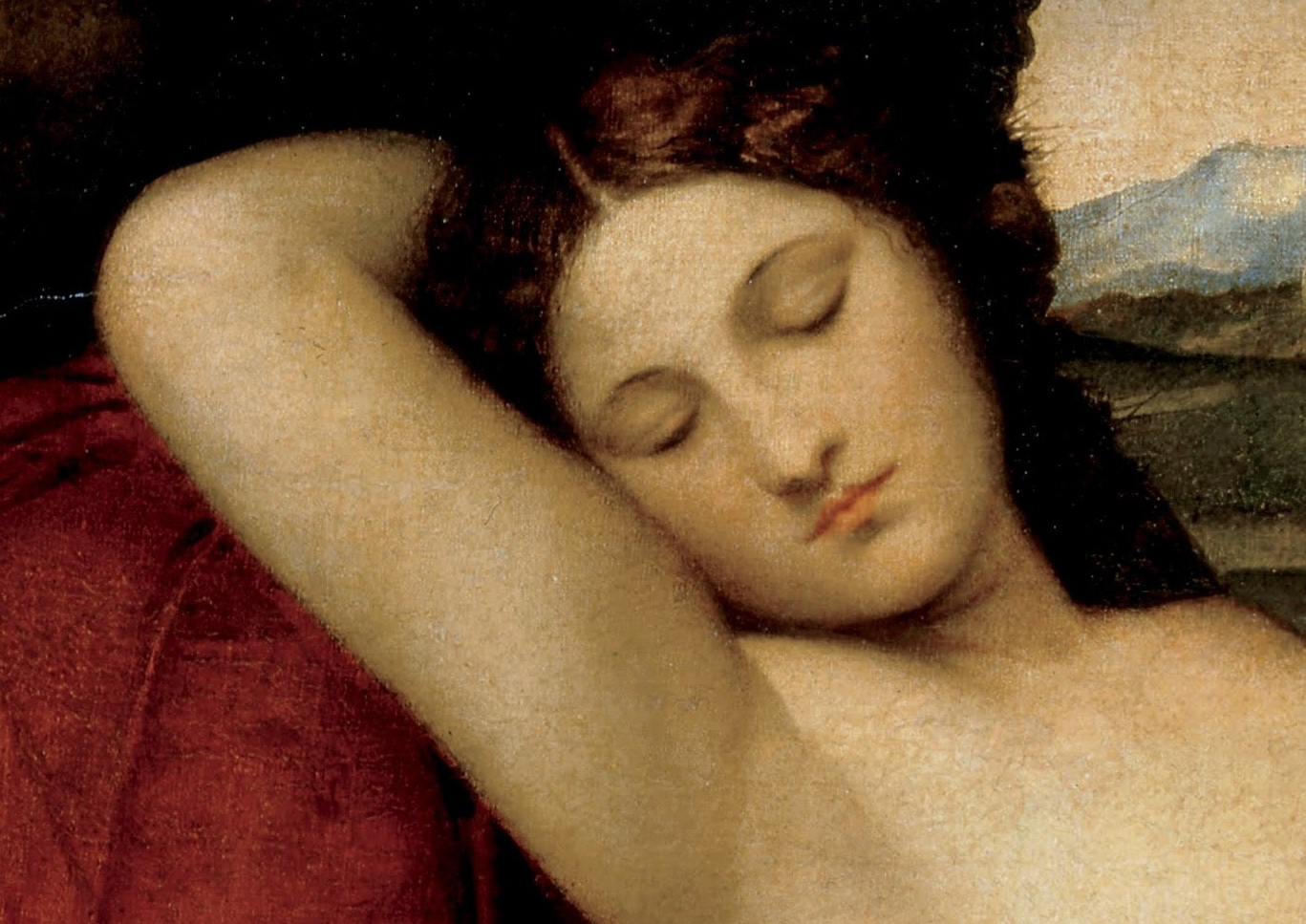
The eyelids are closed and the mouth is relaxed. The head rests beside the raised arm, whose curve helps separate the face from the dark area behind it. A small turn of the cheek makes the sleeping posture feel settled rather than rigid.
No exchanged glance establishes a relationship with the viewer. That differs sharply from a portrait in which the sitter appears aware of being watched. We can examine the face, but it does not acknowledge our presence.
The expression should not be turned into a precise account of a dream. The painting supplies no dream scene or explanatory narrative. Sleep is visible as a bodily condition, while whatever the figure might be experiencing remains inaccessible.
The dark mass behind her also matters. It gives the pale head and arm a firm setting, so their softness does not dissolve into the open sky. Rest depends here on contrast as much as on graceful contour.

Follow the upper contour of the figure from the raised elbow towards the shoulder, torso and legs. It forms a succession of slopes rather than one simple horizontal line.
The landscape offers another set of rises and falls. Low hills extend behind the body, while a larger slope supports the group of buildings on the right. These are not exact copies of individual anatomical shapes. Their relationship is broader: the figure and terrain share a measured, continuous movement.
The scene therefore resists being divided into a foreground subject and an irrelevant background. Remove the countryside and the reclining figure would lose much of its scale and calm. Remove the figure and the hills would cease to have the same immediate bodily comparison.
This is a reading of the visible composition. It does not require a claim that every hill is a coded part of the body, or that the landscape is a map of a particular woman’s identity.
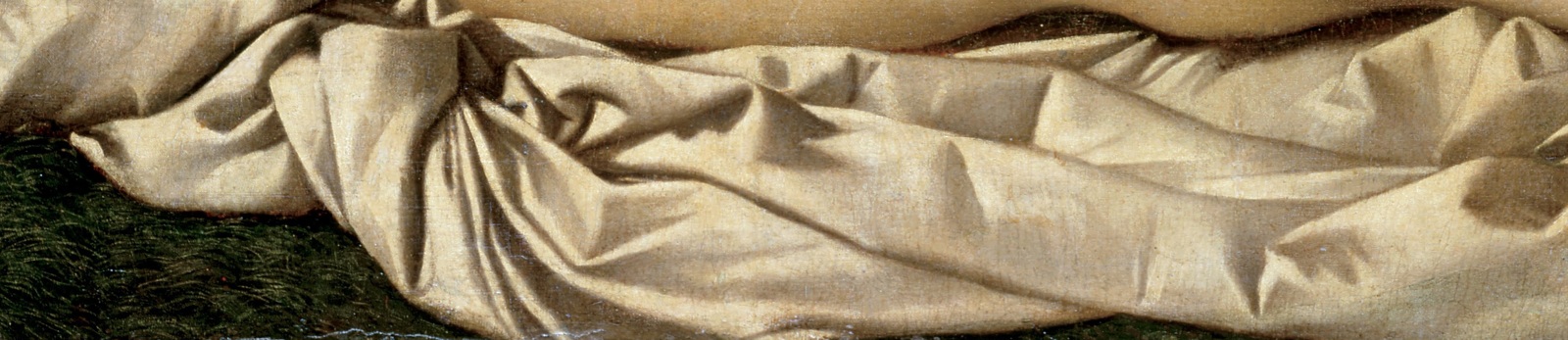
The white material gathers into sharp folds beneath the figure. Light runs along its ridges, then disappears into deeper creases. It appears less smooth than the skin above it and more actively broken into separate changes of direction.
At the left, the red fabric provides a different kind of support. Its deeper colour anchors the head end of the composition, balancing the broad pale area that extends towards the feet.
These fabrics make the scene an arrangement rather than a casual discovery in a field. Somebody has supplied soft, valuable materials. Yet no room encloses them, and no attendant is visible.
The meeting of luxury and open ground gives the setting its peculiar character. It is recognisable as a countryside, but the reclining goddess does not belong to an ordinary episode of rural labour or travel.
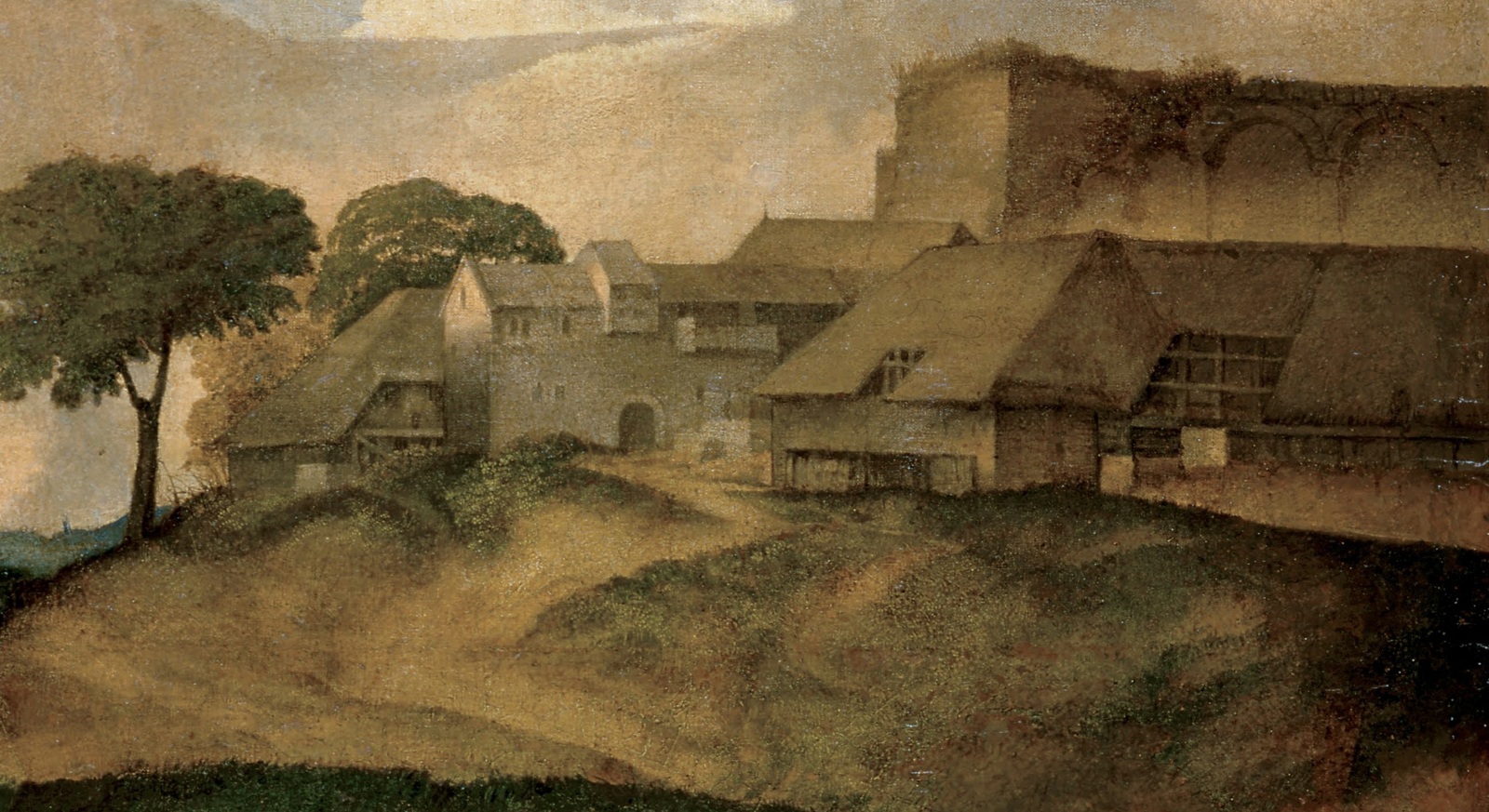
The buildings on the rise are modest in comparison with the enormous foreground figure. Their roofs, walls and shadows give the landscape a human scale without introducing a competing protagonist.
A light route leads the eye towards them. It is possible to imagine movement through that space, although no particular journey is being illustrated. The sleeping figure remains outside that implied activity.
The contrast produces two kinds of time. The body seems suspended in a continuous present. The road and inhabited countryside suggest the possibility of errands, arrivals and daily change.
Neither has to defeat the other. The painting holds the still figure and the more expansive world in the same light. This balance is central to the work’s effect, rather than a background detail to be skipped once we have recognised Venus.
The familiar title often attaches only Giorgione’s name to the picture. Its history is more complex. The museum’s record includes Titian, and the longstanding account of the work describes his completion of parts of it after Giorgione’s death in 1510.
The landscape has been especially associated with that completion. The division should not be treated as a colouring-book boundary in which every brushstroke can confidently be assigned by eye. Attribution and technical history require evidence beyond the impression made by a digital reproduction.
For a reader approaching the work, the important point is that its unity does not mean its making was simple. A picture celebrated for harmony can still have a history involving more than one hand.
It is equally misleading to replace one overconfident label with another and describe the entire canvas as an uncontested work by Titian alone. Naming the traditional association and the documented additional artist gives a more useful account of the object in Dresden.
Dresden’s museum presents the painting as a decisive large-scale Venetian treatment of the reclining female nude. Later artists developed very different encounters from this arrangement of body, fabric and surrounding space.
Velázquez’s Rokeby Venus turns its figure away and gives the viewer an uncertain reflection. Manet’s Olympia confronts us with a wakeful gaze in an interior. These differences matter as much as the shared reclining pose.
In the Dresden painting, sleep makes the encounter unusually one-sided. The landscape provides the movement and distance that the closed eyes withhold. Returning from the details to the whole image, we can see how carefully that quiet has been constructed.
The work is traditionally associated with Giorgione, with Titian involved in its completion. Dresden’s museum lists Giorgione and identifies Titian as an additional artist.
It belongs to the Gemäldegalerie Alte Meister, Staatliche Kunstsammlungen Dresden, inventory number Gal.-Nr. 185.
The museum’s published record dates it to 1508–1510; it is often described more broadly as about 1510.
Yes. Dresden Venus and Sleeping Venus refer to the painting discussed here.
Faithful public-domain reproduction of Sleeping Venus, via Wikimedia Commons. Detail images are crops of the same historical painting; no reconstruction or upscaling.
Enjoyed this story?
Save articles to your collection
Log in or create a free account, and this article will be waiting in your Private Collection.
Log in or sign up
Man Writing a Letter
Gabriel Metsu, c. 1664
The gallery list
Every painting is already 50% off. Join the list and we will send you an extra $15 code, plus first access to new collections.
No spam. Unsubscribe anytime. · Privacy Policy
Welcome
Your $15 code is on its way. Explore the gallery while you wait.