Loading cart…
No products in the cart.

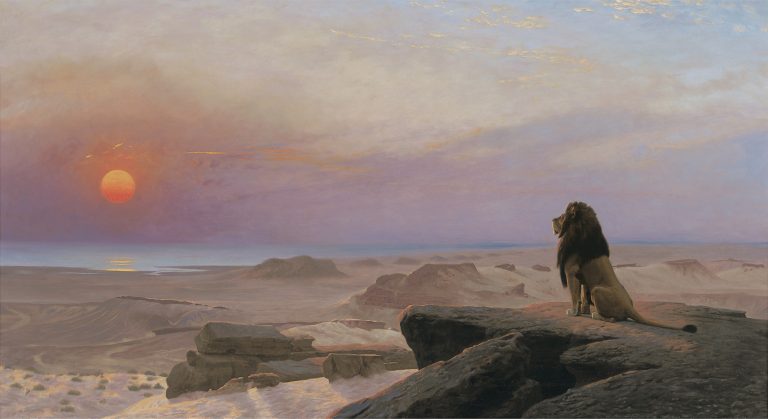
1883 · Oil on canvas · Milwaukee Art Museum, Layton Art Collection
Save articles to your collection
Log in or create a free account, and this article will be waiting in your Private Collection.
Log in or sign up Explore the artistJean-Léon Gérôme →
A lion sits on a rocky ledge, facing something far across the desert. Follow the direction of his muzzle to the opposite end of the canvas. The second majesty is the setting sun.
Jean-Léon Gérôme painted The Two Majesties (Les Deux Majestés) in 1883. The title gives the lion and the sun equal billing. The composition makes that comparison stranger. The lion holds one small outcrop, while the light from the sun reaches nearly every part of the landscape.
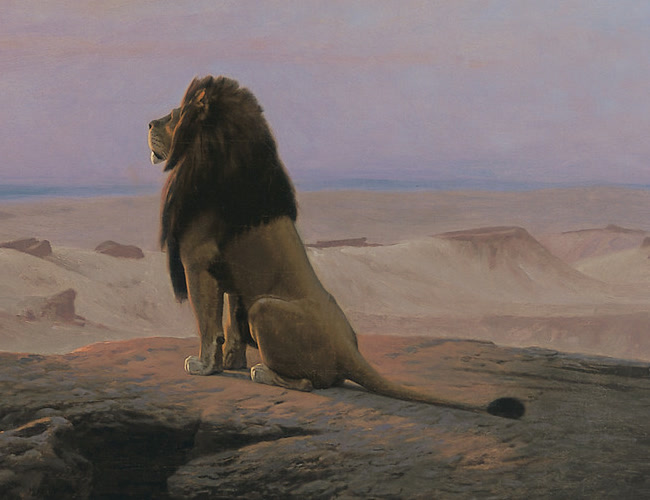
His head is raised and his forelegs are straight. His weight rests on his hindquarters, and his tail trails across the stone. We can see where his attention is directed, but the profile gives away very little about what he feels. That restraint leaves room for the viewer to read the pose as watchful, defiant or simply still.
The lion also gives the landscape a scale. Against the flat bands of desert and sky, his mane and chest make a dark vertical shape. He looks imposing in the detail. In the full painting, even the rock beneath him occupies only a corner of the view.
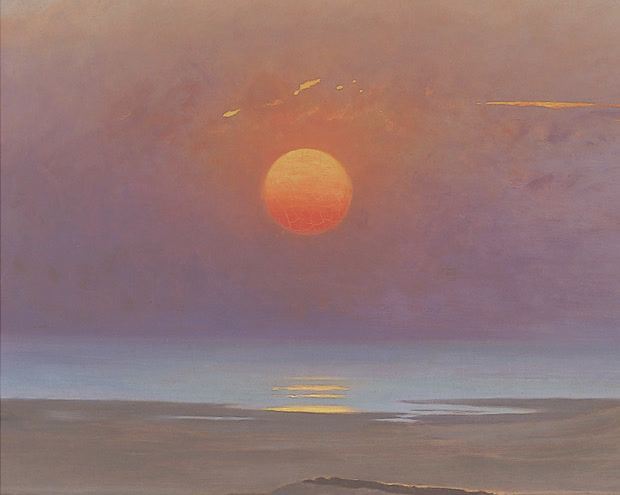
The sun still hangs above the horizon. Below it, thin strokes of gold break up the cooler bands of the distance. The dark rock in the foreground feels close enough to touch, while the pale ridges in between seem to recede into haze.
The long interval between the lion and the sun gives the eye time to cross the painting. There is no second animal to meet the lion’s gaze or draw our attention away. The landscape itself measures the distance between these two kinds of power.
When the Milwaukee collector Edward P. Allis acquired the painting, the Milwaukee Sentinel reported on it in April 1888. The account, reproduced by the Chipstone Foundation, imagined the lion confronting the dying sun. The critic found a contest in a scene whose only visible action is the lion looking outward.
There is another way to read that pause. The sun will drop out of sight and rise again. The lion’s strength belongs to a living body with a finite life. Seen this way, the encounter asks what power amounts to when it cannot hold back the night. If you were sitting beside the lion, would you stay until darkness fell?
It belongs to the Layton Art Collection at the Milwaukee Art Museum. Its accession number is L1968.82.
The oil painting measures 69.22 cm high by 128.91 cm wide. Its broad canvas gives Gérôme room to place the lion and sun far apart.
Enjoyed this story?
Save articles to your collection
Log in or create a free account, and this article will be waiting in your Private Collection.
Log in or sign up
Man Writing a Letter
Gabriel Metsu, c. 1664
The gallery list
Every painting is already 50% off. Join the list and we will send you an extra $15 code, plus first access to new collections.
No spam. Unsubscribe anytime. · Privacy Policy
Welcome
Your $15 code is on its way. Explore the gallery while you wait.