Loading cart…
No products in the cart.

1861 · Oil on canvas · Current location unconfirmed
Save articles to your collection
Log in or create a free account, and this article will be waiting in your Private Collection.
Log in or sign up Explore the artistJean-Léon Gérôme →
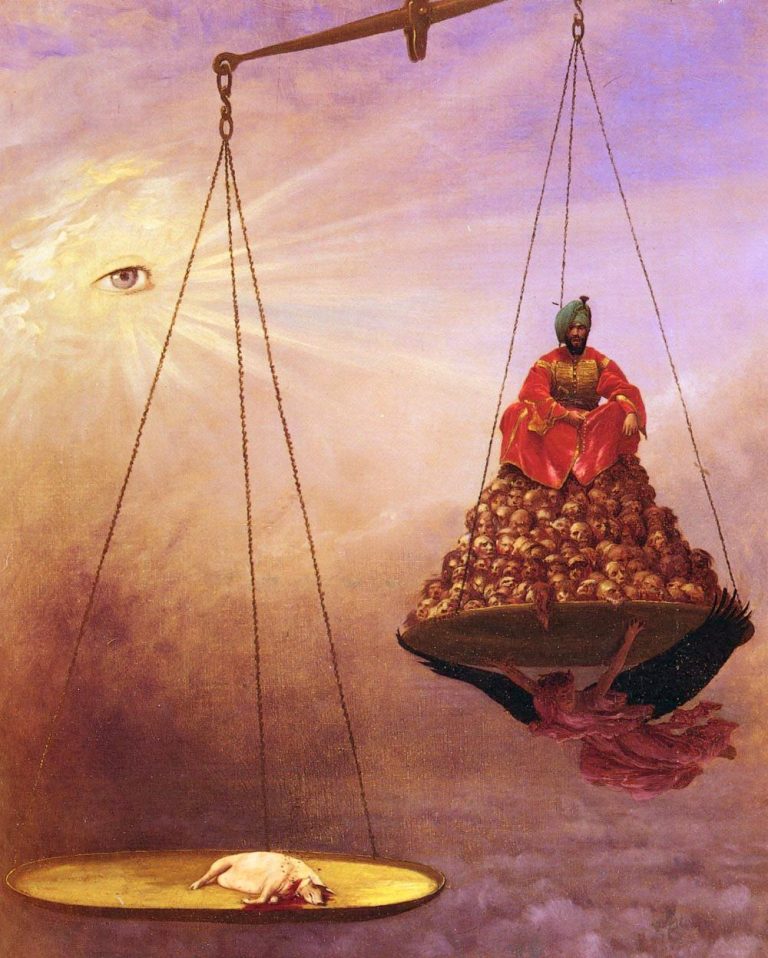
A ruler sits on a mountain of skulls. Across from him, a small pig lies alone on a golden plate. The two are suspended from an enormous balance, and the pig’s side hangs lower. An eye watches from the light.
Jean-Léon Gérôme’s Sultan Mourad, also known as Le Jour du Jugement Dernier or The Day of the Last Judgment, turns a disturbing question into a single image: what weight can one act of kindness have against a lifetime of cruelty?
The painting is dated 1861 and takes its subject from Victor Hugo’s poem Sultan Mourad, published in La Légende des siècles in 1859. The animal is the key to the story. Without it, we see a judgment against a ruler. With it, the meaning of the scales changes.
Hugo introduces Mourad through a long catalogue of violence. He destroys cities, murders members of his own family and treats other people’s lives as material for his power. Praise surrounds him, even when the acts being praised are monstrous.
Then the poem narrows to a street in Baghdad. Mourad notices a pig that a butcher has left dying in the sun. It is wounded, unable to move, and tormented by flies. Other people pass it by.
Mourad approaches. He pushes the animal into the shade with his foot and drives the flies away. This is a brief, practical relief from suffering. The pig looks at him and dies.
That evening, Mourad also dies. In the poem’s heavenly vision, the people he has harmed demand justice. The pig appears with a different request: mercy, because he helped it. A vast balance materialises, carrying the oppressed world on one side and the animal on the other. It tips toward the pig.
The poem ends with a voice offering Mourad salvation. Hugo makes the small kindness decisive, while leaving the catalogue of crimes before the reader. The shock comes from having to hold both parts of the story together.
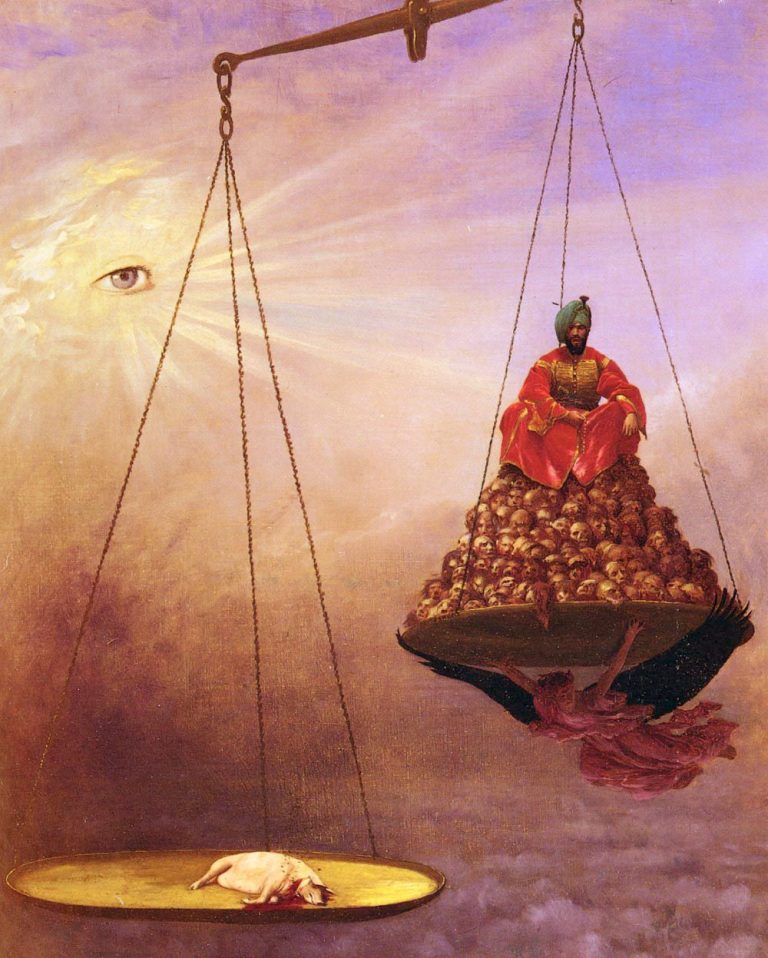
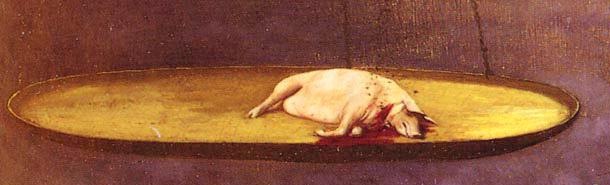
The animal’s pale body is small against the empty gold around it. There are no attendants, trophies or signs of rank. Its isolation makes it easy to overlook when the red-clad ruler first catches our eye.
Yet the position of the pans reverses their apparent importance. The scale gives greater weight to the animal’s testimony than to the crowded mass opposite it. Gérôme makes a moral judgment visible through a physical imbalance.
“Un pourceau secouru pèse un monde opprimé.”
Victor Hugo, Sultan Mourad. ByMuseum’s translation: “A pig given help weighs as much as an oppressed world.”
The line does not say that Mourad brought the pig back to health. The animal dies in the poem. What matters is that he noticed its suffering and, for a moment, relieved it. That distinction makes the action smaller and the result more startling.
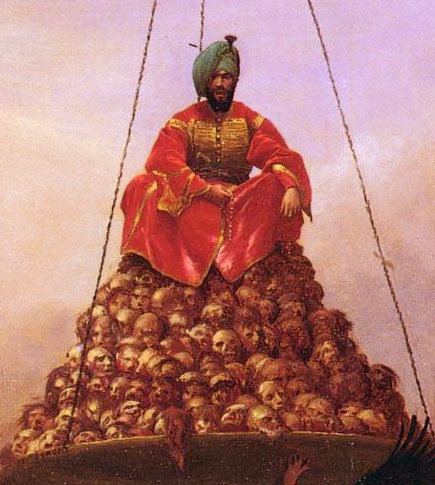
Mourad still has the clothes and posture of a sovereign. His robe is brilliant, his turban carefully arranged, and his body appears composed. At first glance he could be receiving someone at court.
The seat changes that impression. The skulls beneath him make the violence of Hugo’s opening verses impossible to separate from the person who ordered it. They also give the pan a crushing visual density. Gérôme sets this packed surface against the almost empty space surrounding the pig.
The heads are not presented as a list of named historical victims. Within the poem’s allegory, they make a whole record of suffering visible at once. The ruler remains recognisable as an individual, while those he harmed become an overwhelming collective presence.
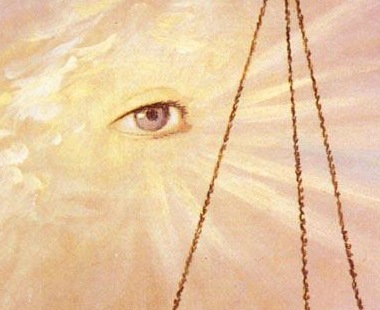
The eye appears inside a burst of warm light. Gérôme gives us a gaze without a complete face or body. It can oversee the scene without becoming another figure standing beside the balance.
Hugo describes the scales operating beneath God’s eye. The painted eye therefore has a direct literary connection, rather than requiring a separate secret code to explain it. Within the story, it represents a judgment that sees the ruler’s crimes and the small kindness that almost everyone else would have missed.
The light also makes the scene strangely beautiful. Pink, violet and gold surround the skulls and suspended bodies. That atmosphere keeps the painting from settling into a straightforward vision of punishment. Its softness prepares us for the unexpected mercy in Hugo’s ending.
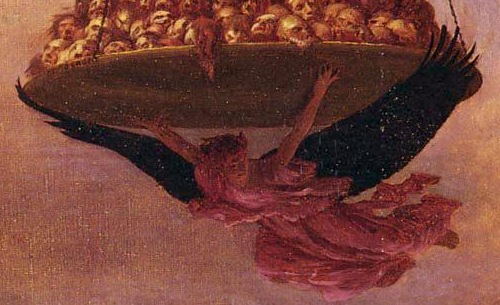
Below the skulls, a figure stretches across the air with black wings spread and arms raised toward the pan. Reddish cloth trails away from the body. Where Mourad sits almost still, this figure is all movement.
The dark wings introduce an association with damnation. Hugo’s final verses describe Mourad’s black wings becoming white as he is welcomed into heaven. That passage offers a useful connection, although it does not identify every painted figure or explain the mechanics of its pose.
Calling the figure a particular named angel would go beyond the evidence used here. What we can see is its place in the composition: beneath the ruler, between the skulls and the open air, adding tension to the suspended judgment.
The painting asks us to compare things that resist comparison. An oppressed world, represented by a heap of skulls, confronts the gratitude of one animal. Hugo’s ending gives mercy the final word, but Gérôme keeps the evidence of cruelty in plain sight.
A viewer can find that conclusion moving and troubling at the same time. Compassion reaches even someone who appears beyond redemption. At the same time, the victims remain there, and their claim to justice does not become less understandable because the ruler once acted kindly.
The lowered pan establishes the outcome of the weighing, but it cannot make the emotional difficulty disappear. That is why the pig is more than an eccentric detail. It unsettles the judgment we were ready to make before we knew the story.
The episode belongs to Hugo’s literary imagination. Its events are best read within the poem, rather than used as a factual biography of a particular Ottoman sultan or as a general explanation of religious belief.
Gérôme was a French painter and sculptor whose carefully staged historical, mythological and Orientalist pictures reached a wide audience. The Getty’s exhibition account emphasises how widely reproductions of his work circulated. This composition also acquired a life on the printed page.
The Maison de Victor Hugo holds an etching by Henri Vion after Gérôme’s design, catalogued as an illustration to Sultan Mourad and dated around 1886. Its inventory number is 2017.0.2305. That museum object is a later print, distinct from the oil painting reproduced here.
The Art Renewal Center lists the painting as oil on canvas, dated 1861, measuring 52.1 by 43.2 centimetres. Published references describe it as privately held; the sources checked for this article do not establish a current public display location or identify its present owner.
To explore the composition for your home, see ByMuseum’s hand-painted oil reproduction of The Day of the Last Judgment, or browse our Jean-Léon Gérôme collection. For another painting built around judgment and its aftermath, read the story of Cabanel’s The Fallen Angel.
Jean-Léon Gérôme painted it in 1861. The work is also called Le Jour du Jugement Dernier or The Day of the Last Judgment.
The pig represents the dying animal to which Mourad showed compassion in Victor Hugo’s poem. It later asks for mercy on his behalf, and the balance tips toward its pan.
No. In the poem, Mourad moves the dying pig into the shade and drives the flies away. The animal dies, but his act relieves its final suffering.
They give visual form to the victims and violence described in Hugo’s poem, connecting the ruler’s power with the suffering he caused.
Yes. Its subject comes from Sultan Mourad, a poem in Hugo’s La Légende des siècles, first published in 1859.
The museum record cited here concerns Henri Vion’s later etching after Gérôme. The present location of the original oil painting has not been independently confirmed for this article.
The complete painting and four detail images come from the image supplied by ByMuseum. Crops contain no generated additions. Visible details, the poem’s narrative and interpretive readings are distinguished throughout. The artwork is in the public domain.
Enjoyed this story?
Save articles to your collection
Log in or create a free account, and this article will be waiting in your Private Collection.
Log in or sign up
Man Writing a Letter
Gabriel Metsu, c. 1664
The gallery list
Every painting is already 50% off. Join the list and we will send you an extra $15 code, plus first access to new collections.
No spam. Unsubscribe anytime. · Privacy Policy
Welcome
Your $15 code is on its way. Explore the gallery while you wait.