Loading cart…
No products in the cart.

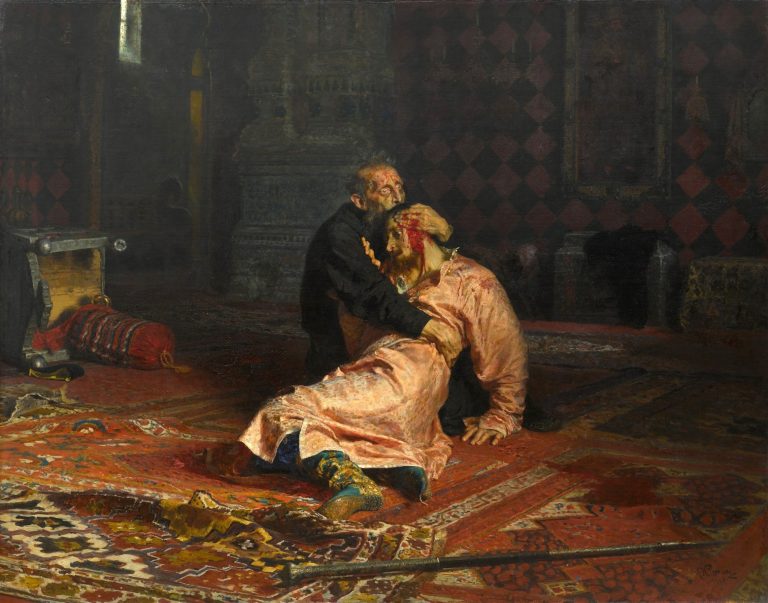
1885 · Oil on canvas · Tretyakov Gallery, Moscow
Save articles to your collection
Log in or create a free account, and this article will be waiting in your Private Collection.
Log in or sign up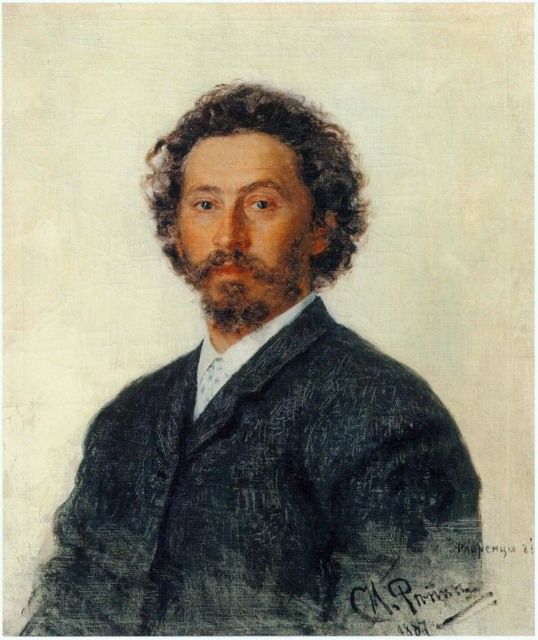 Explore the artistIlya Repin →
Look first at the older man’s eyes. His arms are occupied with holding another body, but his stare seems fixed beyond anything he can do with his hands.
In Ilya Repin’s Ivan the Terrible and His Son, a father kneels on the floor with his wounded son against him. One hand presses the young man’s bleeding head. His other arm closes around the bright robe. The son’s body extends across the carpets, heavy enough to make the embrace look unstable.
Repin places us after the violence. The blow is over; its consequences are still unfolding. The picture’s force comes from the terrible mismatch between the action that caused the wound and the care that follows it.
Completed in 1885, the work is an oil painting on canvas in the State Tretyakov Gallery, Moscow. Its full title, Ivan the Terrible and His Son Ivan on 16 November 1581, names the historical scene. The date in that title should not be confused with the nineteenth-century painting’s creation.
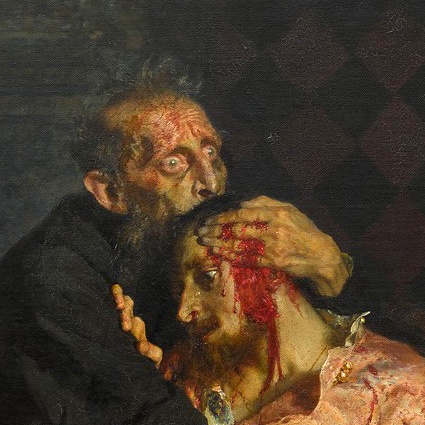
The father’s wide eyes are the part of the picture that many viewers remember. Their whites stand out against the surrounding dark hair, skin and black clothing. His raised brows give the gaze an exposed, almost arrested quality. He seems to be looking without finding an answer.
The son’s head turns sideways under the hand that presses it. His eyes are lowered; his mouth is slightly open. Blood runs down the side of the face, crossing the boundary between pale skin and the lighter collar.
The two expressions do not repeat one another. The father’s face is concentrated and strained, while the son’s seems less able to sustain attention. Even before we know the names, the difference makes one figure appear desperately active and the other increasingly dependent.
The proximity is difficult to overlook. Their heads almost touch. A gesture that could belong to tenderness has become an attempt to contain an injury. The same closeness that makes the relationship intimate also makes the damage impossible to keep at a distance. A raised hand beside the father’s collar adds another point of contact. It can suggest holding on, but it cannot tell us whether words of forgiveness have been spoken.
Follow the father’s black sleeve across the son’s body. It makes a dark diagonal over the pink fabric and tightens the central group into one shape. Yet the younger man’s legs extend away from that shape, spreading the weight of his body across the floor.
The embrace can be read as protective, but it offers no simple reassurance. Within the scene Repin depicts, the person trying to help is also responsible for the harm. Holding the wounded body makes the relationship visible without repairing it.
There is no crowd to turn the event into a public spectacle inside the room. No attendant enters with assistance. The two figures have almost all the human space to themselves, and that absence leaves us watching a father confront what his own action has done.
For a very different painted embrace, consider Rembrandt’s Return of the Prodigal Son. There, a father’s hands can suggest welcome. Here, the encircling arms and urgent pressure carry the weight of an injury that has already happened.
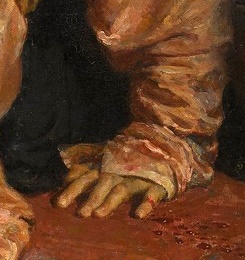
The son’s hand reaches down to the carpet. Its fingers spread rather than close into a fist, and the folded sleeve bends sharply above the wrist. This small area gives us a practical measure of his condition: the body needs support from the floor as well as from the father.
The hand interrupts an easy description of the young man as simply lying motionless. His pose retains a suggestion of effort. At the same time, the fingers cannot make the whole body upright again.
Look back to the hand on his head. One presses from above; the other braces from below. Between them, the wounded figure is held in a position that looks temporary, as though its balance cannot last.
These gestures make the tragedy physical. We do not need to assign a precise thought to either man to recognise the difference between gripping someone and being able to save them.
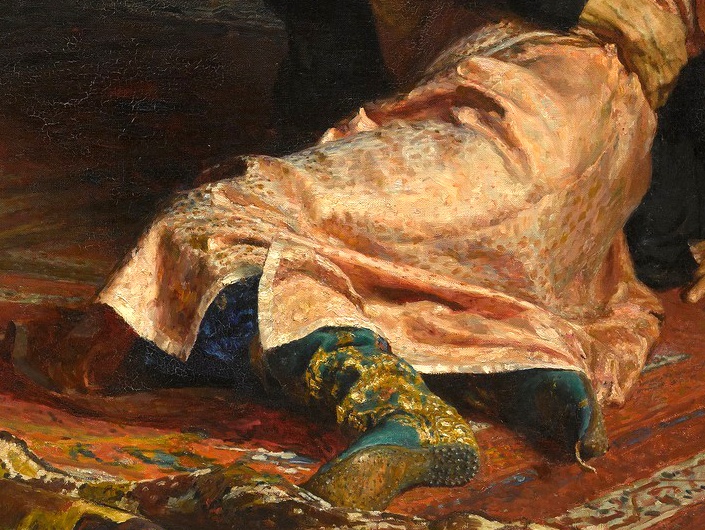
The son’s pink robe is brighter and more expansive than either face. Its folds carry our eyes down the body, away from the wound and toward the green boots. The figure remains recognisably dressed for a world of rank and privilege even as its ability to stand has failed.
Repin sets the light-catching fabric against the father’s nearly black clothing. The contrast separates their bodies while the arms bind them together. It also prevents the young man from disappearing into the room’s heavy shadows.
The sheen gives the folds a restless surface. Light breaks across ridges, then drops into warmer creases. The robe looks sumptuous, but its display is no longer ceremonial: fabric pools and twists because a person has fallen.
The decorated boot sharpens that reversal. An object made to complete an impressive appearance now points along the floor. Rich materials remain intact while the human body wearing them is in danger.
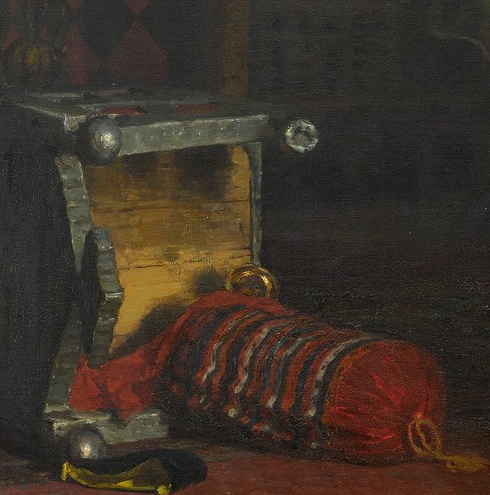
At the left, a chair lies overturned beside a displaced red cushion. Unlike the two people, these objects do not express emotion. Their positions supply another kind of evidence: the room has been disturbed.
The visible underside of the chair turns an ordinary seat into an awkward structure of edges and projecting ends. The cushion has lost its place. Together they give the scene a before and after without showing us a sequence of actions.
It would be too precise to reconstruct every movement from these objects. The painting does not function as a measured crime-scene diagram. Their role is to make the disorder legible around an embrace that might otherwise seem isolated from its setting.
The quiet background makes those displacements count. We search the room for a way to understand what we see in the faces, and find objects that have also fallen out of their proper relations.

A long staff lies near the lower edge of the painting, separated from the central figures by a stretch of patterned carpet. It belongs to the account of the blow, yet Repin places it at a distance from the hands now trying to hold the son.
Its hard line contrasts with the curved arms, the sagging fabric and the body stretched across the floor. As our eyes travel through the foreground, it returns us to the violence that the embrace cannot erase.
The museum’s record of a preparatory sketch makes this placement especially revealing. In that earlier design, the father still holds the staff. In the finished painting, it is discarded. Repin has made the separation between the instrument and the helping hands more emphatic.
That is a compositional decision with emotional consequences. The painting centres on what happens when an action is finished but responsibility for it remains.
The scene follows the account that Ivan IV struck his son, the tsarevich Ivan, with a staff and fatally injured him. Nineteenth-century histories helped give Repin a narrative in which anger turns into horror and an attempt to stop the bleeding.
That account should be distinguished from a settled reconstruction of every historical detail. In its educational lecture on the work, the Tretyakov Gallery explicitly raises the continuing debate over Ivan’s responsibility for his son’s death. The painting is an interpretation of the past, not an eyewitness document from 1581.
This distinction does not make its subject unimportant. It changes the question we ask. Rather than treating every painted gesture as proof of a sixteenth-century event, we can ask why a nineteenth-century artist chose this aftermath and gave it such an intimate form.
Nothing in the room allows us to watch the argument or hear the words that preceded the blow. What Repin makes visible is the consequence: blood, weight, contact and a father’s urgent attention to a son he cannot simply restore.
Repin developed the figures through studies of living sitters. The Tretyakov’s sketch commentary identifies several models, including the painter Grigory Myasoyedov for the tsar and the writer Vsevolod Garshin and painter Vladimir Menk for the son.
Those names do not turn the finished figures into straightforward portraits. They show how observation helped construct an imagined historical encounter. A head, a turn of the body and a particular costume could be studied separately before becoming part of the same event.
Repin’s 1884 portrait of Garshin at the Metropolitan Museum of Art offers a useful comparison. The writer appears alive, seated among books and papers, with the sustained attention of a portrait sitter. His association with the injured prince connects two very different kinds of painting.
Elizabeth Kridl Valkenier’s study in the Metropolitan Museum Journal places their collaboration in the troubled political atmosphere after the assassination of Alexander II in 1881. The historical subject belonged to the distant past, but questions about violence and its consequences were present concerns for painter and writer.
That helps explain why the image need not be reduced to an illustrated anecdote about a notorious ruler. Its attention to an individual body makes the aftermath of violence something the viewer has to confront at close range.
When the painting appeared at the thirteenth exhibition of the Peredvizhniki in 1885, it provoked intense reactions. The Petit Palais’s Repin exhibition catalogue records that Alexander III temporarily prohibited its exhibition. The scene’s treatment of a ruler made its emotional force politically uncomfortable as well.
The canvas later suffered attacks in 1913 and 2018. These belong to the history of the physical painting and should not be confused with the historical violence it represents. The Tretyakov’s restoration project documents the second attack and the work required to repair and stabilise the damaged canvas.
A later museum presentation describes its return after four years of restoration, protected within a purpose-built climate-controlled, anti-vandal case. The picture’s preservation has become part of its public history.
The original measures 199.5 cm high by 254 cm wide, so the two intertwined figures occupy a substantial canvas rather than a small cabinet picture. It was acquired from Repin by Pavel Tretyakov in 1885. Its collection home is the State Tretyakov Gallery in Moscow; consult the museum’s current information when planning a visit.
Ilya Repin, also written Illia Repin. He worked on the painting in 1883–1885 and completed it in 1885.
That date identifies the historical scene in the full title. It is not the date when Repin painted the canvas.
The painting follows that account, but the Tretyakov’s historical lecture notes continuing debate over the event. The image itself is not evidence that can settle the question.
Remorse, responsibility and the inability to reverse violence are strong readings of the father’s embrace. They arise from the contrast between the preceding blow and the urgent attempt to support the wounded son.
The State Tretyakov Gallery, Moscow. It is oil on canvas, 199.5 × 254 cm, inventory number 743.
Alexander III temporarily prohibited its exhibition in 1885. Its disturbing treatment of a ruler and a royal family tragedy made it controversial from its first public appearance.
Painting details are faithful crops of a public-domain reproduction on Wikimedia Commons. Painting: Ilya Repin, 1885, State Tretyakov Gallery, inventory 743. Artist portrait: Repin’s 1887 self-portrait.
Explore another side of Repin’s handling of expression and gesture in Reply of the Zaporozhian Cossacks, or browse the Ilya Repin collection.
Enjoyed this story?
Save articles to your collection
Log in or create a free account, and this article will be waiting in your Private Collection.
Log in or sign up
Man Writing a Letter
Gabriel Metsu, c. 1664
The gallery list
Every painting is already 50% off. Join the list and we will send you an extra $15 code, plus first access to new collections.
No spam. Unsubscribe anytime. · Privacy Policy
Welcome
Your $15 code is on its way. Explore the gallery while you wait.