Loading cart…
No products in the cart.

1880–1891 · Oil on canvas · State Russian Museum, Saint Petersburg
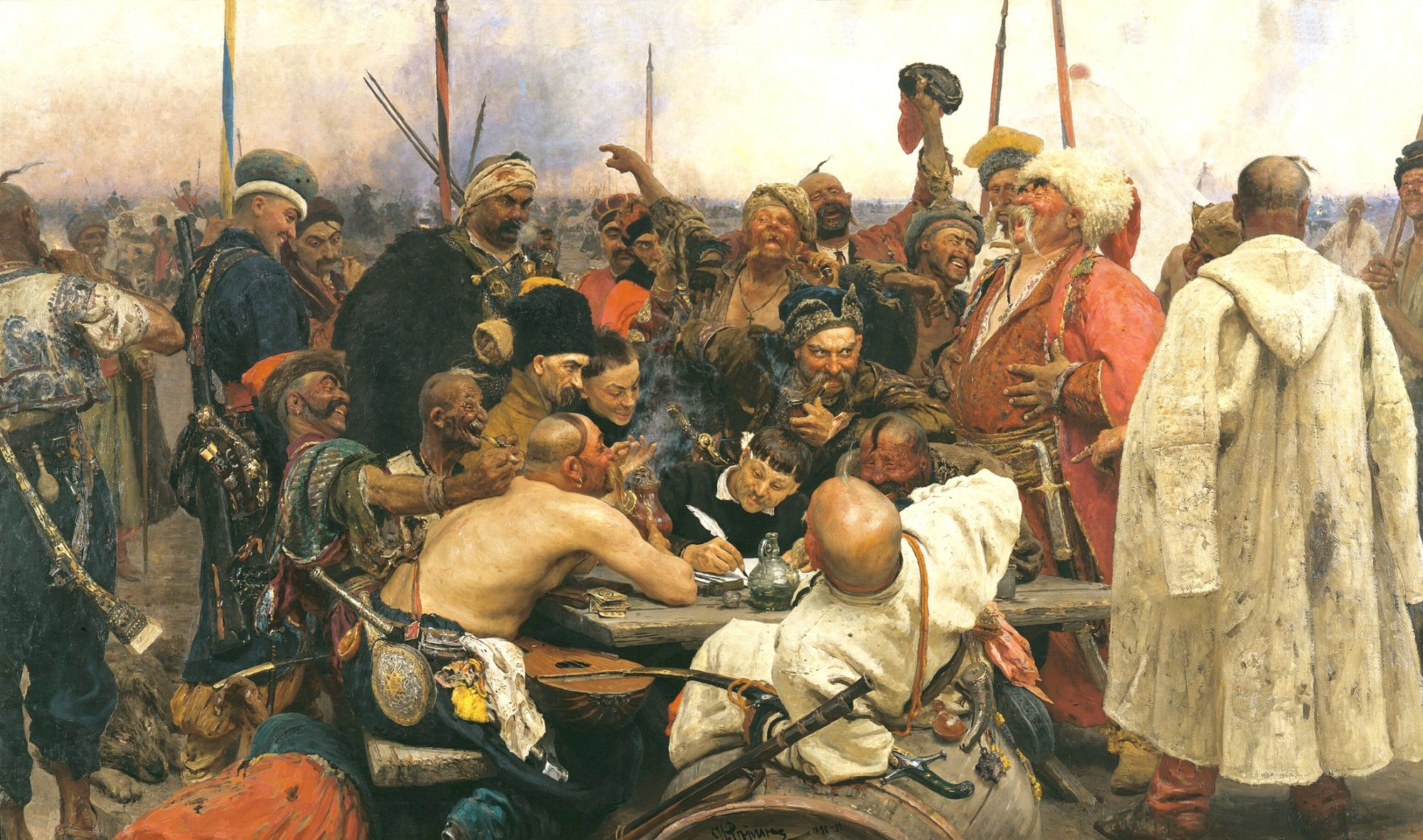
Ilya Repin worked on Reply of the Zaporozhian Cossacks from 1880 until 1891. The monumental canvas, now in the State Russian Museum, grew from a popular story about Cossacks composing an insulting answer to an Ottoman sultan’s demand for submission. The correspondence is legendary rather than securely verified as a historical document.
Repin nevertheless approached the visible world of the painting with intense research. He travelled in regions associated with Cossack history, studied weapons and clothing, and developed figures through many drawings and painted studies. Historian Dmytro Yavornytsky advised him and served as the model for the scribe. Years of revision allowed Repin to make every face distinct while holding the crowd together as one event.
The long table forms the painting’s horizontal spine, but the composition is animated by a rolling sequence of heads, shoulders and raised arms. Laughter appears in many forms: explosive, sly, restrained and expectant. The scribe near the centre gives that energy a destination as the spoken jokes become a written reply.
Repin distributes white shirts and bright red accents through an earth-toned field, preventing the immense crowd from becoming visually confused. Faces receive concentrated modelling, while broader strokes in clothing and background preserve movement. The viewer does not stand outside a formal history painting; the near-life-size scale makes the gathering feel immediate and noisy.
The picture celebrates collective independence through humour. Authority is answered not with solemn rhetoric but with irreverent invention, and no single hero dominates the scene. Repin makes laughter itself the protagonist.
Because the underlying letter is legendary, the painting is more useful as cultural memory than literal documentation. It expresses an idea of Cossack freedom and fellowship that mattered to Repin’s audience. That distinction strengthens rather than diminishes the work: it shows how a community imagines its character through a shared story.