Loading cart…
No products in the cart.

1863 · Oil on canvas · Private collection
Save articles to your collection
Log in or create a free account, and this article will be waiting in your Private Collection.
Log in or sign up Explore the artistIvan Aivazovsky →
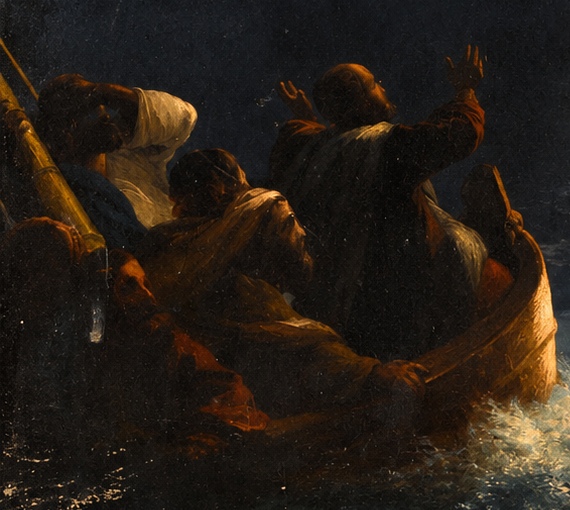
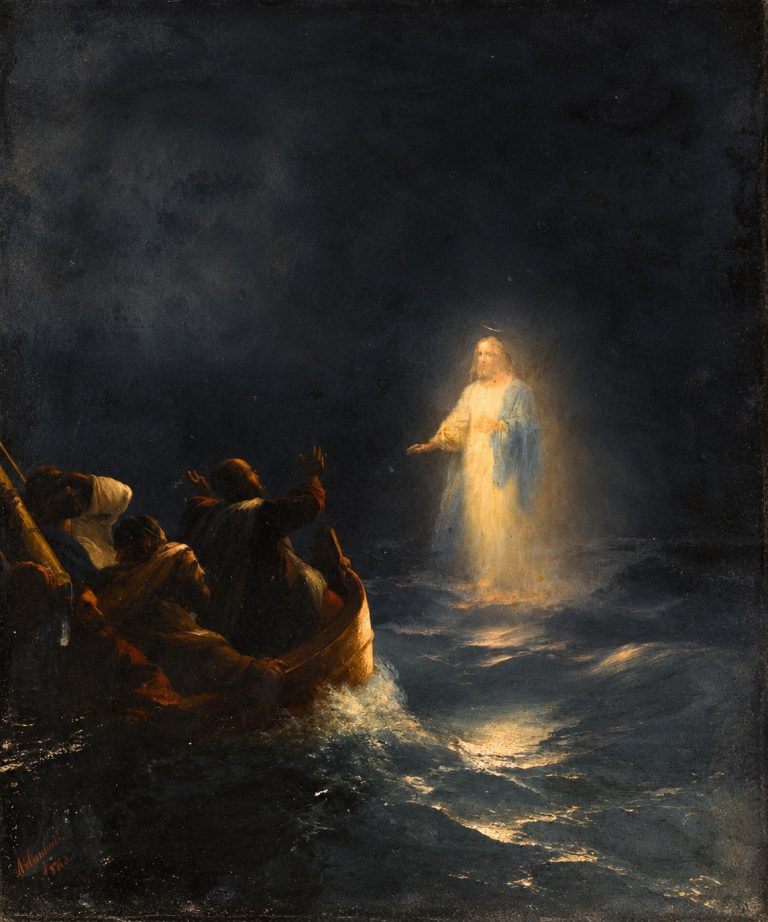
A man turns toward the light with both hands raised. Around him, bodies overlap in a small wooden boat. One passenger bends across the foreground; another lifts an arm near his head. Their clothes catch warm highlights, but much of the group remains difficult to separate from the darkness.
Beyond the boat, a pale figure stands above the waves. We recognise Jesus. The people in the biblical account do not immediately understand whom they are seeing. That difference is the source of the painting’s suspense.
Ivan Aivazovsky painted this version of Jesus Walks on Water in 1863. Often described as Christ walking on a dark sea, it makes the encounter depend on distance, gestures and light. The extraordinary presence is visible before its meaning feels secure.
The raised hands can suggest alarm, appeal or astonishment. They do not reveal the man’s exact thoughts. For that, the painting sends us back to the story it depicts.
In Matthew 14:22–33, Jesus sends the disciples ahead by boat while he remains behind to pray. They encounter contrary wind and waves. During the fourth watch of the night, he comes toward them across the water. Their first reaction is fear: they think they are seeing a spirit.
Mark 6:45–52 also describes the difficult crossing, the unexpected appearance and the frightened response. The reassurance comes when Jesus speaks and identifies himself. The presence that first alarms them is the one that will relieve their fear.
It is I; be not afraid.
Matthew 14:27, King James Version
Aivazovsky makes that uncertainty possible to imagine. The disciples share a crowded space where arms, clothes and the boat’s sides overlap. Jesus stands apart, bright enough to attract every glance. His visibility makes him extraordinary; it does not make the encounter ordinary or easy to understand.
The Gospel supplies the fear of a spirit. The painted gestures alone cannot establish what each person believes at this particular instant.
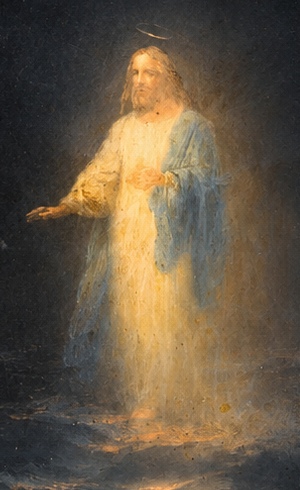
Jesus wears a pale garment with a blue outer cloth. A thin halo hovers above his head. One arm extends toward the boat, while the other hand stays nearer his body. The posture is open and comparatively still.
At the bottom of the figure, outlines become harder to follow. Pale fabric, reflected light and the illuminated water approach one another in colour. The upper body remains recognisable, but the precise meeting of feet and surface is softened by the glow.
This treatment gives the miracle a visual form without explaining its mechanics. The figure appears upright where the passengers require a boat. Around him, dark wave shapes and broken crests remain visible.
There is no painted shoreline offering an easy way out of the scene. The relationship is between the people afloat in the boat and the figure standing beyond it. Aivazovsky keeps that separation clear even as light passes across the water between them.
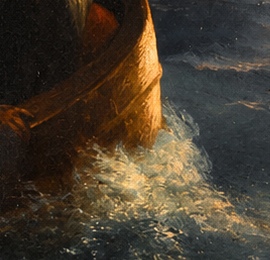
The curved wooden bow catches a warmer, sharper light than much of the clothing behind it. Below, pale foam breaks against the dark hull. These small contrasts make the vessel feel solid, with a surface and an edge that can meet the water.
The boat also provides a measure of the human predicament. The passengers have to share its confined space. Their bodies lean and turn within it, while the sea continues outside. The timber is protection, but its low edge makes the surrounding water feel close.
Against that physical solidity, Christ’s luminous outline seems less bound to the ordinary conditions of the crossing. The difference is built from painted surfaces: dark wood, white foam, pale clothing and the soft transition from figure to reflected light.
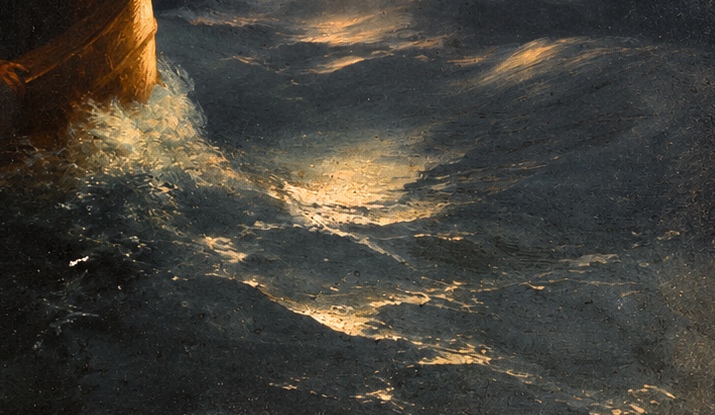
The brightest reflections do not form a smooth golden road. They arrive as separate strokes on different crests, with dark troughs interrupting them. Your eye can follow their general course while still noticing the uneven water beneath.
This is where Aivazovsky’s experience as a marine painter becomes central to the religious subject. The water remains worth looking at in its own right. Its ridges, foam and shifting-looking surfaces carry the scene’s tension as effectively as the figures do.
The reflected light connects different depths of the painting. It gathers near Jesus, catches the boat and reappears in the foreground. Yet light offers a visual connection without removing the physical gap. The disciples still sit in their vessel, separated from the figure they watch.
Read spiritually, these reflections may suggest reassurance reaching into darkness. As a compositional device, they perform a more immediate task: they lead our attention through a large field of blue-black water.
A substantial part of the vertical composition lies above the heads of the figures. There is subdued variation in this upper darkness, but no elaborate architecture, landscape or gathering of heavenly beings to explain the appearance.
That space changes the scale of the encounter. The people occupy only part of the canvas; the atmosphere extends beyond them. The glow around Jesus becomes a concentrated event within a much larger darkness.
The eye has few competing bright points. It moves between the figure, the raised hands, the illuminated timber and the waves. The limited distribution of light gives these details unusual importance.
Darkness here can feel threatening, but it also leaves room for uncertainty. The painting does not show a visible moon or lantern that would turn the central illumination into an ordinary lighting arrangement.
Matthew continues the episode with Peter leaving the boat, becoming afraid and beginning to sink. In this composition, no separate disciple stands between the vessel and Jesus. The human group remains on board.
Sotheby’s catalogue explicitly distinguishes the 1863 painting from Aivazovsky’s later treatment of 1888, observing that Peter is still in the boat in this earlier version. That does not securely identify which painted passenger is Peter. The prominent raised-hands figure can remain a disciple without an invented name.
The ending of the Gospel episode is also outside the moment we see. Matthew and Mark describe the wind ceasing after Jesus enters the boat. Here he remains beyond its edge, with unsettled-looking water around him. The picture gives us the encounter before the narrative’s resolution.
This is a different episode from Christ calming a storm while already aboard with the disciples. The distinction helps explain why Aivazovsky places Jesus outside the boat and makes the intervening water so important.
Ivan Aivazovsky (1817 to 1900) is known for seascapes in which changing light and the scale of water shape the human experience. In The Ninth Wave, survivors face the sea beneath a dramatically illuminated sky. Here, the concentration of light around Christ changes the terms of a similarly vulnerable encounter with water.
Writing for The Tretyakov Gallery Magazine, Galina Churak places his Gospel subjects within a wider interest in creation, spiritual mystery and the sea. She discusses his repeated attraction to walking-on-water scenes as an opportunity to connect the figure of Christ with light and his enduring subject of water.
That context supports a religious reading without requiring us to invent a private statement from the painter about this particular canvas. His choices are visible: the boat is crowded, the figure is separate, and the sea carries light while remaining dark.
Sotheby’s records Jesus Walks on Water as an oil painting on canvas, signed in Cyrillic and dated 1863 at the lower left. The historical canvas measures 58 cm high by 47 cm wide. Its 2016 catalogue traces it through the Demidoff family collection and descent.
The private-collection record belongs to this particular composition. Aivazovsky returned to the subject, and the 1888 Walking on Water associated with the State Museum of the History of Religion in St Petersburg is a different painting. Dates and museum locations should not be transferred between them.
The ByMuseum hand-painted reproduction follows the composition shown here. Available reproduction sizes are the dimensions selected when ordering, rather than a claim that every version matches the historical canvas.
The image shown here is Ivan Aivazovsky’s Jesus Walks on Water, catalogued by Sotheby’s as a signed and dated painting of 1863.
Matthew and Mark say they initially mistake the figure approaching across the water for a spirit. Their recognition follows Jesus’ reassurance. The painting’s individual expressions remain open to interpretation.
His identity is not securely established by the sources used here. Peter belongs to the biblical episode, but that does not prove which passenger represents him.
The water in the painting still has visible crests and foam. The Gospel accounts place the wind’s cessation after Jesus enters the boat, which has not happened in this composition.
The 1863 work is documented in a private collection. It should not be confused with Aivazovsky’s later walking-on-water paintings held elsewhere.
The main image was supplied by the ByMuseum owner. Detail illustrations are faithful crops of that image. Historical facts, the Gospel narrative and visual interpretation are distinguished throughout.
Read The Ninth Wave story →Browse Aivazovsky reproductions →
Enjoyed this story?
Save articles to your collection
Log in or create a free account, and this article will be waiting in your Private Collection.
Log in or sign up
Man Writing a Letter
Gabriel Metsu, c. 1664
The gallery list
Every painting is already 50% off. Join the list and we will send you an extra $15 code, plus first access to new collections.
No spam. Unsubscribe anytime. · Privacy Policy
Welcome
Your $15 code is on its way. Explore the gallery while you wait.