Loading cart…
No products in the cart.

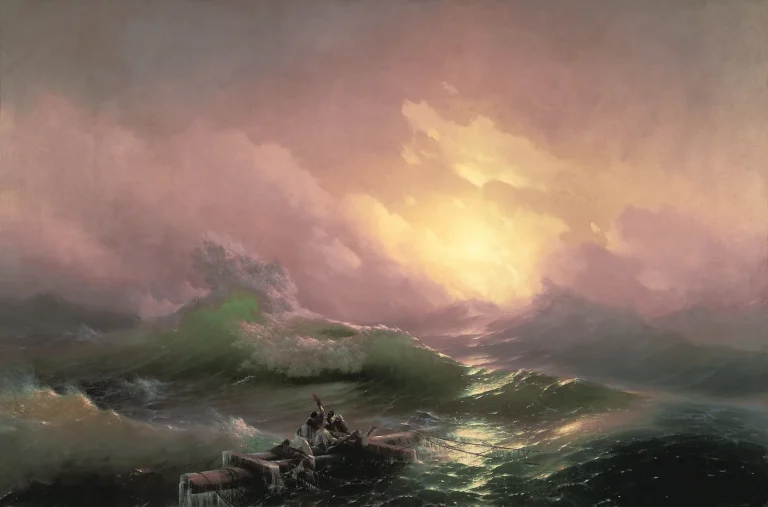
1850 · Oil on canvas · State Russian Museum, St Petersburg
Save articles to your collection
Log in or create a free account, and this article will be waiting in your Private Collection.
Log in or sign upSailors have always believed that waves come in sets, and that one wave in the set is the killer. The Greeks said it was the third. The Romans said the tenth. The Russians, and the English, said the ninth: after eight waves a storm draws breath and sends the biggest, and if you are in the water when it comes, you will not be in the water afterwards.
That is what the painting is about. A ship has gone down in the night. Six men have survived it by clinging to a broken mast. Dawn has come, the sky is turning gold and pink, and the ninth wave is rising behind them. Aivazovsky painted the moment before it breaks, and left us not knowing.
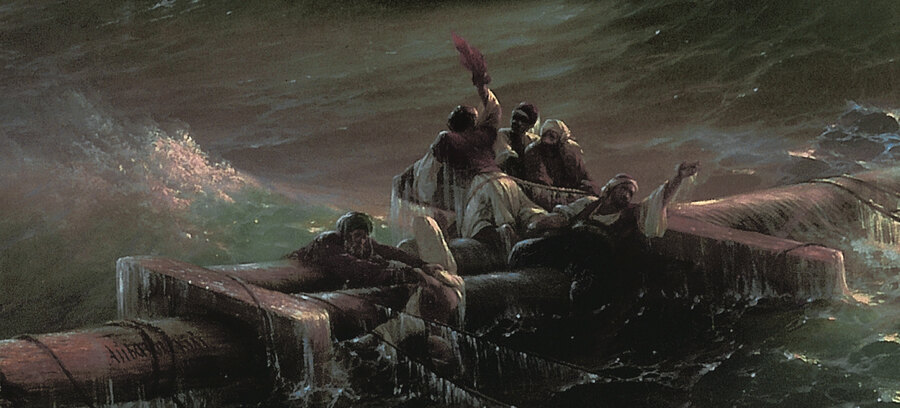
Find the survivors first, because the sea makes you look everywhere else. They are small, low in the picture, at the bottom of a trough between two mountains of water. The mast they cling to has snapped so that its yard makes a cross, and Aivazovsky knew what he was doing when he drew it that way. One man has climbed to the top of it. One is waving a red cloth at a horizon where there is nothing to see. One holds another who has stopped holding.
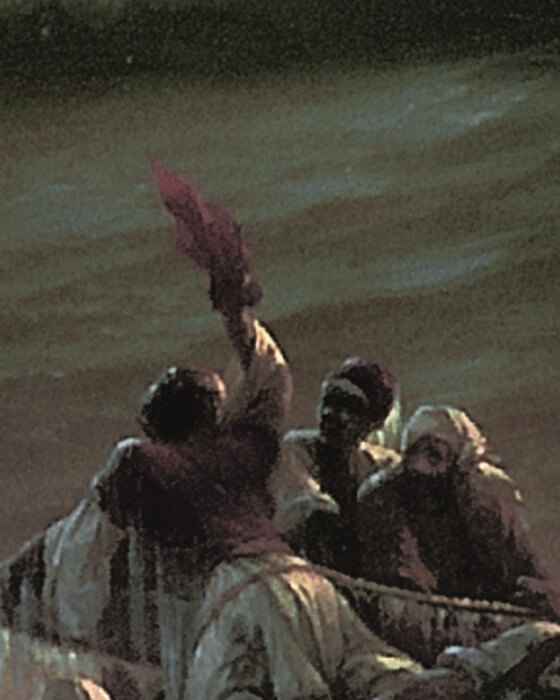
They are the only people in a painting three metres wide, and Aivazovsky has painted them with a few strokes each. That is a choice. The subject is not the men. The subject is what they are inside.
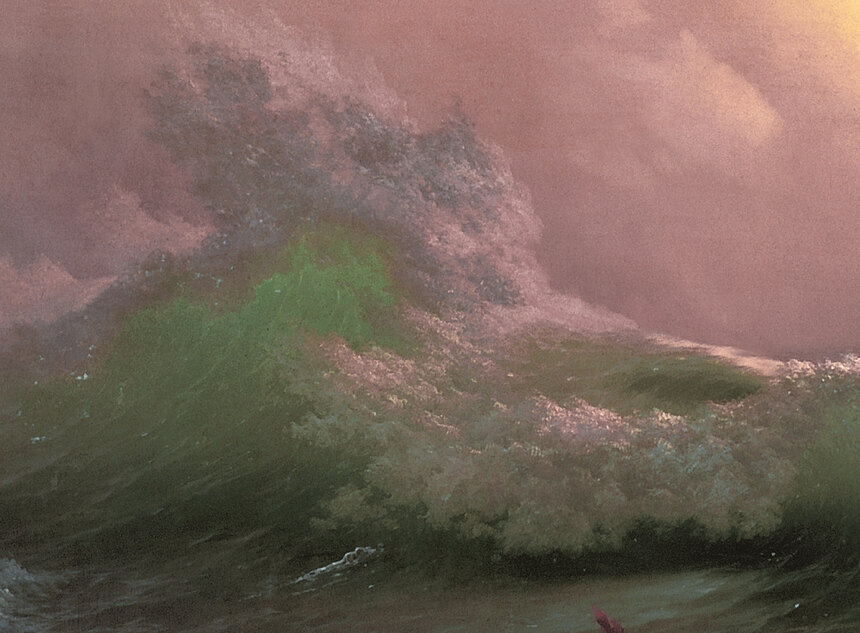
The wave on the left is the reason the painting is famous. It is not painted from the outside like a wall of water. It is painted from the inside: the light of the sunrise comes through the crest and turns it to green glass, the foam tears off the top in the wind, and the whole mass leans forward with the weight of a thing that is about to fall. You can feel how cold it is.
Aivazovsky never painted from nature. He said the movement of water could not be copied on the spot, only remembered, and he worked in the studio from a memory trained by a lifetime on the Black Sea coast at Feodosia. He was famous for speed: this enormous canvas was painted in about eleven days. He was famous, too, for the trick of the translucent wave, which he did with thin glazes over a light ground so that the colour comes up from underneath, exactly as light comes up through water.

Above the wave the sky is doing the opposite of what the sea is doing. The storm clouds are tearing apart and the sun is coming through them in gold, rose and violet, laying a path of light across the water toward the men. It is the kindest sky Aivazovsky ever painted, and it fills two thirds of the canvas.
That is the structure of the picture: hope above, death below, and six men on a cross in between. The Romantic painters of the generation before, Turner in England and Friedrich in Germany, had made the sea a place where people find out how small they are. Aivazovsky, who had seen Turner's work in Rome and been praised by him, took that and added the one thing Turner left out: the possibility of being saved.
The painting refuses to say whether the men live. That is its meaning. The wave will break or pass; the sun will reach them or not; the red cloth will be seen or not. Aivazovsky gives you every reason to hope and every reason to fear, and holds the moment open.
Russian viewers in 1850 read it as an image of endurance, and it became one of the country's best-loved paintings almost at once: bought for the imperial collection, engraved, copied, hung in every schoolroom. The cross-shaped mast gave it a religious reading, the survivors a national one. Later it became simply the picture of the sea in Russia, the way Hokusai's wave is the picture of the sea in Japan.
Outside Russia it has had a stranger life: as the source for a thousand posters and album covers, and as the standard image of what the sublime looks like when it has a sunrise in it.
Ivan Aivazovsky was born Hovhannes Aivazian in 1817, the son of an Armenian merchant in Feodosia in the Crimea, and he painted the sea for seventy years. He was the official painter to the Russian navy by twenty-seven, an academician at twenty-eight, and by his death in 1900 had produced around six thousand paintings, nearly all of them of water. He was rich, generous, adored, and slightly disreputable among the avant-garde, who thought he painted the same wave too many times.
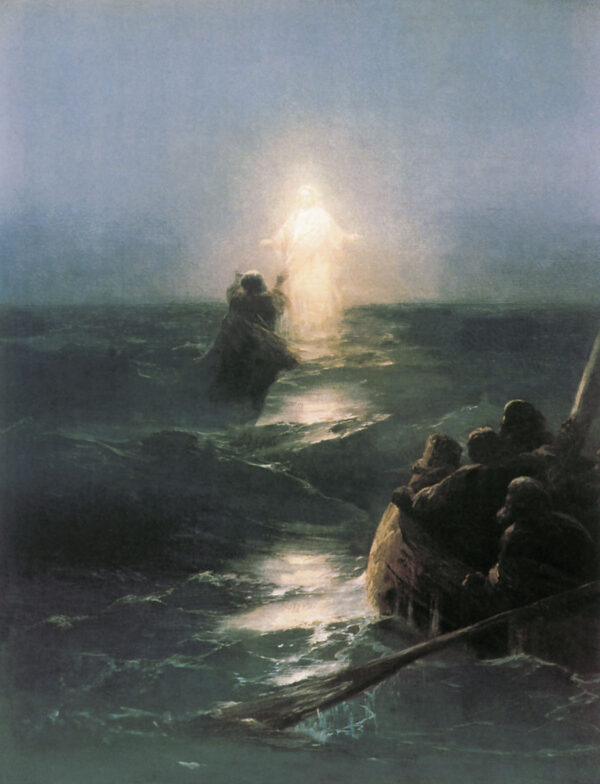
He did. But he painted it better than anyone. The Ninth Wave is the one everybody agrees on, and it hangs in St Petersburg beside its calmer companions, ships at anchor, moonlit bays, Christ walking on the water, and the storms.
In the State Russian Museum in St Petersburg, where it has been since the museum opened in 1897 and where it is one of the two or three pictures every visitor is taken to see. It is oil on canvas, 221 by 332 centimetres, so the wave is bigger than you.
It is a painting for a wide wall and a room where people sit facing it: living rooms, offices, the long wall of a dining room. It is also one of the pictures where a hand-painted copy makes the most difference, because the translucent wave is built from glazes and a print flattens them. Our hand-painted reproduction of The Ninth Wave is painted in oil on canvas from the St Petersburg original, with the wave glazed the way Aivazovsky glazed it. A gilt or dark wood frame suits the sunrise.
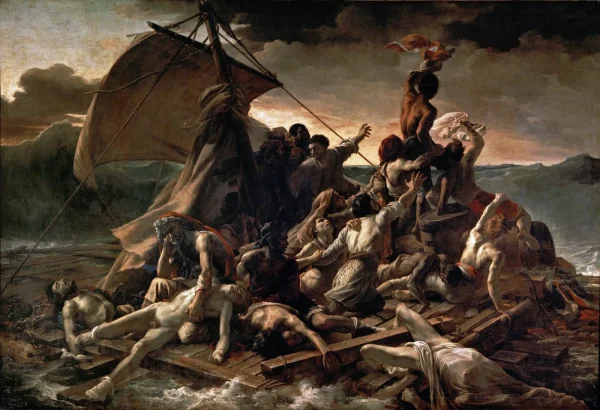
More sea in our Ivan Aivazovsky collection, and the wider Romanticism archive, where the Raft of the Medusa and the Wanderer keep him company.
Enjoyed this story?
Save articles to your collection
Log in or create a free account, and this article will be waiting in your Private Collection.
Log in or sign upVisible details, documented facts and interpretation are kept separate throughout this article. The eleven-day painting time is reported from the painter's biographers.