Loading cart…
No products in the cart.

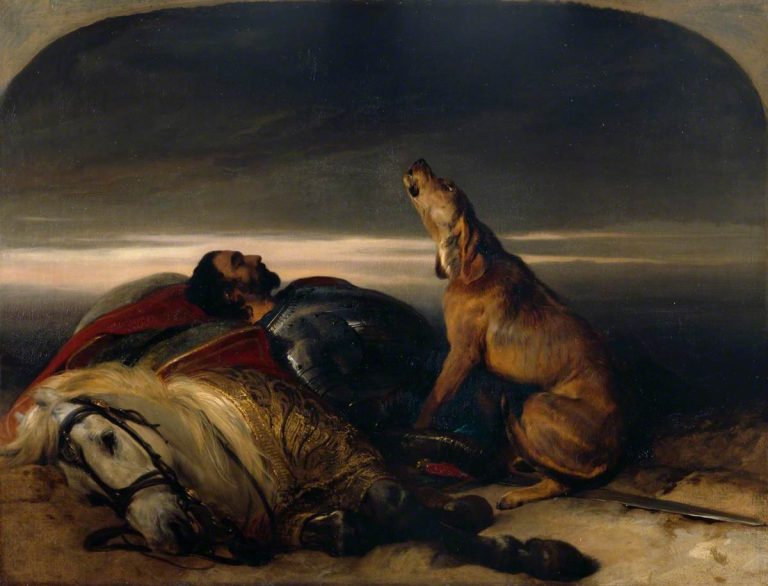
c. 1830 · Oil on canvas · Royal Academy of Arts, London, United Kingdom
Save articles to your collection
Log in or create a free account, and this article will be waiting in your Private Collection.
Log in or sign up Explore the artistEdwin Henry Landseer →
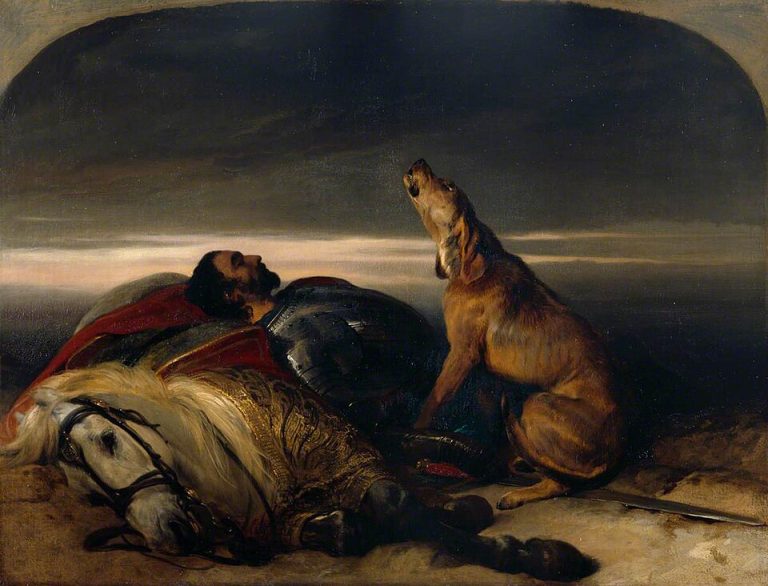
A hound sits beside a fallen knight and a white horse, lifting its muzzle into the dark sky. The man cannot respond. The dog remains close enough for its front legs to overlap his armour, and its open mouth makes the silence of the other figures feel heavier.
Edwin Landseer painted The Faithful Hound around 1830. It is an oil on canvas in the Royal Academy of Arts collection in London, measuring 68.4 cm high by 91.2 cm wide. The subject is canine fidelity after a violent death, told through an animal's posture and its place beside a human body.
Landseer leaves the battle outside the picture. We encounter its aftermath at ground level, among the horse's mane, the knight's armour and the hound's paws.
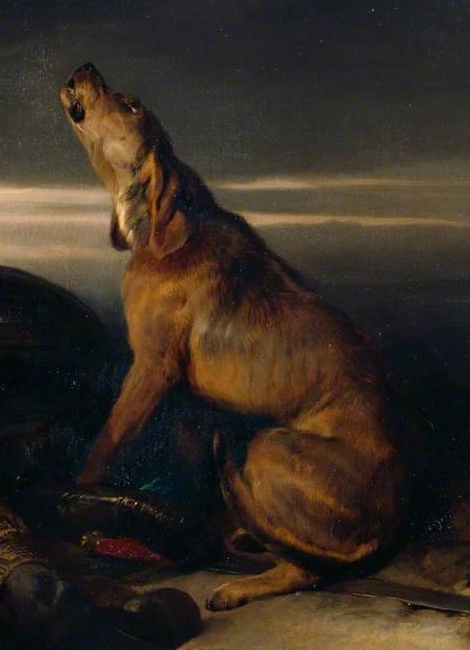
The raised head is only part of the gesture. The long ears hang down as the neck stretches upward. The chest rises above two braced front legs, while the hindquarters rest heavily on the ground. Seen together, these parts make the dog feel physically present beside the dead man.
Its mouth points into a large area of dark sky. Nothing in the picture answers that movement. The hound stays upright while the knight and horse lie across the lower half of the canvas, so our attention returns to it even when we look away toward the other figures.
The title supplies the word faithful. Landseer gives that idea a visible form: the dog is still beside its master when the action that killed him has ended. We read grief in the howl and loyalty in the animal's continued closeness.
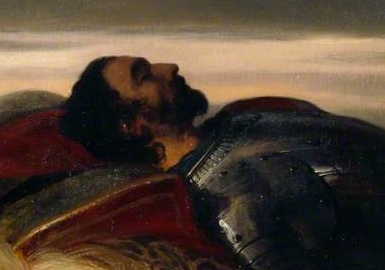
The knight's head falls backward, exposing his bearded face above the breastplate. His upward-facing profile creates a quiet connection with the hound's lifted muzzle. Their heads turn in a similar direction, but the dog's stretched neck and open mouth suggest an action the man can no longer make.
A narrow reflection follows the rounded steel over his chest. Beneath and beside it, the red cloak gives warmth to a body painted largely in dark tones. These remnants of martial display establish his rank and the violence of the setting, without showing the fighting itself.
The composition does not provide a name for this knight. His importance to the painting comes from the relationship still visible beside him.
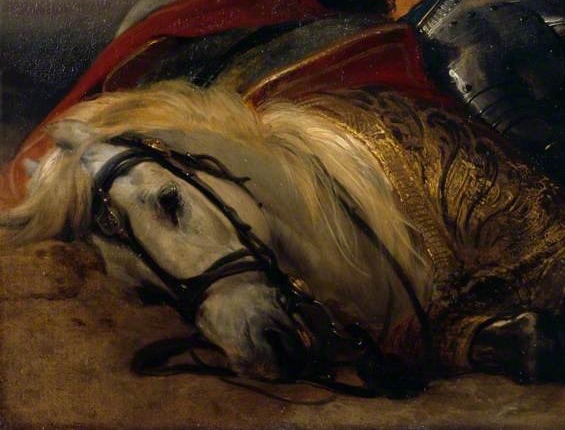
The horse's pale head lies close to the lower edge, with its muzzle against the earth and the dark bridle still in place. Its mane spreads between the head and the richer equipment behind it. This is a large, familiar animal brought down to the level of the ground.
The pale coat draws our eye before we have sorted out all the darker shapes of the knight's body. From the horse, the composition leads through the red cloth and the breastplate toward the hound. Human and animal figures share the same small patch of earth.
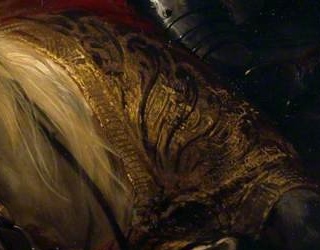
The horse's equipment is still elaborate. Gold-coloured patterns, curved borders and straps sit against the pale mane, with the dark armour close above. The care given to these surfaces keeps the scene from dissolving into a general impression of gloom.
Landseer distinguishes the coarse-looking hair of the mane, the dog's warmer coat, the folds of the cloak and the hard reflections on steel. Looking across those textures also reveals how little the possessions can do for their owner now. The equipment remains around him; the hound remains beside him.
Much of the canvas is given to sky. A low band of pale light passes behind the figures, separating their dark outlines from the distance. Above it, the clouds form a broad, heavy space around the hound's raised head.
That space makes the imagined sound of the howl seem to travel beyond the small group. There is no answering face in the distance and no arriving rescuer within the frame. The picture holds us with the dog in the interval after something irreversible has happened.
This is an interpretation of the arrangement, rather than proof that Landseer intended a particular religious message. The visible relationship is enough: a living companion stays close to someone who has become still.
The armour places the scene in an imagined chivalric past. Discussing a related Landseer study, The Maas Gallery connects the subject with the ballad of Chevy Chase, a story of a hunt that ends in a bloody clash. The gallery also notes that the hound and knight occupy different positions in the study and the finished Academy painting.
That documented comparison is more useful than attaching any famous loyal-dog legend to the image. The figures shown here do not establish the story of Gelert, and the painting should not be treated as a record of an identifiable modern accident. Landseer has arranged a historical-looking scene in which the dog carries the surviving attachment.
The Faithful Hound was Landseer's diploma work for the Royal Academy. A diploma work is an artwork given to the institution in connection with full membership, becoming part of its collection. The Academy's historical record lists Landseer's contribution under 1831, a separate date from the painting's usual dating of about 1830.
Its later exhibition history helps explain how it has been understood. In the teacher notes for the Royal Academy and Bendigo Art Gallery's 2014 Genius and Ambition exhibition, Landseer's ability to join animal subjects with moral storytelling is discussed through this painting and his images of mourning dogs. Here, the hound does more than accompany the knight: it gives the scene its emotional direction.
The painting belongs to the Royal Academy of Arts in London. Collection ownership does not mean it is always on public display, so consult the Academy when planning a visit.
For another treatment of a hound beside a dead knight, continue to Briton Rivière's Requiescat. You can also explore dog paintings in the ByMuseum collection or the hand-painted reproduction of The Faithful Hound.
Edwin Landseer painted it around 1830. It is an oil on canvas measuring 68.4 × 91.2 cm, height × width.
Its master lies dead beside it. The raised muzzle and open mouth convey a howl, which viewers read as grief. The title connects the dog's continued presence with faithfulness.
The collection title does not identify it as Gelert. A specialist catalogue connects Landseer's related study with the ballad of Chevy Chase; the finished image does not name either the dog or the knight.
It is in the Royal Academy of Arts collection, London, inventory number 03/945.
Edwin Landseer, The Faithful Hound, c. 1830. Royal Academy of Arts, London. Full-composition reference image via Wikimedia Commons, credited there to the Royal Academy of Arts / Art UK. The detail images are faithful crops of that image, with no reconstruction or upscaling.
Enjoyed this story?
Save articles to your collection
Log in or create a free account, and this article will be waiting in your Private Collection.
Log in or sign up
Man Writing a Letter
Gabriel Metsu, c. 1664
The gallery list
Every painting is already 50% off. Join the list and we will send you an extra $15 code, plus first access to new collections.
No spam. Unsubscribe anytime. · Privacy Policy
Welcome
Your $15 code is on its way. Explore the gallery while you wait.