Loading cart…
No products in the cart.

1888 · Oil on canvas · Ashmolean Museum, Oxford, United Kingdom
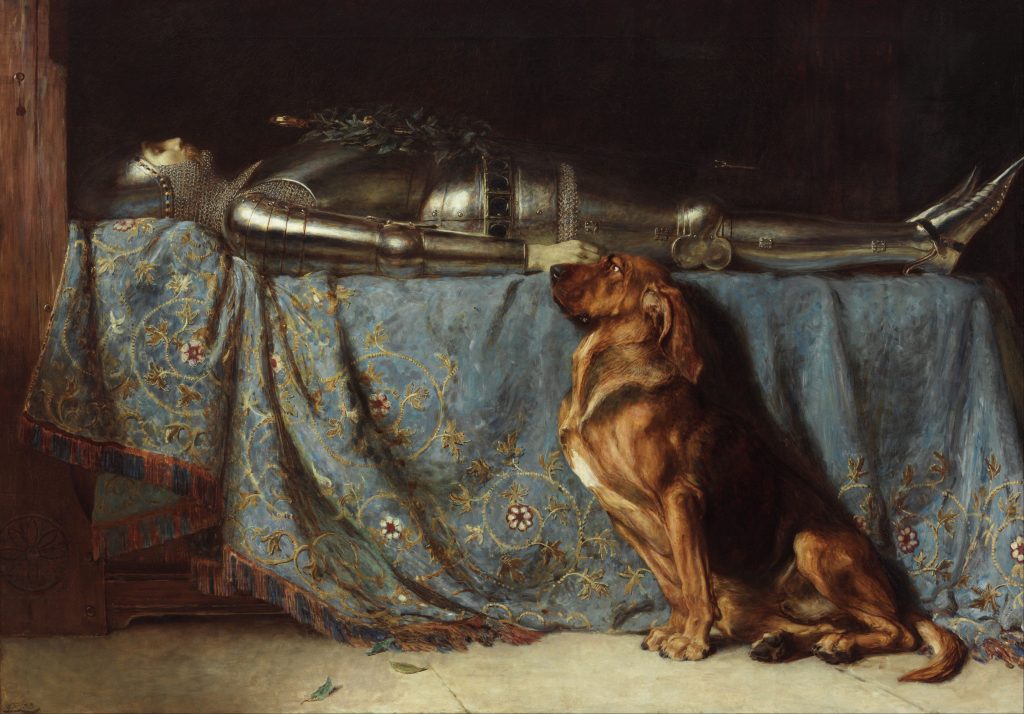
Briton Rivière completed Requiescat in 1888, and the work was exhibited at the Royal Academy to considerable critical and public response. The title, drawn from the Latin phrase meaning rest in peace, signals immediately that the painting engages with themes of death, mourning, and the loyalty of animals to those they love. By 1888, Rivière had been exhibiting at the Royal Academy for three decades and had established himself as a painter capable of bringing genuine emotional depth to subject matter that lesser artists handled with cloying sentimentality. Requiescat represents one of his most ambitious and emotionally complex works from this period. The painting draws on a long tradition in European art of depicting scenes of mourning and lamentation, yet it filters that tradition through the specific visual and moral concerns of Victorian culture, particularly its deep investment in the emotional lives of animals and the relationships between humans and their pets. The work was acquired by the Ashmolean Museum at Oxford, a collection with deep connections to the artistic life of the university city where Rivière had studied as a young man, which lends the acquisition a certain biographical resonance. The painting has been reproduced and discussed extensively in studies of Victorian art and animal painting, and it remains one of the works most frequently associated with Rivière in scholarly and popular writing alike. For those who wish to experience this profound image in their own home, ByMuseum offers this work as a hand-painted oil reproduction, made to order by skilled painters.
The composition of Requiescat is horizontal and expansive, with the reclining figure of the young woman occupying the lower portion of the canvas in a pose that simultaneously evokes sleep and death. Rivière positions the viewer at ground level, which creates an intimacy with the scene that a more elevated perspective would have denied. The dog lowers its head onto the body of the woman in a gesture of extraordinary tenderness, and it is this single point of contact between the living animal and its still companion that becomes the emotional fulcrum of the entire work. Rivière renders the textures of the scene with his customary precision: the softness of the fabric against the coolness of the stone floor, the weight of the dog suggested through the way its body settles and its head presses gently downward. The color palette shifts from the warm ochres and golds that characterize much of his animal work toward cooler, more subdued tones that suit the solemnity of the subject. The light is diffuse and even, avoiding the dramatic contrasts that might have made the scene feel theatrical, and instead producing a quality of stillness that is entirely appropriate to the subject matter. The background is kept relatively spare, preventing any distraction from the central relationship between the human figure and the animal. The painting rewards sustained looking, revealing more of its technical and emotional intelligence the longer one spends with it. This is a work that deserves to be seen at scale, and those who wish to own this as a hand-painted oil reproduction can do so through ByMuseum.
Requiescat engages with mortality and loyalty in ways that made it immediately legible to Victorian audiences and that continue to resonate in the present day. The Latin title places the painting within a tradition of memorial art, invoking the language of epitaphs and funerary monuments, yet the image itself is intimate rather than monumental. The choice to focus on the dog rather than on any human mourner is both unconventional and deeply moving: Rivière implies that the animal, incapable of understanding death in the abstract, nevertheless responds to loss with a constancy and depth of feeling that human beings might struggle to match. This was a theme with considerable cultural traction in the Victorian period, when the sentimental literature of animal loyalty had become a significant genre in its own right, but Rivière elevates the theme through the quality of his observation and the restraint of his pictorial means. The painting also participates in Victorian ideas about feminine virtue and the beauty of passive suffering, with the reclining figure carrying associations drawn from the iconography of sleeping saints and martyrs in earlier European art. Yet the presence of the dog complicates any reading that would reduce the work to simple allegory: the animal is too specifically observed, too physically present, to function merely as a symbol. It grounds the painting in something felt and real. The painting continues to move contemporary viewers who encounter it in the Ashmolean, and those who wish to bring its atmosphere of tender grief into their own living spaces can own this as a hand-painted oil reproduction, available now from ByMuseum.