Loading cart…
No products in the cart.

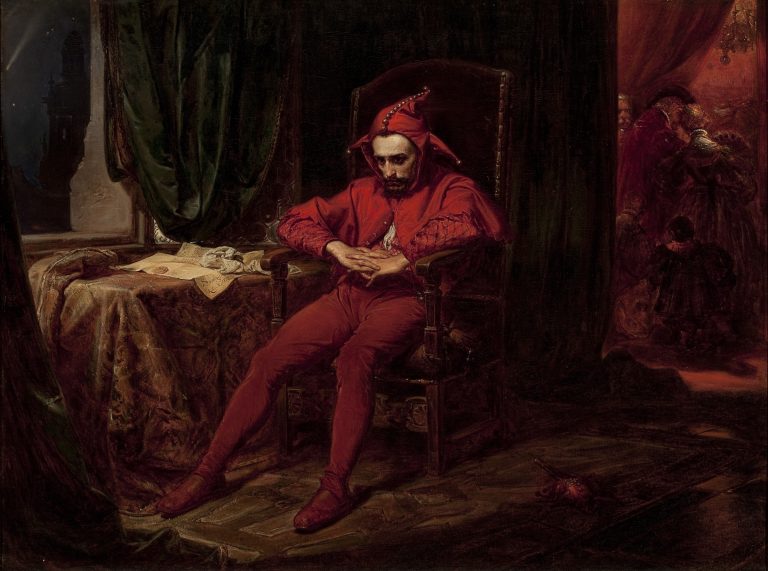
1862 · Oil on canvas · National Museum in Warsaw
Save articles to your collection
Log in or create a free account, and this article will be waiting in your Private Collection.
Log in or sign up Explore the artistJan Matejko →
He is dressed to entertain, yet nothing in his face offers entertainment. His legs stretch forward, his hands close together, and his gaze settles somewhere below the people who might expect him to make them laugh.
Jan Matejko’s Stańczyk shows a court jester alone in a dark chamber while a gathering continues through the doorway. The red costume makes him the first thing we see. The room beyond gives his stillness a context: he has withdrawn from an occasion that carries on without him.
The painting dates to 1862 and belongs to the National Museum in Warsaw. Its longer title connects the jester’s troubled reflection with the loss of Smolensk. The subject therefore reaches beyond a sad individual. It asks what happens when the person employed to amuse the court seems to understand a danger that others can put aside.
Look at the objects before trying to settle on an explanation. A letter lies on the table. A small staff rests on the floor. Through the window, a streak of light crosses the night sky. None of these details replaces the face, but each changes what we bring to it.
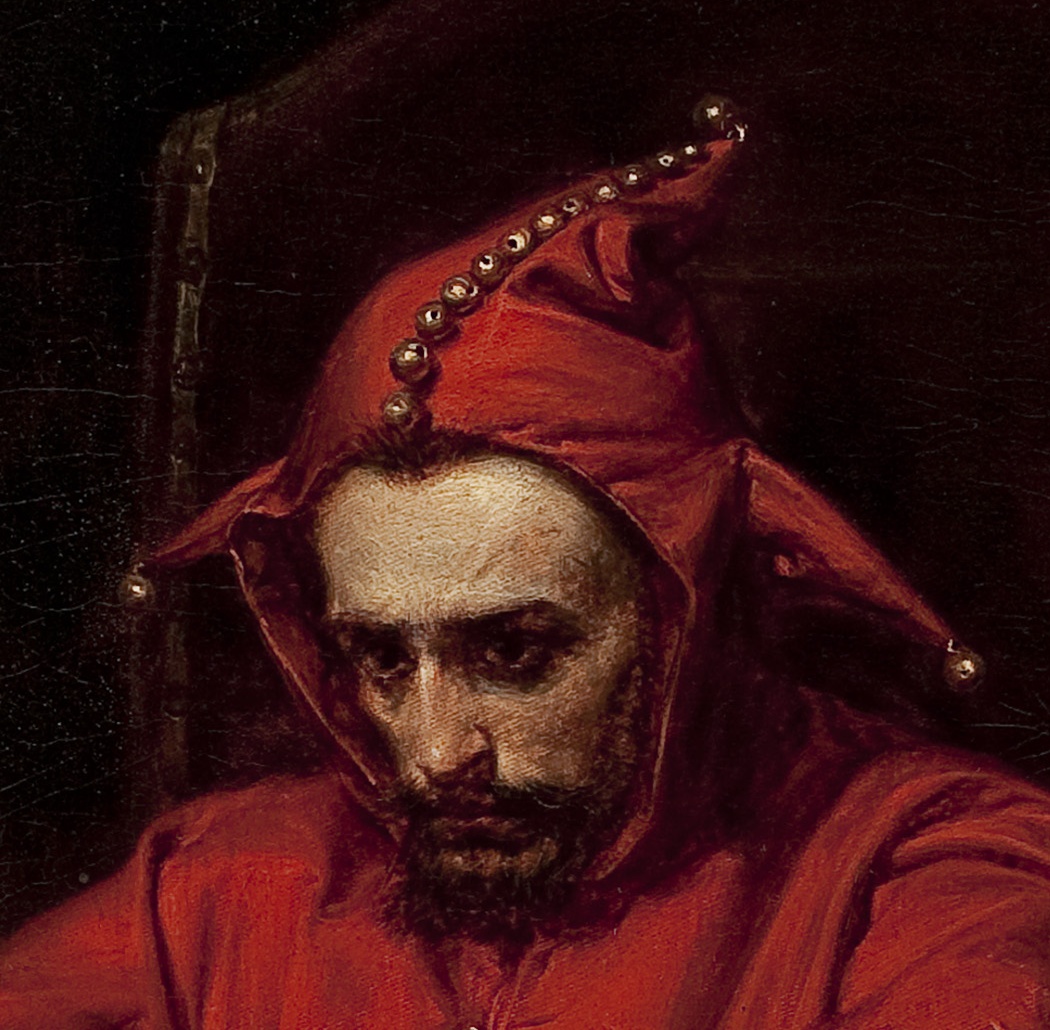
The brows draw together above eyes that do not meet ours. Shadows sit beneath them, while a narrow light describes the forehead and nose. The mouth remains closed. There is no open expression of grief that would turn the scene into a public appeal.
The cap matters because it prevents us from forgetting his profession. Its points and small bells frame a face whose expression seems entirely unsuited to the work of a jester. Costume and feeling pull in different directions.
We can recognise concentration or distress without diagnosing the man. The painting gives us a pose and an expression, not a medical history. Its uncertainty leaves space for several closely related responses: worry, disappointment, exhaustion or the effort of thinking through unwelcome news.
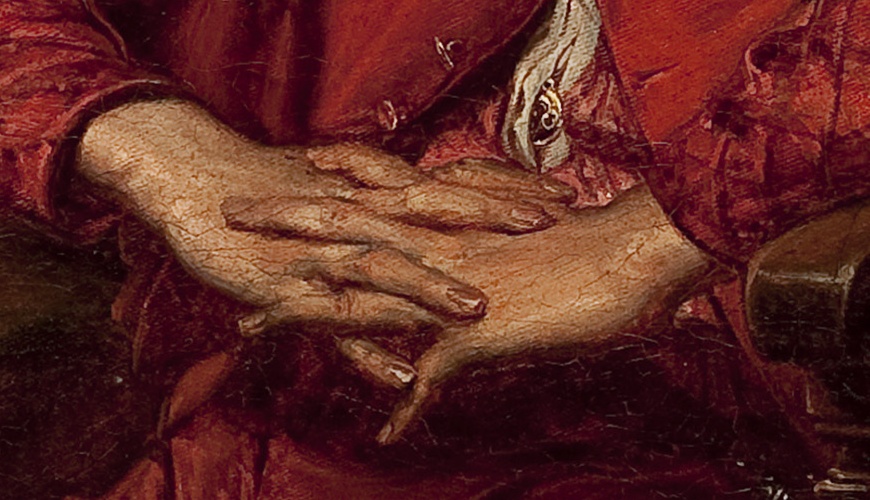
Both hands remain close to the body. The fingers interlace over the lap instead of reaching toward a guest or lifting an object. The forearms rest on the chair, making a small enclosed shape beneath the face.
That enclosure has a practical effect on the composition. After the bright spread of red sleeves, the eye arrives at a pale knot of hands. Movement seems to stop there. He has the space to act, but the gestures do not lead outward.
Look back at the face after seeing the hands. The lowered gaze and folded fingers appear to belong to the same sustained pause. Matejko does not need to show a dramatic outburst to make the figure difficult to approach.
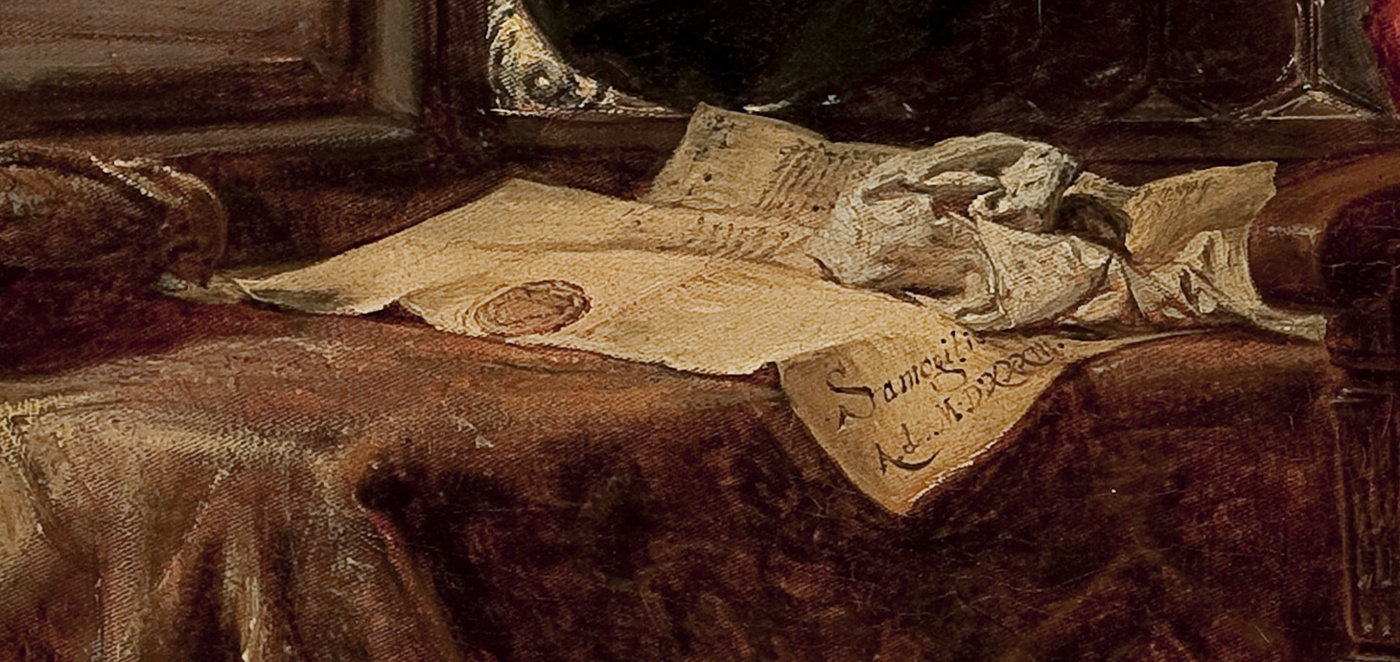
The papers occupy the space between the window and the chair. Their pale surfaces catch enough light to be noticed, although they are much smaller than the figure. A seal, folds and writing make them look handled and consequential.
The familiar reading of the painting connects this correspondence with Smolensk, the strategically important fortress lost to Muscovite forces in 1514. That historical association helps explain why an apparently private silence has been understood as concern for the country.
Within the composition, the letter also changes the direction of attention. The jester is not holding it up for us to read. It has been put down, leaving the consequences to register in his face and posture. The document occupies the table; its apparent burden occupies the person.
The inscription is commonly transcribed as Samogitia, A.D. MDXXXIII. The Roman numerals mean 1533, not 1514. This is an important complication in an image often described simply as the moment news of Smolensk’s fall arrives.
The National Museum in Warsaw’s contribution to its 2019 adoption-auction catalogue explicitly discusses the difficulty. Smolensk fell in July 1514, when Barbara Zápolya was queen. Bona Sforza, named in the painting’s longer title, became queen in 1518. The title, the paper and the historical event cannot all be read as one straightforward contemporary report.
The safest approach is to keep those layers separate. The work invokes the loss of Smolensk, but it is a nineteenth-century construction of historical meaning. Its chronology is part of the interpretation, rather than a reason to replace the visible date with a more convenient one.
That distinction does not weaken the painting. It prevents us from mistaking a carefully staged meditation on history for a documentary view of a single evening.
Source: National Museum in Warsaw text in the 2019 adoption-auction catalogue.
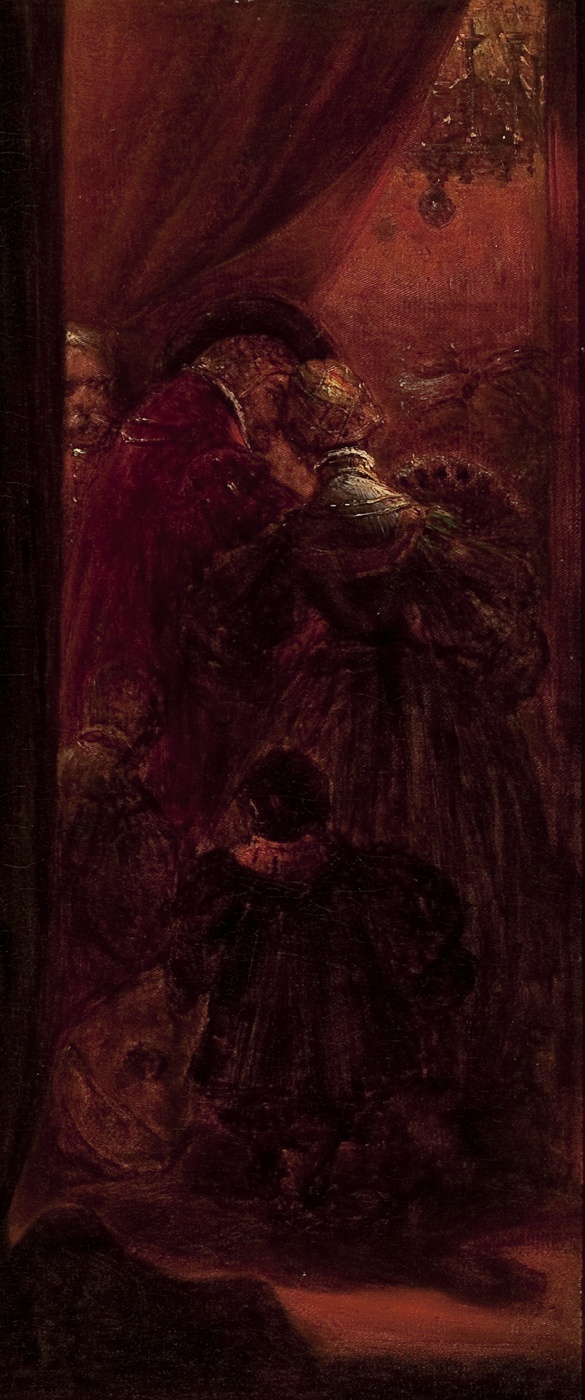
The neighbouring room is close enough to make the separation feel deliberate. Warm red light, decorated clothing and overlapping figures suggest a social world continuing at its own pace. We do not need to identify every guest to recognise a contrast with the isolated man.
The dark vertical space between the jester and the gathering works almost like a pause in a sentence. One area contains a single legible face and a settled body. The other compresses people into a narrow opening.
Notice that Matejko has not placed the court in an entirely different setting. They share the same interior. That closeness gives the contrast its force: physical proximity does not guarantee a shared concern.
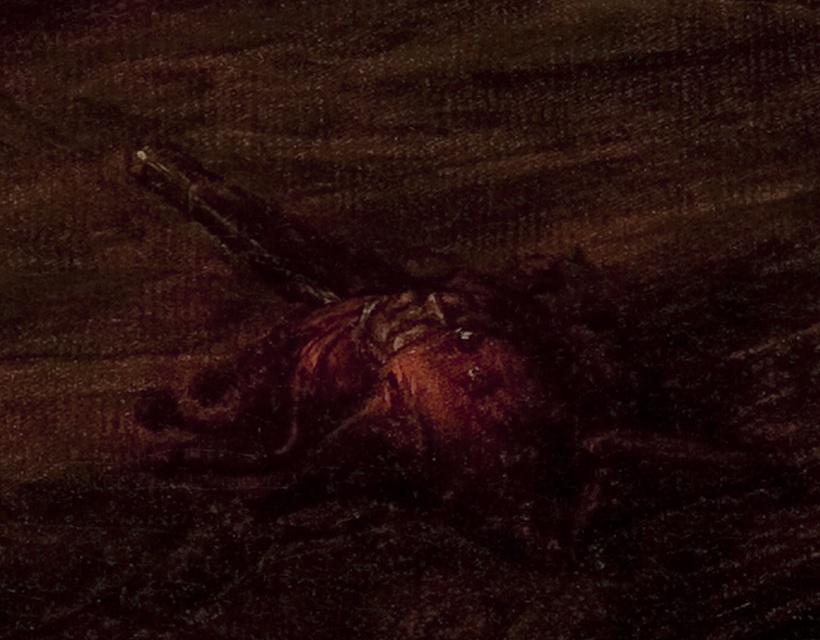
A small red-capped head lies on the floor at the end of the jester’s staff, or marotte. Its scale makes it easy to miss when the full red figure dominates our attention.
The object offers a reduced version of the person above it: another cap, another head, another sign of the profession. But it is no longer being used. Laid aside, it helps make this a moment between performances.
There is no need to invent the instant when it fell or was dropped. The painting does not show that action. What matters is the present relationship: the instrument of amusement is near the jester, yet separated from his hands.
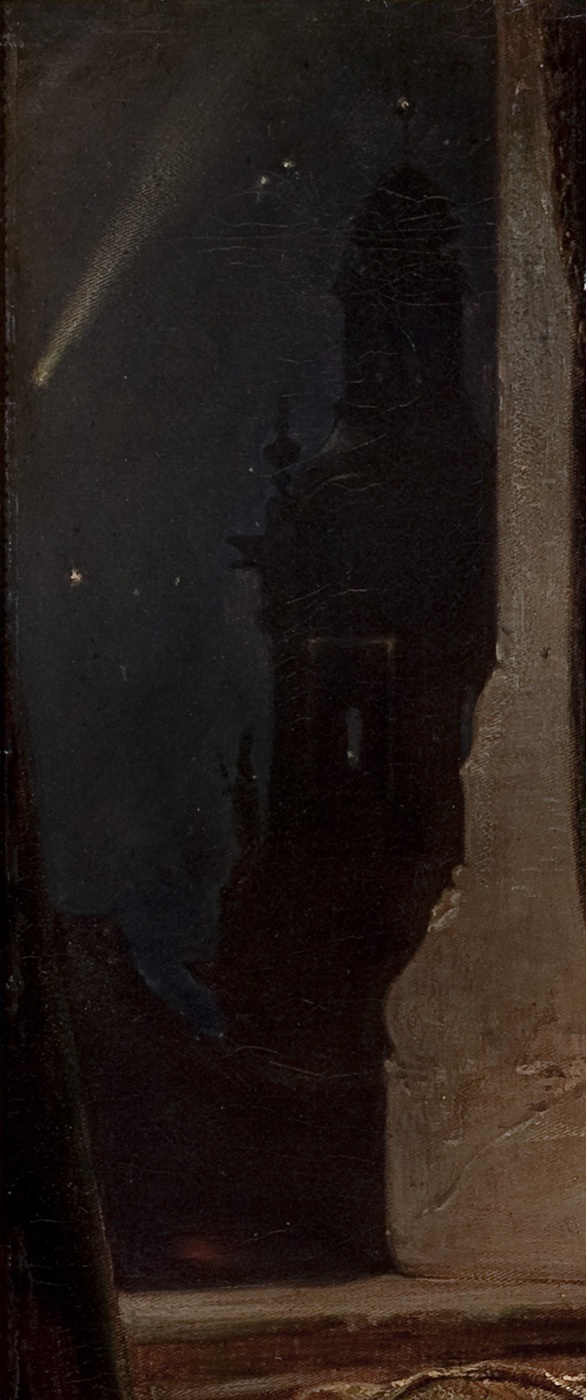
The window opens the left edge of the painting onto a darker, more distant space. A tower rises against the sky, and a pale diagonal streak cuts past it. The room is enclosed, but it is not completely sealed from the world outside.
Collection commentary identifies the tower with Wawel Cathedral in Kraków and reads the comet as an ominous sign. In that interpretation, the night sky gives a wider historical scale to the anxiety concentrated in the seated figure.
The two openings also balance one another visually. On the right, we look toward people and artificial light. On the left, we look toward architecture and the sky. Between them, Stańczyk seems unable to take comfort in either prospect.
The identification of Stańczyk with the artist is more than a resemblance invented by recent viewers. Museum commentary and the Adam Mickiewicz Institute’s Culture.pl discuss the figure as a self-portrait in historical costume. Matejko was only twenty-four when he painted it.
Giving the jester his own features brings the painter into the question the scene poses. He does not enter as a king directing events, but as someone who sees, reflects and remains apart from the occasion.
That decision helps explain why the image has been read as a statement about the artist’s role. The figure who appears marginal within the court becomes central within the picture. The person expected to provide amusement receives the seriousness of a principal historical actor.
Stańczyk is remembered as a royal jester associated with the Jagiellonian court and with wit directed at public affairs. The surviving record leaves substantial gaps, including uncertainty about his appearance. The painted face should therefore not be treated as an authenticated likeness of a sixteenth-century sitter.
Matejko had already used the character in an earlier painting, Stańczyk Feigning Toothache, dated 1856. The National Museum in Kraków connects that work with an anecdote in which the jester records unsolicited remedies offered by passers-by. There the wit operates through an encounter with other people.
In the 1862 canvas, the character has become much more inward. The contrast is useful: this painting’s gravity is a choice within Matejko’s treatment of the jester, not a definition of everything a court fool could be.
Matejko was born in Kraków in 1838 and died there in 1893. His career unfolded while Poland was partitioned, and his historical paintings addressed readers of the past who also had urgent reasons to think about their own present.
The National Museum in Kraków describes an artist who wanted history painting to do more than illustrate old events. It could examine their significance and shape a sense of national continuity. Stańczyk belongs to that larger ambition even though it concentrates on a solitary figure.
The room’s silence can be felt before that context is known. Learning it changes the scale of the concern. What might first seem like an individual’s bad evening becomes an image about the relationship between awareness and responsibility.
Another work by the artist in our collection, Rejtan, or the Fall of Poland, offers a different encounter with his historical imagination. For another nineteenth-century painter’s treatment of a charged historical scene, explore Repin’s Ivan the Terrible and His Son.
After the close details, step back to the full composition. The papers, window, court gathering and abandoned staff are arranged around a figure who remains vividly present. They do not compete equally for attention. They give the red costume somewhere to lead the eye.
The most unsettling thing may be the small distance between solitude and company. A doorway is open. Other people are nearby. Yet the body in the chair seems to inhabit a different occasion from the one taking place next door.
Matejko makes that separation visible without allowing it to become comfortable. The costume promises lightness; the face refuses it. The court carries on, and the jester remains with what he has understood.
Jan Matejko painted Stańczyk in 1862. The Polish artist lived from 1838 to 1893.
The painting is traditionally read as the jester’s troubled reflection on the loss of Smolensk and its consequences, while a court ball continues nearby. The scene uses historical references symbolically; it should not be treated as a literal report of one evening.
He is a court jester, a role associated with royal entertainment and wit. Calling him a sad clown can describe a modern viewer’s first impression, but it misses the courtly and political setting of Matejko’s painting.
The inscription includes MDXXXIII, the Roman numerals for 1533. Smolensk fell in 1514, so the dates should be distinguished rather than silently made to agree.
The original belongs to the National Museum in Warsaw, inventory MP433 MNW. Check the museum’s current information before a visit, since collection ownership does not guarantee that a work is on display.
The canvas measures 88 centimetres high and 120 centimetres wide. Those are the original painting’s dimensions, separate from the reproduction sizes available in the shop.
The main image preserves the full composition. Detail images are faithful crops of the museum-sourced historical painting. Artwork: Jan Matejko,1862; source photograph credited to Krzysztof Wilczyński / National Museum in Warsaw. Image sources and public-domain records are linked above.
Enjoyed this story?
Save articles to your collection
Log in or create a free account, and this article will be waiting in your Private Collection.
Log in or sign up
Man Writing a Letter
Gabriel Metsu, c. 1664
The gallery list
Every painting is already 50% off. Join the list and we will send you an extra $15 code, plus first access to new collections.
No spam. Unsubscribe anytime. · Privacy Policy
Welcome
Your $15 code is on its way. Explore the gallery while you wait.