Loading cart…
No products in the cart.

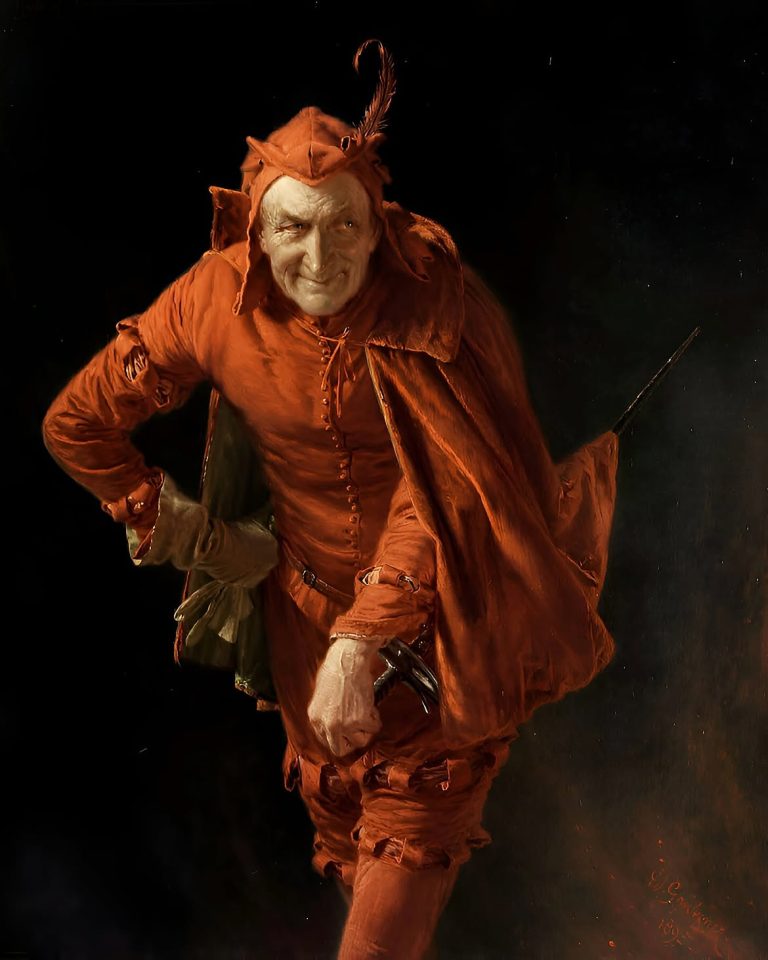
1895 · Oil on canvas · Private collection
Save articles to your collection
Log in or create a free account, and this article will be waiting in your Private Collection.
Log in or sign upA man in brilliant red steps out of an almost completely black background. He leans toward us, one arm bent sharply at his side while the other drops beside the hilt of a sword. His cape swings behind him. A curling feather rises from a close-fitting cap. Most striking of all, he smiles.
This is Mephistopheles, the tempter from Johann Wolfgang von Goethe's Faust. Yet Eduard von Grützner does not paint him with horns, flames or a monstrous body. He appears as a performer in costume, alert, amused and disturbingly human. The painting's tension comes from that contradiction. We know the character represents danger, but nothing about him tells us to run immediately.
Grützner signed and dated the painting in 1895. The documented canvas measures 44 by 36 centimetres, a compact scale that makes the encounter feel close and personal. Mephisto does not rule a vast supernatural landscape. He enters our space.
Mephisto is a shortened form of Mephistopheles. In Goethe's tragedy, he challenges the value of human striving and becomes the companion and tempter of Faust, a scholar frustrated by the limits of knowledge. Their arrangement is more precisely a wager than the simple contract often remembered in popular culture. Faust declares that if any earthly experience satisfies him so completely that he wishes the moment to remain, his striving will end and Mephistopheles may claim him.
That story matters because Mephisto's chief weapon is persuasion. He does not need to overpower Faust physically. He offers experience, pleasure, possibility and escape from dissatisfaction. Faust must agree to follow. Grützner's figure suits that role: he looks like someone prepared to begin a conversation, not someone arriving to attack.
The Faust story existed before Goethe, but Goethe worked on his version across much of his life. Faust, Part One appeared in 1808, while Part Two was published after his death in 1832. By Grützner's time, Mephistopheles had become one of the great theatrical roles of the German-speaking stage.
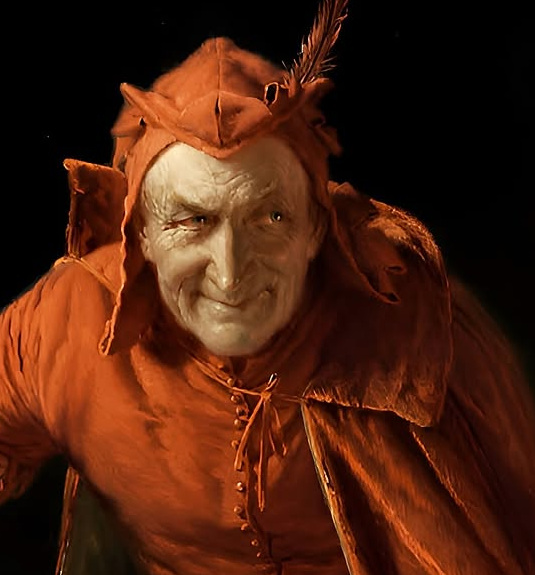
The smile is small enough to remain ambiguous. It can be read as amusement, confidence, mockery or anticipation. The auction catalogue that documented this canvas described it as a victorious, mocking smile. Grützner reinforces that expression with narrowed eyes, deeply modelled wrinkles and a slight forward tilt of the head.
There is no uncontrolled rage in the face. Mephisto seems composed. That control is the source of his psychological power. A visibly furious devil would reveal his intentions at once. This one appears patient enough to let another person talk themselves into a mistake.
The painting therefore turns a literary villain into a study of social intelligence. Mephisto watches, calculates and performs. His expression suggests that temptation succeeds through attention and timing as much as through desire.
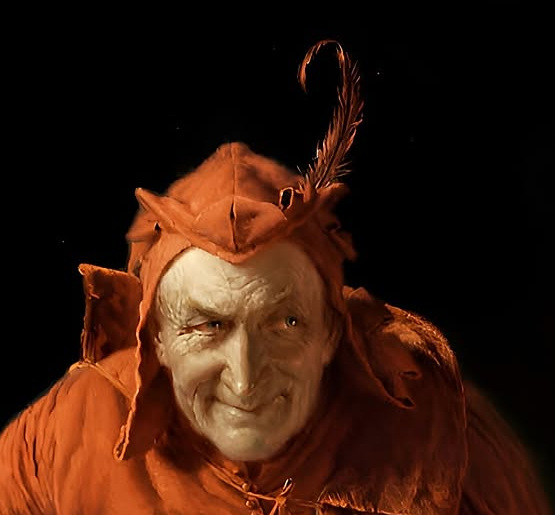
The costume belongs to a long stage tradition. Goethe's text refers to the cock's feather and red clothing associated with Mephistopheles, while surviving nineteenth-century theatrical objects show how firmly the feathered cap became attached to the role. Grützner uses that familiar visual language but makes the fabric unusually material. Buttons, seams, tears and patches are all visible.
The cap resembles a jester's hood. That connection is important. A fool can speak dangerously under the cover of comedy, and Mephisto often uses wit to make destructive ideas entertaining. The feather curves above him like a question mark, adding movement to a figure already leaning into the viewer's space.
Red carries obvious associations with heat, blood and the devil, but it also works as stagecraft. Against the black ground, the costume appears suddenly, almost like a performer caught by a spotlight. The color first attracts us. Only later do we notice how worn and damaged the clothing is.
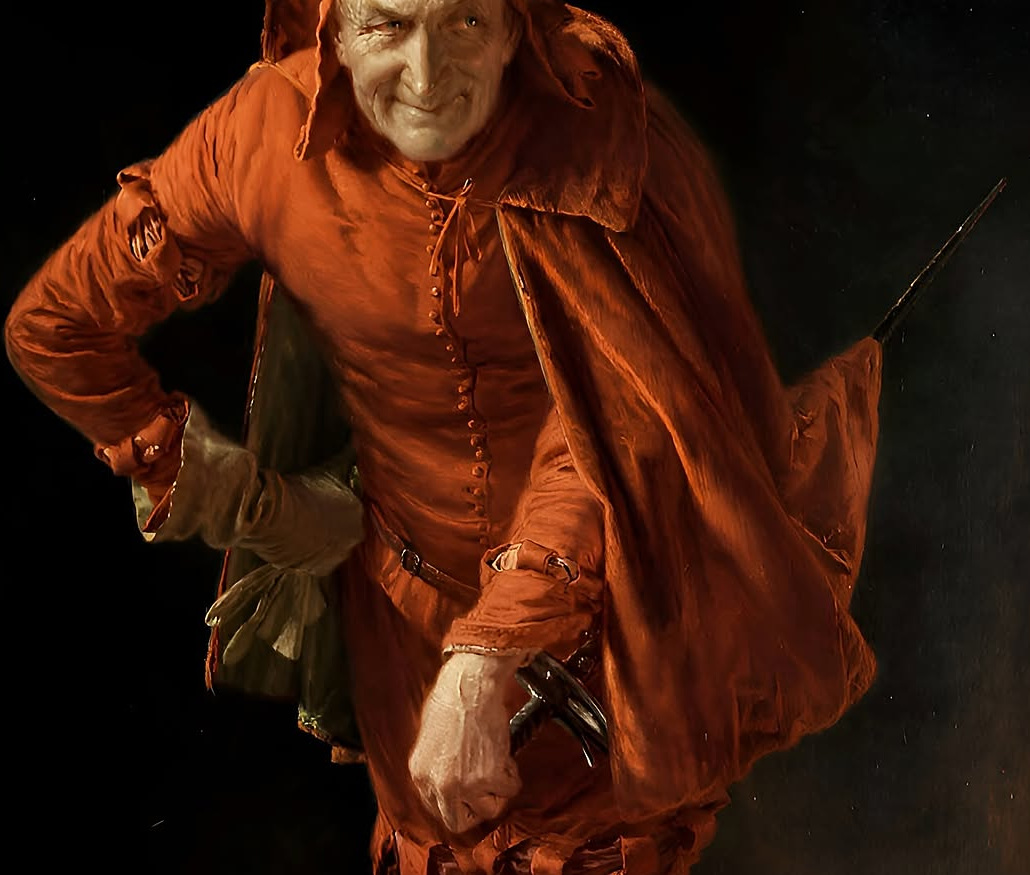
The torn knees and patched sleeves keep the costume from looking regal. Mephisto is flamboyant, but he is also a working performer. The wear may simply record an actual stage garment, yet within the painting it gives the character history. This tempter seems to have played the role many times before.
The sword changes the mood. Its hilt lies close to Mephisto's lowered hand, while the blade rises behind the cloak and almost disappears into darkness. He does not draw it or threaten the viewer with it. Violence remains available but concealed.
Grützner lets the costume communicate two ideas at once. The red fabric, feather and exaggerated pose offer spectacle. The sword and dark background introduce danger. This is how the painting builds suspense without action: the entertaining surface keeps us looking long enough to find what it hides.
The figure is almost certainly conceived through theater, and he may have been painted from an actor. The Hampel auction record notes that Grützner knew prominent people of his day, including performers from the Munich court theater, and suggests that one of those actors may have served as the model. No surviving identification proves exactly who the sitter was, so the claim should remain an informed possibility rather than a certainty.
That uncertainty strengthens the painting. We are looking at Mephisto, but also at a human being skilled at becoming him. The wrinkles, pale skin and individual expression resist the smooth generality of an imaginary demon. Grützner's close attention makes the supernatural character believable because it begins with observation.
The theatrical pose is equally revealing. Mephisto bends forward as though making an entrance or acknowledging an audience. His left arm forms a sharp angle, his cape opens behind him, and his face turns directly toward us. The painting does not merely illustrate Faust. It recreates the instant when an actor captures the room.
Grützner removes every detail that might identify a room or stage. There is no furniture, scenery or second character. Darkness isolates the figure and concentrates attention on the parts that carry meaning: the pale face, the red costume, the hand near the sword and the gleaming feather.
The black ground also prevents us from knowing where Mephisto came from. He seems to materialize rather than walk into view. This effect supports the theatrical reading because the lighting resembles a spotlight, but it also allows the character to occupy a psychological space. He emerges from whatever fear, desire or curiosity the viewer brings to the encounter.
The strongest contrast lies between face and costume. Warm red advances visually while black recedes. The pale face sits between them, human in its detail but almost masklike in its illumination. Grützner guides the eye from attraction to recognition, and then from recognition to suspicion.
Mephisto can be read as a portrait of persuasion. The painting asks why temptation is compelling when we already understand its danger. Grützner's answer is not written as a moral lesson, but it is built into the figure. Mephisto is lively, intelligent, humorous and visually magnetic. He makes danger interesting.
That reading fits Goethe's character without reducing the painting to a scene from the play. The most effective temptations rarely introduce themselves as ruin. They arrive as opportunity, relief, excitement or a harmless exception. Mephisto's smile seems to offer precisely that kind of invitation.
The painting's humanity is therefore more disturbing than a monstrous image would be. A creature with horns and claws would make resistance easy. Grützner gives us someone capable of conversation. The viewer knows his name and still wonders what he might say next.
Eduard von Grützner was a German painter born in 1846 and trained in Munich. He became known for richly observed genre paintings, especially scenes of monks, drinkers and historical characters. His figures often combine precise costume with expressive faces and a strong sense of performance.
Grützner's art belongs to the culture of late nineteenth-century Munich, where academic skill, theatrical life and a market for humorous character pictures overlapped. The Bavarian state collections preserve several of his works, including The Silesian Drinker and the Devil from 1884. He received the title of professor in 1886 and was ennobled in 1916.
Mephisto shows the darker side of the same talent that made his tavern and monastery scenes successful. He could make a character readable through clothing and gesture, then complicate the first impression with a face that suggests an inner life.
The 1895 canvas documented here is in a private collection. It measures 44 by 36 centimetres, is signed and dated at the lower right, and appeared in the Lepke auction catalogue in Berlin in June 1897 as catalogue number 37. It is also reproduced in László Balogh's catalogue raisonné of Grützner's work.
Grützner painted Mephisto more than once, so dimensions and supports vary among versions offered on the market. The 44 by 36 centimetre oil on canvas is the version shown on this page. If you would like to bring Mephisto into your own space, ByMuseum recreates the painting by hand in oil on canvas. Choose your size and frame on the Mephisto reproduction page linked here.
Mephistopheles is a demonic tempter associated with the devil in the Faust tradition. Goethe gives him a more complex dramatic role than a simple embodiment of evil, but Grützner expects viewers to recognize the familiar theatrical devil.
Eduard von Grützner signed and dated this version in 1895.
The documented original is oil on canvas and measures 44 by 36 centimetres.
The feathered red cap belongs to the nineteenth-century stage image of Mephistopheles and reflects details associated with the character in Goethe's text. It also gives the figure the witty, theatrical appearance of a jester.
Grützner avoids obvious horror. The restrained smile, direct gaze and human face make Mephisto appear persuasive. The danger emerges slowly through the sword, darkness and calculating expression.
Enjoyed this story?
Save articles to your collection
Log in or create a free account, and this article will be waiting in your Private Collection.
Log in or sign upDocumented facts and visual interpretation are identified separately. The artwork is in the public domain.