Loading cart…
No products in the cart.

1942 · Oil on canvas · Art Institute of Chicago
Save articles to your collection
Log in or create a free account, and this article will be waiting in your Private Collection.
Log in or sign up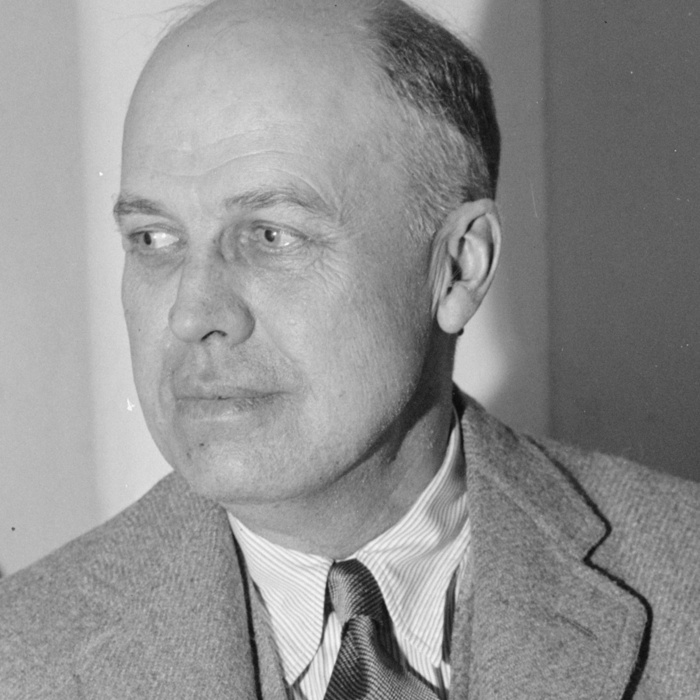 Explore the artistEdward Hopper →
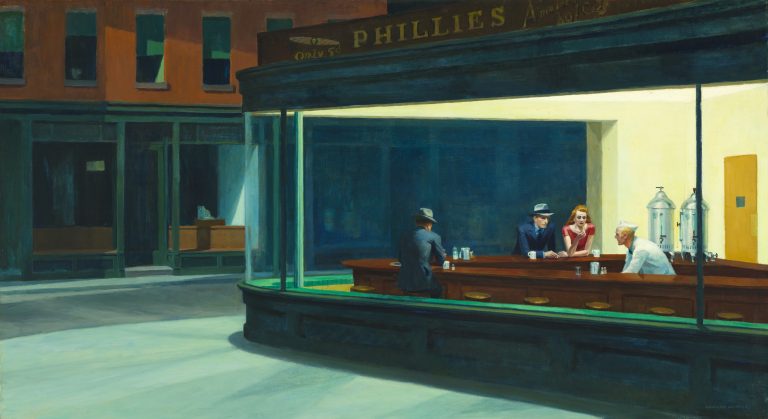
The diner is open. The street is empty. Four people occupy a pool of light, close enough for us to see their hands, yet none acknowledges us. We can look through the glass, but Hopper gives us no obvious way to join them.
Edward Hopper painted Nighthawks in 1942. Its subject could scarcely be more ordinary: three customers and a server in a late-night diner. What makes the scene difficult to leave is how little it explains. Nobody arrives. Nobody finishes a conversation. The painting holds us in the interval before something might happen.
Start with your own position. We stand outside, across a stretch of pavement. The counter sweeps past the figures like another barrier behind the window. Before deciding what these people feel, notice how firmly the composition keeps us apart from them.
The diner’s rounded corner creates a long, continuous view into the room. Its pale ceiling and reddish counter narrow toward the left, directing our attention back into the scene. The window is so clear that it can almost disappear until we remember that we are on the wrong side of it.
There is no visible entrance from the street in the view Hopper gives us. That is more precise than saying the building has no door: a yellow doorway appears behind the counter, but it does not offer the passer-by a route inside.
The effect can feel both welcoming and excluding. There is warmth, company and coffee within reach of our eyes. Our feet remain on the pavement. That contradiction comes from the architecture before it becomes a theory about loneliness.
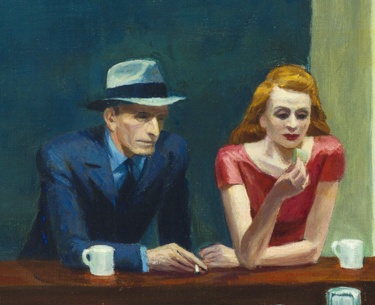
The red-haired woman supplies the room’s most concentrated patch of colour. Her dress stands out against the blue-green window behind her and the man’s dark jacket. One elbow rests on the counter; her other hand is lifted close to her face, holding a small pale object.
The man beside her leans forward, his hands low on the counter. Their hands come close, but the painting does not give us a clear affectionate touch. Nor does it show a quarrel. Their proximity leaves the relationship open: a couple, companions, or two people sharing the same counter.
Look at the contrast between her bent arm and his extended forearm. Together they make a compact arrangement of diagonals. Hopper can bind two figures into one shape without settling how emotionally close they are.
It is tempting to supply a private story for them. The more carefully we look, the more we have to separate what is visible from what we bring: a red dress, two cups, nearby hands, and a conversation we cannot hear.
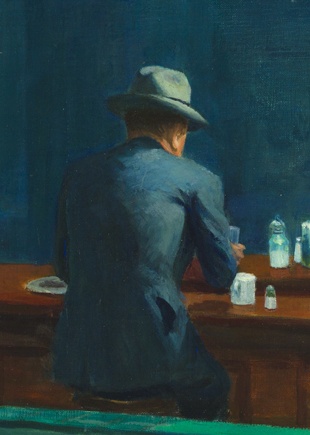
The nearest customer has turned his back to us. We see a hat, a sliver of profile and a broad dark coat. His body blocks the counter where he sits, making him the most physically present figure and the hardest to read.
Because we cannot meet his eyes, we try to follow his posture. He inclines toward the interior, while the curved counter draws him into the same space as the other customers. His seat is separate, but he is not outside the group in the way we are.
That distinction matters. Calling every figure lonely can flatten the painting. This man might be resting, waiting, listening, or simply having coffee. Hopper gives us the conditions for those possibilities without choosing one on our behalf.
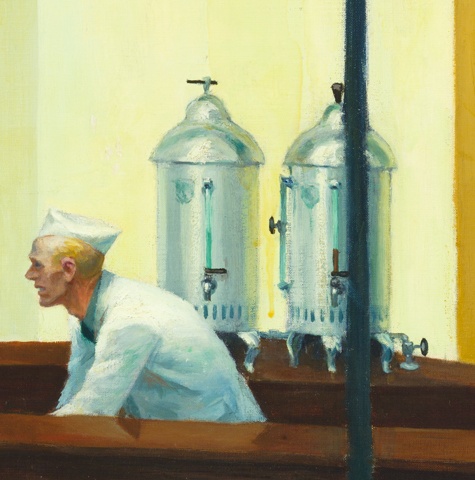
The server bends forward in a white cap and uniform. His body suggests work in progress, but his turned head introduces the possibility of an exchange with the customers. The moment is suspended between practical movement and human attention.
Behind him, two tall coffee urns repeat his pale colouring. Their lids, handles and taps make the room specific. This is a place equipped to serve people through the night, not an abstract stage with four bodies on it.
Small cups, glasses and containers punctuate the broad counter. They provide a different rhythm from the large curves of the architecture. Their modest scale makes the room believable even while the enormous pane of glass makes it feel strangely exposed.
The urns also explain some of the painting’s stillness. Everything needed for service seems to be in place. We are looking at a working environment in a pause, rather than an abandoned one.
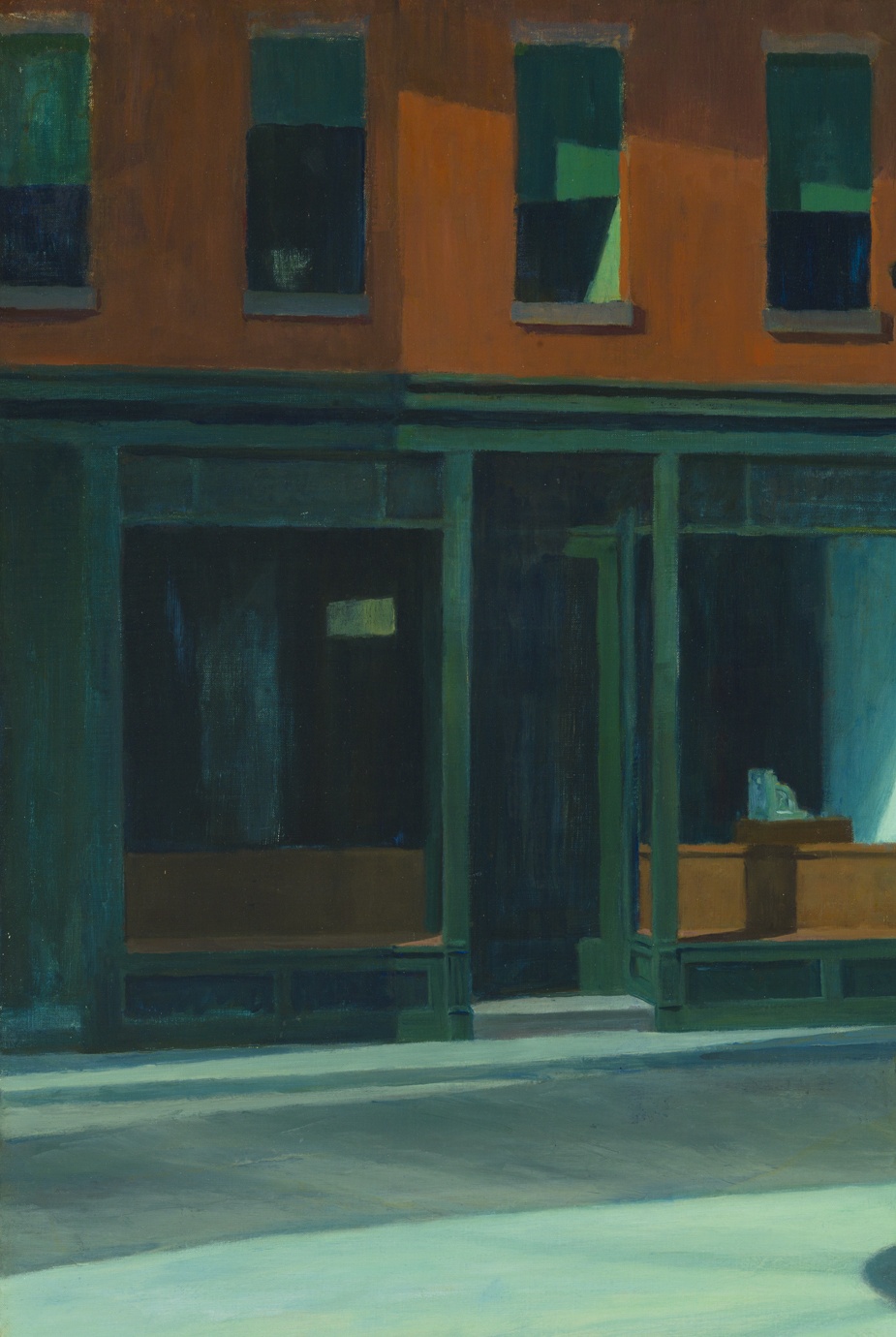
Across the street, dark shop windows face the diner. There are no pedestrians to connect the two sides, no traffic to break the open foreground, and little activity in the upper windows. The illuminated room feels more intense because so much around it has fallen quiet.
Hopper does not paint the night as a uniform black. Blue, green and muted red remain visible in the surrounding buildings. Pale light spreads across the pavement, pulling the diner’s colour out into the street. The boundary between inside and outside is therefore strongest for people, not for light.
The Art Institute associates the room’s eerie brightness with fluorescent lighting, then a relatively new feature of everyday interiors. Notice how that brightness sharpens the counter’s edges and exposes the customers while leaving the surrounding city subdued.
Stand back from the individual faces and the whole painting becomes an arrangement of light-bearing surfaces: ceiling, wall, counter, pavement. The people occupy that arrangement, but they do not overwhelm it.
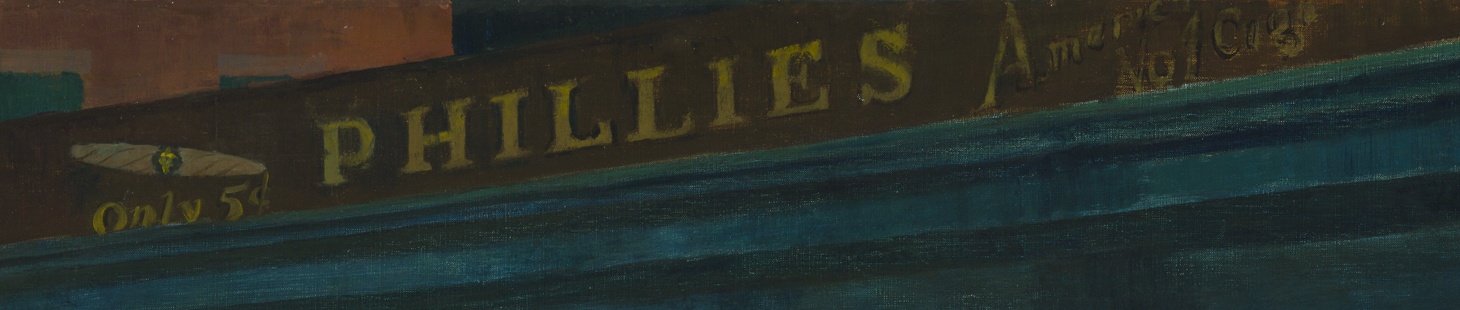
The large lettering above the window can look like a restaurant sign. The accompanying cigar image and price identify it as an advertisement for Phillies cigars. PBS’s American Masters specifically corrects the assumption that Phillies names the diner.
This small distinction changes the way we read the setting. A familiar commercial message sits above an interior whose occupants remain anonymous. Hopper gives the city a recognisable surface without providing a complete address or a personal history for the people inside.
The sign is also painted much more quietly than the room below. Its subdued gold lettering belongs to the dark upper band, while the light under the canopy does the work of drawing us toward the window.
Hopper connected the picture with a Greenwich Avenue restaurant at a junction of two streets. That starting point does not make the finished canvas an exact architectural record or establish one surviving diner as its original.
The Whitney describes a broader habit in his work: observed places were often combined into an imagined whole. He lived and worked on Washington Square from 1913 until his death in 1967, returning repeatedly to windows, streets and the relation between public space and private lives.
In Nighthawks, the invented corner is exceptionally effective. The diner’s wedge gives us a long view of the figures without bringing us inside. Across from it, the empty storefront anchors the other half of the street. Each side makes the other more convincing.
That is why finding a plausible street address cannot explain the whole painting. The important location is also the one Hopper constructed: a place where visibility and access have come apart.
The finished image can feel immediate, as though Hopper glanced through a window and preserved what he saw. Preparatory drawings reveal a more deliberate process. The catalogue for his final study for Nighthawks describes approximately seventeen preliminary sketches, working through architecture, figures and details such as the coffee urns.
The relationships changed as the design developed. In the final study, the seated pair turn more intimately toward one another. In the painting, their orientation becomes less directly connected. A change in a head or shoulder can alter the emotional possibilities of an entire room.
Josephine Nivison Hopper, an artist herself, contributed more than a recognisable face. Her January 1942 letter records that Edward posed for the two men using a mirror, while she posed for the woman; she also proposed the title. Her account puts the work at roughly a month and a half.
These preparations make the uncertainty more interesting. The ambiguous gestures are the result of decisions, not a shortage of observation. Hopper worked toward a scene that we can see distinctly without fully knowing.
Loneliness is a compelling reading, but it is not a complete script. The Art Institute preserves Hopper’s qualified acknowledgement that “unconsciously, probably, I was painting the loneliness of a large city.” The hesitation matters: it leaves room for effects that were not planned as a fixed symbolic message.
We can feel isolation in the back-turned customer, in the pair who do not quite meet, or in our own place on the pavement. We can also see endurance: a room that stays open, someone continuing to work, and people choosing company over a completely empty street.
The picture’s stillness accommodates both readings. It does not need a secret crime, a doomed romance or an identified stranger to hold our attention. The unresolved ordinary situation is enough.
For another way a recognisable everyday setting can withhold its story, explore the stories behind famous paintings. In Hopper’s diner, the central question remains unusually close to our own experience: what can we know about people simply by sharing a view of them?
Edward Hopper painted Nighthawks in 1942. It is an oil painting on canvas.
It belongs to the Art Institute of Chicago, which acquired it in 1942. The canvas measures 84.1 × 152.4 cm, approximately 33⅛ × 60 inches.
Four: three customers seated at the counter and one server behind it.
A Greenwich Avenue restaurant helped inspire it, but the composition was transformed. It should not be treated as a precise portrait of an identified surviving diner.
No street entrance is visible in the composition. The uninterrupted view through the glass allows us to observe the occupants while leaving our route into their space unresolved.
It is commonly discussed within American Realism. Its recognisable city setting is carefully constructed, with simplified forms and colour relationships that carry much of the emotional effect.
Painting image: Art Institute of Chicago, Friends of American Art Collection, 1942.51, via Wikimedia Commons. Details are faithful crops used to discuss the composition. Artist portrait: Harris & Ewing, 1937, Library of Congress, hec.22501.
Enjoyed this story?
Save articles to your collection
Log in or create a free account, and this article will be waiting in your Private Collection.
Log in or sign up
Man Writing a Letter
Gabriel Metsu, c. 1664
The gallery list
Every painting is already 50% off. Join the list and we will send you an extra $15 code, plus first access to new collections.
No spam. Unsubscribe anytime. · Privacy Policy
Welcome
Your $15 code is on its way. Explore the gallery while you wait.