Loading cart…
No products in the cart.

1653 · Oil on canvas · Metropolitan Museum of Art, New York, United States
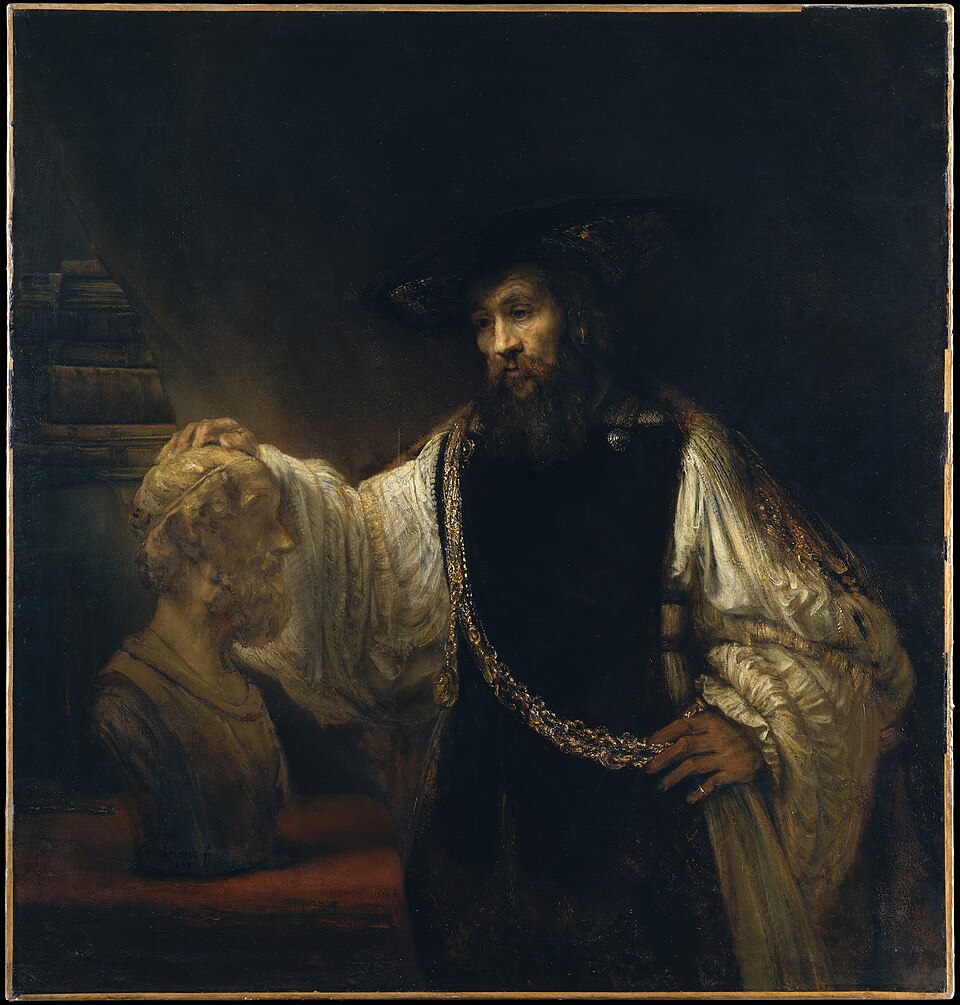
Aristotle with a Bust of Homer was completed by Rembrandt van Rijn in 1653 and was commissioned by Don Antonio Ruffo, a Sicilian nobleman and one of the most important foreign patrons of Dutch art during the seventeenth century. Ruffo placed an order for a painting depicting a philosopher, and Rembrandt responded with this large and ambitious composition. The work was sent to Messina, where it remained in the Ruffo collection for some time. Over the following centuries the painting passed through various hands before being acquired by the Metropolitan Museum of Art in New York in 1961 for what was at that time a record price for a painting at auction, reflecting the enormous prestige the work had accumulated in the eyes of collectors and institutions.
The painting is one of the few works by Rembrandt that can be connected to a specific commission with documentary evidence, as correspondence between Ruffo and Rembrandt survives and has been studied extensively by historians. Ruffo later commissioned two additional large figure paintings from Rembrandt, including works depicting Alexander the Great and Homer, suggesting that the Aristotle composition was intended as part of a series celebrating great figures of antiquity. The work represents an unusual intersection of Dutch Baroque painting with the traditions of Italian humanist patronage, demonstrating the international reach of Rembrandt's reputation during the height of his career.
The figure of Aristotle is depicted in a pose of quiet contemplation, his right hand resting on the marble bust of Homer, which sits at the lower left of the composition. Aristotle is dressed in an elaborately rendered costume that combines historical and fantastical elements, including a wide-brimmed hat and a heavy black robe adorned with a gold chain. This chain, according to some scholars, may represent a chain given to Aristotle by his pupil Alexander the Great, introducing a narrative of patronage and intellectual succession into the image. The contrast between the dark costume and the warm illumination of the face and hand gives the figure a sense of dignified presence.
Rembrandt's handling of surface textures in this painting is technically impressive. The gold chain is rendered with meticulous attention to reflected light, while the black robe absorbs light and recedes into the background. The marble bust of Homer is painted with a cooler, grayer palette that distinguishes it from the warm flesh tones of the living figure above. The compositional arrangement encourages the viewer to draw a contrast between the ancient poet, now reduced to stone, and the philosopher who contemplates his legacy. The directional light falls across Aristotle's face from the upper left, modeling his features with characteristic Baroque drama.
The pairing of Aristotle and Homer in a single image invites reflection on the relationship between different forms of intellectual and creative achievement. Homer represents the visionary power of poetry and oral tradition, while Aristotle represents the analytical and systematic traditions of philosophy. By placing the living philosopher in contemplation of the poet's bust, Rembrandt creates an image of one great mind meditating on the legacy of another, a theme with obvious resonance for a patron who valued learning and cultural prestige.
The gold chain that adorns Aristotle has been interpreted as a symbol of worldly success and royal favor, and some scholars have suggested that Aristotle's expression carries a note of ambivalence about the relationship between intellectual life and material reward. This reading would give the image a layer of moral complexity, suggesting that great learning and great wealth do not always sit comfortably together. For Rembrandt, who experienced his own complicated relationship with wealth and financial instability, this theme may have carried personal meaning. The work exemplifies the capacity of Dutch Baroque painting to use historical and mythological subjects as vehicles for nuanced philosophical reflection, moving beyond simple illustration of classical sources toward genuine interpretive engagement with ideas.