Loading cart…
No products in the cart.

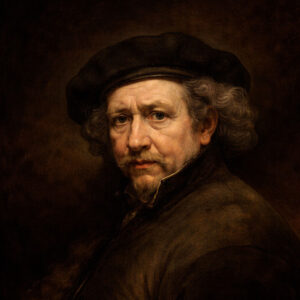
Few names in the entire history of Western art carry the cultural weight that Rembrandt van Rijn carries today. His works hang in the most celebrated museums across the globe, from the Rijksmuseum in Amsterdam to the Hermitage in Saint…
Few names in the entire history of Western art carry the cultural weight that Rembrandt van Rijn carries today. His works hang in the most celebrated museums across the globe, from the Rijksmuseum in Amsterdam to the Hermitage in Saint Petersburg, the Louvre in Paris, and the Metropolitan Museum of Art in New York. His influence reaches far beyond the walls of those institutions. Contemporary painters, filmmakers, and photographers continue to study and replicate his use of dramatic lighting and his extraordinary capacity to render human emotion with unflinching honesty. The term Rembrandt lighting has entered the vocabulary of portrait photographers worldwide, describing a specific technique of illuminating one side of a face while leaving the other in shadow. Collectors and institutions compete fiercely to acquire works bearing his name, and hand-painted oil reproductions of his paintings remain among the most sought-after in the world. His legacy is not simply that of a celebrated painter from a distant century. It is an ongoing conversation between his vision and every artist or viewer who encounters his work. That legacy was built through decades of rigorous practice, personal hardship, and an evolving artistic philosophy rooted in profound observation of human life. Born in Leiden in 1606 as the son of a miller, Rembrandt demonstrated exceptional talent from an early age and enrolled at the University of Leiden before abandoning academic study to pursue painting full time. He apprenticed under the history painter Jacob van Swanenburgh and later studied briefly with Pieter Lastman in Amsterdam, whose influence on narrative composition would prove lasting. By his mid-twenties, Rembrandt had established a reputation in Amsterdam as a portrait painter of remarkable skill, attracting wealthy patrons and lucrative commissions. His marriage to Saskia van Uylenburgh brought both personal happiness and social elevation. Yet prosperity gave way to financial ruin in later life, driven by extravagant collecting habits and shifting tastes among Amsterdam patrons. Rather than diminish his output, those years of difficulty seemed to deepen the emotional resonance of his work. His late self-portraits, painted with loose and expressive brushwork, stand as some of the most searching and psychologically complex images of a human face ever committed to canvas. Through triumph and loss alike, Rembrandt never stopped looking, never stopped questioning, and never stopped painting.
The defining characteristic of the style of Rembrandt is his command of light and shadow, a technique known as chiaroscuro that he inherited from the broader Baroque tradition and then transformed into something entirely his own. Where other painters of his era used dramatic contrast primarily for decorative or theatrical effect, Rembrandt wielded it as a tool of psychological revelation. Light in his compositions does not simply illuminate objects. It selects them, assigns them meaning, and draws the eye toward the emotional core of the scene. Figures emerge from deep, velvety darkness with a warmth and solidity that gives them an almost sculptural presence on the flat surface of the canvas. He achieved this effect through a meticulous layering of paint, building up translucent glazes over an initial imprimatura to create luminous depths, then applying thicker, more textured paint in the highlighted areas. The result is a surface that seems to glow from within rather than reflect light from without. His palette favored warm earth tones, rich ochres, deep umbers, and glowing siennas, punctuated by carefully placed accents of gold, red, and white that guide the viewer through the composition. Beyond his technical mastery of light, the visual language of Rembrandt is distinguished by an extraordinary commitment to psychological truthfulness. He did not flatter his subjects in the manner of many court painters of his time. Instead, he painted faces with wrinkles, sagging skin, tired eyes, and the visible marks of age and experience. This unflinching honesty extended to his more than eighty surviving self-portraits, which form a sustained visual autobiography spanning nearly four decades. In his history paintings and biblical scenes, the figures are not idealized heroes but recognizable human beings caught in moments of doubt, grief, wonder, or tenderness. His brushwork evolved significantly over his career, moving from the tight, highly finished surfaces of his early Leiden period toward the bold, expressive handling of his late works, where individual strokes remain visible and the paint itself becomes part of the meaning. This evolution from precision to expressive freedom anticipates later developments in European painting by more than two centuries and continues to reward close study by anyone who loves the art of painting.
Each card links to its own article with full analysis and reproduction details.
 #2
#2
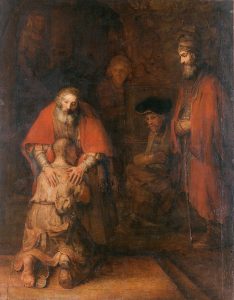 #3
#3
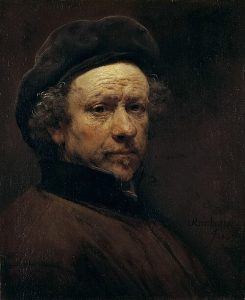 #4
#4
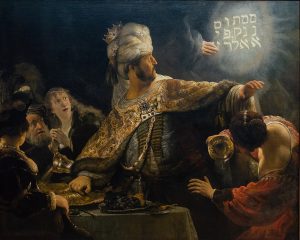 #5
#5
 #6
#6
 #7
#7
 #8
#8
 #9
#9
 #10
#10
A print can reproduce colors. What it cannot reproduce is texture, depth, and the physical presence of oil paint on canvas. Rembrandt van Rijn technique depends on these.
At ByMuseum, every reproduction is painted by hand using oil on canvas. There is no inkjet, no digital print. The brushwork is real. The result looks like a painting because it is one.