Loading cart…
No products in the cart.

c. 1635 · Oil on canvas · The National Gallery, London, United Kingdom
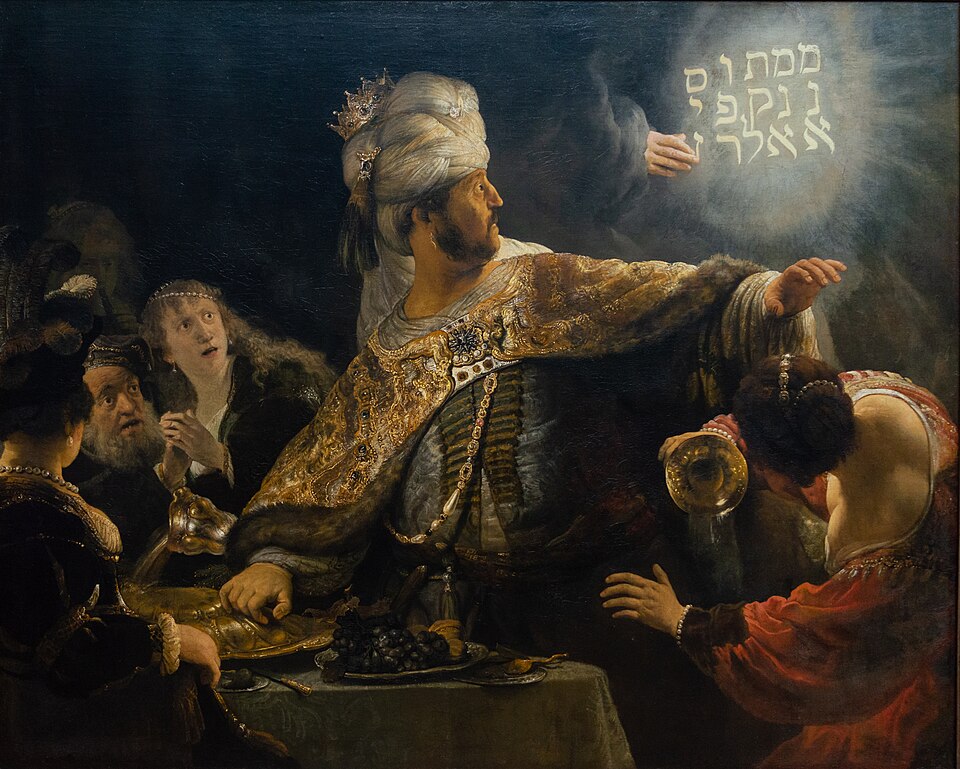
Belshazzar's Feast was painted around 1635, during a period when Rembrandt van Rijn was establishing himself as one of the most sought-after painters in Amsterdam. The work is based on the biblical account found in the Book of Daniel, in which the Babylonian king Belshazzar hosts a feast using sacred vessels looted from the Temple in Jerusalem, only to be confronted by a mysterious hand writing a divine judgment on the wall. The painting remained in various private collections over the centuries before entering the permanent collection of the National Gallery in London, where it has been housed since the nineteenth century. The inscription on the wall, rendered in Hebrew characters, was a subject of scholarly attention even during Rembrandt's lifetime. It is documented that the painter consulted with Menasseh ben Israel, a prominent Amsterdam rabbi and scholar, regarding the correct form of the Hebrew text and its vertical arrangement. This collaboration reflects the intellectual environment of seventeenth-century Amsterdam, where Jewish scholars and Christian artists sometimes engaged in productive exchange. The painting was likely intended to appeal to a sophisticated audience familiar with both biblical narrative and scholarly debate surrounding ancient languages. Its large scale and theatrical composition suggest it may have been created for display in a prominent domestic or civic interior.
The composition is organized around the figure of Belshazzar himself, who turns sharply to his right in a posture of shock and alarm, his robes and turban gleaming with gold and jeweled embroidery rendered in extraordinary detail. His outstretched arms and open mouth convey immediate, visceral terror. The female figures surrounding him react with equal alarm, one of them spilling a vessel of wine whose liquid catches the light as it falls. The luminous inscription hovers at the upper right of the canvas, surrounded by a concentrated glow that functions as the primary light source for the entire scene. Rembrandt's use of chiaroscuro in this work is among the most theatrical of his career. The figures emerge from a dense, almost impenetrable darkness, their faces and garments lit from the direction of the supernatural inscription. The textures of fabric, metal, and skin are rendered with technical precision, and the variety of expressions among the secondary figures demonstrates Rembrandt's well-documented interest in capturing transient emotional states. The diagonal thrust of Belshazzar's body, moving from the lower left toward the upper right, creates a dynamic sense of interrupted motion, reinforcing the painting's central narrative of sudden divine interruption.
The story of Belshazzar carries a clear moral message about the dangers of hubris, sacrilege, and the misuse of sacred objects for worldly pleasure. In the biblical account, the writing on the wall, translated as a judgment that Belshazzar has been weighed and found wanting, announces the imminent fall of his kingdom. Rembrandt's painting captures the moment just before this judgment is understood, when shock and confusion have replaced the confidence of the feast. The contrast between the richness of the king's garments and the terror on his face underscores the theme that worldly power offers no protection against divine reckoning. For seventeenth-century Dutch audiences, many of whom were deeply familiar with Old Testament narratives, this subject carried both devotional and political resonance. The Dutch Republic had recently won its independence from Spanish Habsburg rule, and stories of proud empires brought low by divine judgment had obvious contemporary relevance. The painting also reflects the broader Baroque interest in dramatic narrative moments and the depiction of extreme emotional states. Rembrandt's choice to depict the moment of shock rather than the moment of punishment focuses attention on psychological experience rather than violent consequence, a choice that aligns with his consistent interest in interiority and human vulnerability.