Loading cart…
No products in the cart.

c. 1665 to 1669 · Oil on canvas · Kenwood House, London, United Kingdom
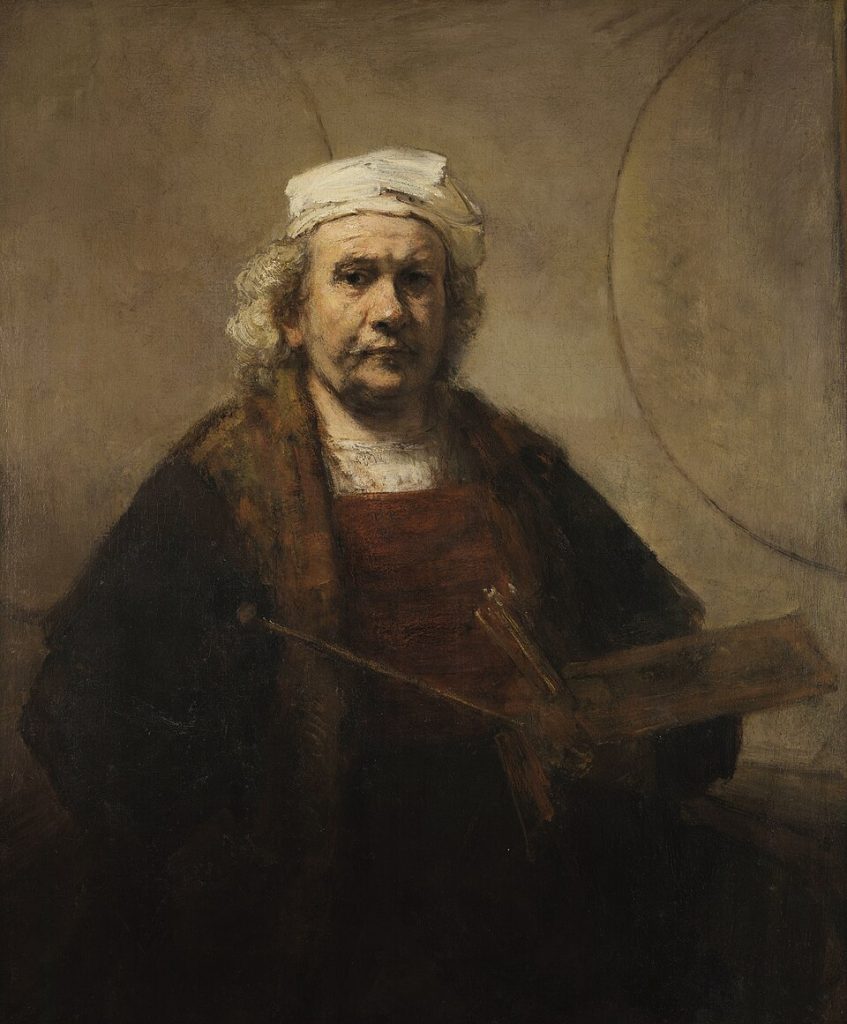
Self-Portrait with Two Circles was painted during the last years of the life of Rembrandt, most likely between 1665 and 1669, the year of his death. It belongs to the late period of an extraordinary series of self-portraits that the artist produced across more than four decades, from the experimental etchings and small panels of his Leiden years through to this monumental final statement. By the time this painting was made, Rembrandt had experienced financial ruin, the death of his common-law partner Hendrickje Stoffels in 1663, and the death of his son Titus in 1668. He was living in reduced circumstances in the Jordaan district of Amsterdam, far from the grand house on the Breestraat that had been sold to pay his creditors. None of this biographical context is visible in the painting as distress or diminishment. What is visible is a man of complete professional confidence, standing before his work with a steadiness that feels earned rather than performed. The painting entered the collection of the Earls of Iveagh and has been housed at Kenwood House on Hampstead Heath in London since the early twentieth century, when the house and its contents were bequeathed to the nation by Edward Cecil Guinness, the first Earl of Iveagh. It was the subject of a famous theft attempt in 1974, when it was taken from Kenwood as part of a ransom scheme and later recovered undamaged. The work has been extensively studied and conserved and is considered one of the most revealing documents of the artistic identity and self-conception of Rembrandt in any medium. It draws visitors from around the world to Kenwood House, where it hangs in an elegant neoclassical library room designed by Robert Adam.
The visual composition of Self-Portrait with Two Circles is deceptively simple and yet structurally bold. The figure of Rembrandt occupies the full height of the canvas, positioned slightly left of center, his body turned three-quarters toward the viewer while his gaze meets ours with a directness that is neither confrontational nor passive. He wears a white cap and a loose, paint-stained working coat, the clothing of a craftsman rather than a courtier. His hands hold brushes, a palette, and what appears to be a maulstick, the implements of his trade displayed without ceremony but with great physical confidence. Behind him, two large arcs or circles on the canvas he is working on or standing before have generated more interpretive discussion than almost any other formal element in the history of self-portraiture. The handling of paint in this work is among the most extraordinary in the entire career of Rembrandt. The face is built up in thick, richly varied impasto, with ridges and furrows of paint that physically model the sagging skin, the broad nose, the creased forehead, and the deep-set eyes with a three-dimensional materiality that no reproductive medium can fully convey. The shadows around the eyes are achieved with thin glazes of warm brown, while the highlighted areas of the cheeks and brow are built up with palette-knife-like strokes of creamy, light-laden paint. The overall tonal structure is that of a figure emerging from warm darkness into soft, frontal light, with the background dissolved into an ambiguous atmospheric space. The result is a portrait of extraordinary psychological presence. Own this late work of Rembrandt as a hand-painted oil reproduction and appreciate the full depth of its tonal range in person.
Self-Portrait with Two Circles is, among many things, a meditation on the nature of artistic identity and the relationship between the maker and the made. Rembrandt produced more self-portraits than any other major European painter of his era, and scholars have long debated the motivation behind this sustained self-scrutiny. Some have argued that he used himself as a convenient and always-available model for the study of expression and physiognomy. Others have proposed that the self-portrait series represents a deliberate act of self-construction and self-narration, a visual autobiography produced across a lifetime. Self-Portrait with Two Circles, with its direct gaze and its tools of the trade prominently displayed, seems to assert above all that the artist is defined by the act of looking and making, not by wealth, social position, or the favor of patrons. The two circles in the background remain unexplained by any documentary source and have attracted interpretations ranging from the practical to the cosmological. Some scholars suggest they are geometric construction lines used in the preparation of a composition. Others have connected them to the story of the painter Apelles, who was said to have demonstrated his skill to a rival by drawing a perfect circle freehand, an act of pure technical mastery with no practical function. If this reading is correct, the circles become a signature of extraordinary confidence, a quiet claim to membership in the lineage of the most celebrated painters of antiquity. Whatever their precise meaning, they frame the figure of Rembrandt in a way that is simultaneously mysterious and monumental, giving the painting a resonance that exceeds any single interpretation. You can own this deeply human and technically extraordinary late work as a hand-painted oil reproduction. Visit the product page to choose your size and format.