Loading cart…
No products in the cart.

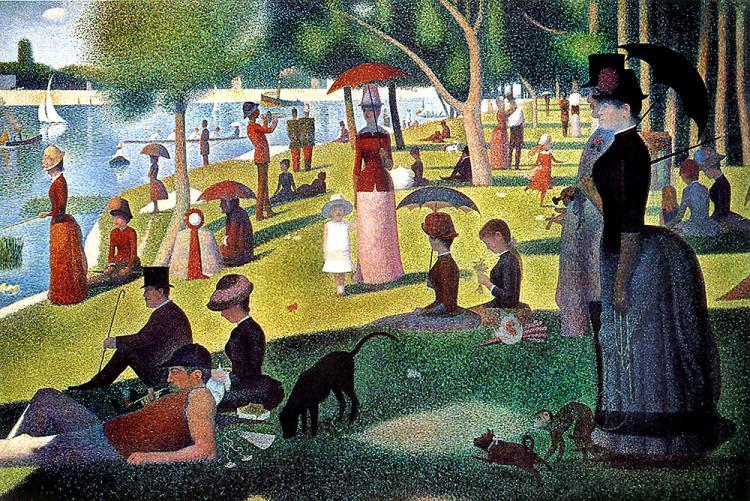
Picture a sun-drenched afternoon on an island in the Seine. Parisians in their finest clothes stand, sit, and stroll along the riverbank. A woman holds a parasol. A small monkey strains at a leash. Children run near the water. The…
Save articles to your collection
Log in or create a free account, and this article will be waiting in your Private Collection.
Log in or sign upPicture a sun-drenched afternoon on an island in the Seine. Parisians in their finest clothes stand, sit, and stroll along the riverbank. A woman holds a parasol. A small monkey strains at a leash. Children run near the water. The scene hums with leisure and social ritual, yet something unusual holds the eye. Every inch of the canvas is built from tiny, deliberate dots of pure color, laid side by side so that the eye blends them into shimmering light. This is A Sunday on La Grande Jatte, completed in 1886, and it changed the direction of Western painting forever. The man who made it was Georges Pierre Seurat, a young Parisian artist who had combined the color theories of scientists such as Michel Eugene Chevreul and Ogden Rood with the ambitions of the Impressionists to arrive at something entirely his own.
Seurat was born on December 2, 1859, in Paris, the son of a legal official. He studied at the Ecole des Beaux-Arts under Henri Lehmann, a pupil of Ingres, and absorbed the classical tradition of precise draftsmanship before turning toward the revolutionary color experiments that would define his short but transformative career. His method, which came to be called Pointillism or Divisionism, was built on the premise that small strokes of unmixed pigment placed in close proximity would blend optically in the eye of the viewer, producing a luminosity impossible to achieve by mixing colors on the palette. He tested this hypothesis obsessively, producing hundreds of preparatory drawings and panel studies before committing a composition to large canvas. Despite producing a relatively small body of finished work, Seurat attracted a devoted circle of followers including Paul Signac and Camille Pissarro, and his ideas rippled outward through Fauvism, Neo-Impressionism, and early abstraction. He died of a sudden illness, likely diphtheria, on March 29, 1891, at the age of thirty-one, leaving behind a legacy that continues to shape how painters and scientists think about color, light, and perception.
The defining characteristic of the style of Seurat is its radical systematization of color and light. Where the Impressionists applied paint in loose, intuitive strokes intended to capture fleeting sensation, Seurat worked with scientific deliberation. He studied the color wheel and the principle of simultaneous contrast, which holds that colors placed adjacent to one another influence each other visually. From this foundation he developed Pointillism, a technique in which small, uniform dots or strokes of pure, unmixed pigment are applied to the canvas in tight formations. When viewed from a proper distance, these dots merge in the perception of the viewer rather than on the palette, producing a vibrant optical mixture that Seurat believed was inherently more luminous than conventional blended paint. His surfaces have a characteristic shimmer, a quality of trembling light that no photographic reproduction can fully convey. Each painting required months or years of preparation, including extensive oil sketches on small wooden panels and meticulous charcoal drawings that display a mastery of tonal gradation equal to any academic draftsman of his era.
Beyond technique, the visual language of Seurat is notable for its monumental stillness. Unlike the spontaneous movement suggested by Impressionist brushwork, his figures tend toward a frozen, hieratic quality that critics have compared to Egyptian frieze painting and early Renaissance fresco. There is a geometric rigor to his compositions: horizontal bands of color organize the picture plane, figures are silhouetted with clean outlines, and space is constructed through careful tonal contrast rather than linear perspective alone. He also developed a theory of emotional expressiveness based on line direction, believing that ascending lines suggest joy, descending lines suggest sadness, and horizontal lines suggest calm. This synthesis of scientific method and classical structure gives the paintings of Seurat their peculiar power: they feel simultaneously ancient and modern, deeply ordered yet alive with light.
Each card links to its own article with full analysis and reproduction details.
 #1
#1
 #2
#2
A print can reproduce colors. What it cannot reproduce is texture, depth, and the physical presence of oil paint on canvas. Georges Seurat technique depends on these.
At ByMuseum, every reproduction is painted by hand using oil on canvas. There is no inkjet, no digital print. The brushwork is real. The result looks like a painting because it is one.
Enjoyed this story?
Save articles to your collection
Log in or create a free account, and this article will be waiting in your Private Collection.
Log in or sign up