Loading cart…
No products in the cart.

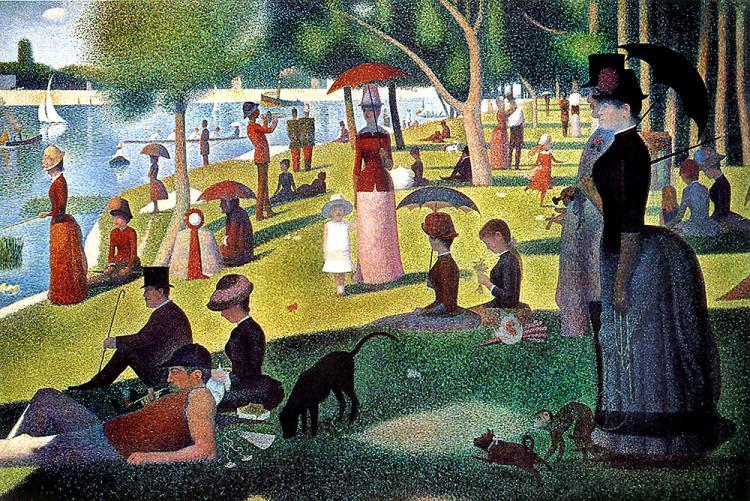
1884 to 1886 · Oil on canvas · Art Institute of Chicago, Chicago, United States
Save articles to your collection
Log in or create a free account, and this article will be waiting in your Private Collection.
Log in or sign upSeurat began work on A Sunday on La Grande Jatte in 1884, making numerous visits to the island of La Grande Jatte in the Seine northwest of Paris to observe the bourgeois and working-class Parisians who gathered there on weekends. Over two years he produced more than fifty preparatory oil sketches on small wooden panels and a large compositional study before beginning the final canvas, which measures over three meters wide. He reworked sections repeatedly, and after the painting was shown at the eighth and final Impressionist exhibition in 1886, he repainted the border entirely, adding a frame of painted dots in complementary colors to control the transition between the image and the surrounding wall. The exhibition caused an immediate sensation. Critics such as Felix Feneon recognized a new movement and coined the term Neo-Impressionism to describe what Seurat and his ally Paul Signac were doing.
The painting entered the collection of the Art Institute of Chicago in 1924, a gift from Frederic Clay and Helen Birch Bartlett. It has since become one of the most visited and studied works in that institution. Its influence on subsequent art history has been vast, inspiring not only the Neo-Impressionist movement but also informing the development of abstract color theory well into the twentieth century. The painting was famously parodied and celebrated in Stephen Sondheim's 1984 musical Sunday in the Park with George, which introduced its visual language to a broad popular audience. For those who want to live with this iconic image every day, owning it as a hand-painted oil reproduction offers an encounter with the luminosity of the original that no print can provide.
The composition of A Sunday on La Grande Jatte is organized with the geometric precision of a classical frieze. Seurat arranges his figures in a shallow, stageline space parallel to the picture plane, creating a series of overlapping silhouettes that read almost like cutout shapes. The horizontal bands of shadow and sunlight divide the canvas into registers, and the placement of the tall parasol-carrying woman near the center-right establishes a strong vertical anchor around which the rest of the scene pivots. Despite the apparent busyness of so many figures, the painting achieves a profound stillness: no one makes eye contact, no gesture is completed, time itself seems suspended.
The Pointillist technique is here at its most fully realized. Seurat applied thousands upon thousands of small dots of unmixed orange, yellow, green, blue, and violet pigment in a carefully calibrated density. In the sunlit areas, warm yellows and oranges dominate while cool violets vibrate in the shadows, demonstrating the principle of simultaneous contrast with extraordinary consistency. The grass reads as green not because Seurat mixed green paint but because the eye fuses dots of yellow and blue. When viewed up close, the canvas dissolves into an abstract field of color; stepping back, the scene assembles itself into crystalline clarity. This optical experience is central to the work and cannot be replicated in digital form. To own this as a hand-painted oil reproduction is to experience the textured, layered reality of the original surface in your own home. Visit the product page at the link below to commission your reproduction.
The social landscape depicted in A Sunday on La Grande Jatte is rich with observation and quiet irony. Seurat populates his island with figures drawn from multiple social classes: bourgeois families with their formal dress and parasols, soldiers and working men, a nurse with a child, a woman fishing. Yet despite the shared space, the figures do not interact. Each is enclosed in private isolation, a quality that many scholars read as a commentary on the atomizing effects of modern urban life in late nineteenth-century Paris. The very technique of the painting, built from isolated dots that only cohere when the viewer steps back, echoes this social fragmentation at a formal level.
The monkey on a leash in the right foreground has attracted particular scholarly attention. In the slang of the period, the word for monkey carried associations with sexual availability, and the elegantly dressed woman who holds the leash may carry a satirical charge that contemporary viewers would have recognized immediately. Whether Seurat intended a pointed social critique or a more neutral observation of Parisian life remains a subject of scholarly discussion, but the painting undeniably treats its subjects with a cool, almost anthropological distance that feels very modern. Over more than a century since its completion, A Sunday on La Grande Jatte has lost none of its capacity to prompt reflection on how people inhabit shared space, and it remains one of the most analyzed paintings in the history of Western art. Bring this extraordinary image into your home as a hand-painted oil reproduction, crafted by skilled artists at ByMuseum.
Enjoyed this story?
Save articles to your collection
Log in or create a free account, and this article will be waiting in your Private Collection.
Log in or sign up