Loading cart…
No products in the cart.

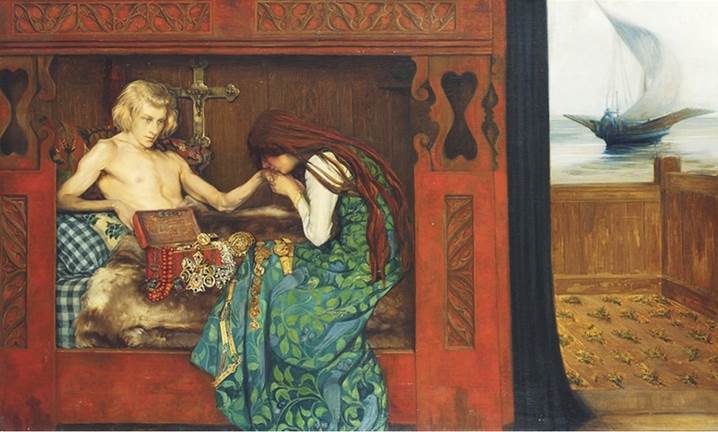
1906 · Oil on canvas in a gilded carved frame · Private Collection; owner unknown
Save articles to your collection
Log in or create a free account, and this article will be waiting in your Private Collection.
Log in or sign upAgnes Slott-Møller completed The Dying Betrothed in 1906. Modern scholarship records the work as oil on canvas in a gilded carved frame, measuring 81 by 133.5 centimetres, with the present owner unknown. An early exhibition catalogue described the subject through translated lines from the Danish ballad and listed the painting as lent by the artist.
The work belongs to Slott-Møller's sustained engagement with Danish history and folk-ballad subjects. Her frames often formed an active part of the composition, and here the carved ornament continues the patterns of the bed, clothing and jewellery beyond the painted surface. This integration of image and frame is central to understanding the painting's place within Danish Symbolism.
The horizontal composition centres on Hr Oluf lying in a large bed surrounded by embroidered pillows, patterned fabrics and a gilded carved frame designed as part of the work. His betrothed appears in a blue-green dress ornamented with leaves, while a chest of jewellery stands between the figures. These decorative elements are not incidental: they extend the ballad's material world into the structure of the painting and slow the viewer's attention across the scene.
Slott-Møller combines a naturalistically described interior with a deliberately decorative language associated with medieval art and Danish folk tradition. The contrast between the still figure in bed, the arriving woman and the richly worked textiles makes the approaching death legible without theatrical gesture. The painting's emotional force comes from this tension between visual abundance and the finality of the event.
The painting draws on a Danish ballad about Hr Oluf, who lies mortally ill and sends for his betrothed. When she arrives, he gives her his gold chains and rings despite his mother's objections, then turns toward the wall and dies. The title refers to the dying bridegroom, not to a dying woman.
Slott-Møller uses the medieval narrative to explore loyalty, inheritance, separation and grief. Jewellery and textiles connect private emotion with social obligations, while the carved frame makes the story feel closer to an illuminated or ceremonial object than to a detached modern scene. The work is therefore both a narrative painting and an example of how Slott-Møller joined naturalism with a decorative Symbolist vocabulary.
Enjoyed this story?
Save articles to your collection
Log in or create a free account, and this article will be waiting in your Private Collection.
Log in or sign up